
Prince William supervisors press staff for clearer data center rules, new tracking of projects
Get AI-powered insights, summaries, and transcripts
Subscribe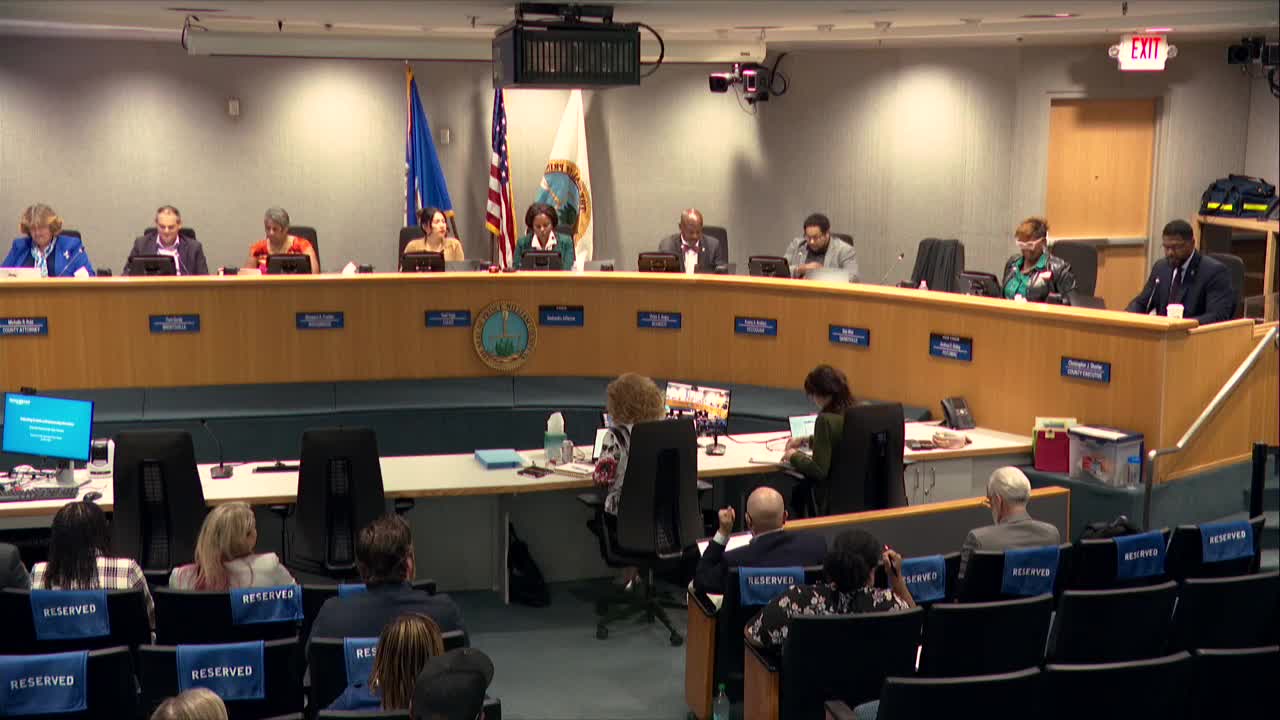
Summary
At a Oct. 14 work session, county economic development and planning staff reviewed decades of data center growth, new EnerGov tracking numbers, and options to keep development focused. Supervisors asked for policy choices on the overlay district, permitted zones, and community protections.
Prince William County staff asked the Board of Supervisors on Oct. 14 for direction on how to manage a surge of data center development, presenting new permitting and entitlement counts and a menu of land-use options including keeping, changing or eliminating the county’s Data Center Opportunity Zone overlay.
The presentation, led by Deputy County Executive Wade Hu and Christina Wynne of Economic Development, described the county’s evolution from active recruitment of data centers to “strategic management” of an industry that has outpaced earlier planning assumptions. Planning Director Tanya Washington outlined regulatory tools and the history of the overlay, adopted in 2016 and updated in 2019, that concentrates by‑right data center development in areas with existing infrastructure.
County officials said they now have improved tracking of data center permits. Christina Wynne told the board EnerGov retrofits show “33 completed buildings at 6,800,000 square feet” and an additional set of approved or permitted buildings “of 9,800,000 square feet” in the pipeline; she also cautioned that entitlement totals can overstate future buildout because historic entitlements sometimes include projects that were later built at smaller sizes.
Why it matters: supervisors noted the industry’s rapid, concentrated land demand has driven up land prices, affected existing industrial businesses, and pushed some proposals closer to residential and environmentally sensitive areas. That has raised questions about where the county should allow data centers, what zoning or special‑use conditions should apply, and how to protect other target industries and local employers.
What staff presented
- History and role: Wynne framed data centers’ arrival as a multi‑decade arc (early 1990s regional fiber anchor → Loudoun County growth → Prince William overlay in 2016) and said the county’s posture shifted from competing to managing projects.
- Tracking and numbers: staff said EnerGov now reports completed buildings with certificates of occupancy and permitted/under‑construction buildings in near real time, giving the county a clearer pipeline metric than the annual assessment database. Wynne said the EnerGov retrofit will feed a new public data‑center layer on the county’s PWC Mapper.
- Planning and regulation: Tanya Washington reviewed the overlay’s purpose (focus development where power and fiber exist; reduce transmission‑line conflicts) and the 2019 design updates that added architectural guidance and options for increased floor‑area ratio and height with SUPs. She outlined options staff will analyze further: keep/modify the overlay; remove the overlay and require SUPs or rezoning; narrow the zoning districts where data centers are allowed; or use incentives to steer projects to desired locations.
Board reactions and recurring questions
Supervisors raised recurring themes: preserving industrial land for non‑data‑center job creators, protecting existing businesses from purchase pressure, distance buffers from residences and schools, how incentives could be tied to sustainability or workforce benefits, and whether the county’s power constraints should shape siting decisions.
- Supervisor Gordy said he is seeing speculators buying land and that the county is now “power constrained,” urging limits on where data centers can locate and more urgency to act.
- Supervisor Vega pressed staff for specificity on what “sustainability” would mean in incentives and how enforceable performance metrics could be crafted; Wynne answered that incentives could be tailored to reward measurable sustainability or workforce outcomes if legally permissible.
- Supervisor Boody asked about developers’ interactions with utilities (transmission and substations); Wynne and planning staff said applicants are advised early about power needs and that developers are increasingly creative about substation siting but must coordinate with utilities.
- Several supervisors urged better public transparency; Wynne said staff will post a data‑center layer on the county map within weeks (staff gave a late‑fall timeline for public availability).
What staff will do next
Staff told the board the discussion is intended to give direction for work already underway: the zoning ordinance update, a directed boundary study of overlay sites, the design and construction standards manual (DCSM) review, and the pending noise ordinance rewrite. Tanya Washington said staff will return with more detailed analysis and consequences for each option the board asks them to study.
Ending
Board members agreed the county is past the stage of ad hoc responses and needs a policy direction — including whether to restrict data centers to certain industrial districts, require SUPs, and use incentives tied to measurable community benefits. Staff left the board with a clear charge to analyze specific regulatory scenarios and their legal and practical consequences.