
Skagit planning commission hears wide-ranging public comment on proposed agritourism code amendments
Get AI-powered insights, summaries, and transcripts
Subscribe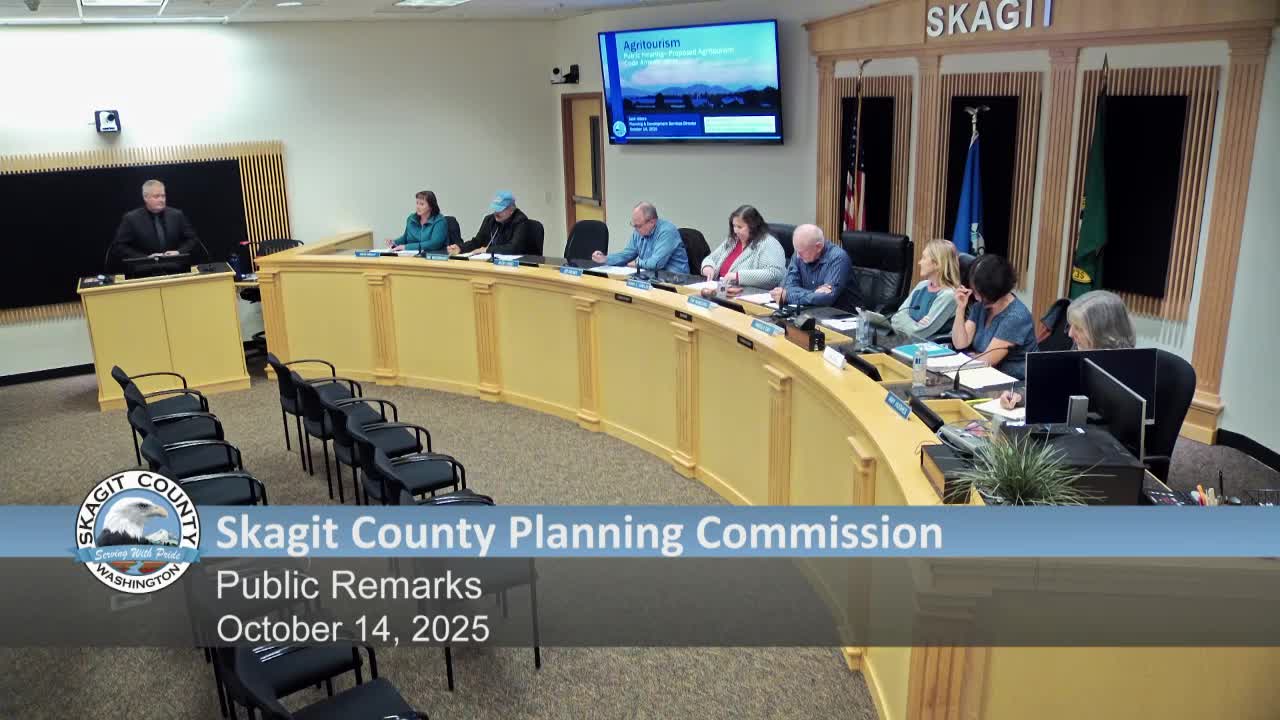
Summary
The Skagit Valley Planning Commission held a public hearing Oct. 14 on draft agritourism code amendments that would set a definition, tiered activity levels, and new limits on events on lands zoned for agricultural and natural resource uses.
The Skagit Valley Planning Commission held a public hearing Oct. 14 on draft agritourism code amendments that would set a definition, tiered activity levels, and new limits on events on lands zoned for agricultural and natural resource uses. Jack Moore, planning and development services director, introduced the draft and described key elements, saying the proposal "includes 3 levels of agritourism based on number of attendees and frequency of events" and would prohibit limited event venues, restaurants and regularly occurring celebratory gatherings in some agricultural natural resource lands (ANRL).
Why it matters: The proposed rules would affect family farms, tourism businesses and private landowners across Skagit County by restricting which kinds of public gatherings are allowed on agriculturally designated land, changing enforcement expectations, and creating a path that could influence whether small operators can supplement farm income with events such as weddings, dinners or festivals.
The proposal and schedule: Moore told the commission the draft sets a purpose and intent, tiers activities by attendance and frequency, and applies in zones that currently allow agricultural activity (Agricultural Natural Resource Lands/ANRL, Natural Resource Lands, Rural Resource, Rural Reserve and Rural Intermediate). He said the written comment period remains open until Thursday, Oct. 16 at 4:30 p.m., the commission will deliberate Nov. 18, the Board of County Commissioners has a work session Nov. 24 and possible adoption is tentatively scheduled for Dec. 23.
Public comment: More than two dozen speakers — including farm owners, tourism officials and land preservation advocates — addressed the commission. Several small and family farm operators said the draft is too restrictive. Jessica Benson, speaking for the Hobenick family, described a family-run venue and said the draft would make it "nearly impossible for families like ours to succeed." Vanessa Harrington of Tula Valley Farms argued agritourism is a vital economic driver and cited national industry figures, saying a strong local agritourism sector supports hotels, restaurants and vendors.
Farm advocates pressed specific objections: Andrew Miller, who identified himself as a farmer, PUD commissioner and attorney, criticized guest caps as arbitrary and said the rules could have constitutional and economic consequences for small farms, arguing the draft imposes "arbitrary guest caps" that do not scale with farm size. Multiple farmers and residents asked for clearer distinctions between small, farm-based educational or farm-connection activities and large commercial events.
Equity and enforcement concerns: Several speakers — including Laura Claus of Skagitonians to Preserve Farmland and Jan Edelstein — urged the commission to ensure compliance with state law. Ellen Bynum of Friends of Skagit County told commissioners the code must account for the Washington State Supreme Court ruling in King County v. Friends of the Sammamish Valley and subsequent Growth Management Hearing Board orders; she urged additional legal and policy review to ensure the draft does not conflict with the Growth Management Act (GMA). Jan Edelstein and others also asked how the county will enforce limits if the draft relies on self-certification and whether staff capacity and funding exist for recurring inspections.
Tourism perspective and economic framing: Kristin Kelts, CEO of the Skagit Tourism Bureau, and other tourism proponents supported a path that protects farmland while allowing farms to thrive through events and experiences. Kelts urged the code to use performance standards — traffic, parking and farmland preservation — rather than fixed guest caps. Several speakers said restricting small-scale agritourism would divert tourist dollars to neighboring counties.
Areas of agreement and disagreement: Commenters broadly agreed on the goal of preserving agricultural lands and rural character but differed sharply on how permissive rules should be for small farms, event limits, and what enforcement should look like. Some participants supported the draft as a necessary protection of designated agriculture lands in light of GMA constraints; others warned it would accelerate consolidation and loss of family farms.
Next steps and how to comment: The public comment period for the agritourism amendments closes Oct. 16 at 4:30 p.m. Written comments may be mailed to Planning and Development Services at 1800 Continental Place, Mount Vernon, or emailed to PPDSComments@co.skagit.wa.us. The commission will deliberate Nov. 18 and forward a recommendation to the Board of County Commissioners; the board has scheduled related work sessions and a tentative adoption date in late December.