Get Full Government Meeting Transcripts, Videos, & Alerts Forever!
Get email alerts on the Land Use Procedures topic
No spam. Unsubscribe anytime.
Evanston Land Use Commission reviews proposed updates to rules on virtual participation, continuances and testimony
Summary
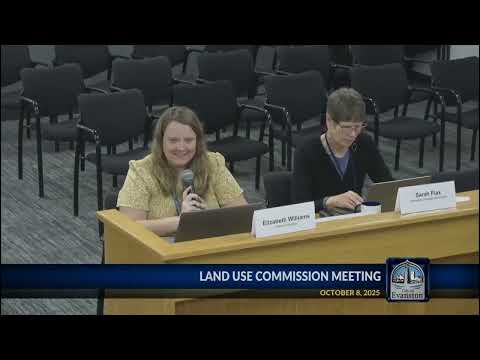
The Evanston Land Use Commission on Oct. 8 discussed a proposed overhaul of its meeting rules to clarify virtual participation, continuance requests, written‑evidence deadlines and how groups may present testimony.
The Evanston Land Use Commission on Oct. 8 discussed a proposed overhaul of its meeting rules to clarify virtual participation, continuance requests, written‑evidence deadlines and how groups may present testimony. The commission did not take votes; staff said it will return with a tracked‑change draft for the Nov. 12 meeting.
City planning staff presented the proposed changes and asked the commission for direction. Liz Williams, planning manager, said staff would "propose that your rules and procedures incorporate some language around how you would like to conduct your meetings as it relates to allowing members of the public and or commissioners to participate virtually," and that the language would align with the Open Meetings Act and other city boards' practices. Chair Lynn Wall noted the commission had five members present and therefore a quorum for the evening's discussion.
Why it matters: the commission conducts quasi‑judicial public hearings whose outcomes move to City Council. Commissioners said clearer rules would help manage lengthy hearings, reduce repeated testimony and ensure applicants, neighbors and staff understand deadlines and who can request delays.
Virtual participation. Staff recommended explicit rules spelling out when commissioners and members of the public may participate remotely and how remote testimony will be handled. Williams noted the city already offers Zoom participation and proposed incorporating Open Meetings Act provisions into the commission rules. Commissioners asked staff to confirm legal limits — including the usual requirement that a quorum be physically present — and to draft precise language. The commission generally favored keeping virtual public comment as an equity measure but asked staff to account for the additional administrative load.
Continuances and who may request them. Staff told the commission that, under city code, a continuance must be granted for a taxpayer of record within the noticing radius; the radius varies by application type (typically 500 to 1,000 feet). Current rules give staff and the commission discretion about continuances requested by others with an interest in property (for example, renters or business tenants). Several commissioners said they preferred treating renters and other notified parties the same as property owners and making the ability to request a continuance more predictable.
Key clarifications discussed: - City code and staff practice currently treat a "taxpayer of record" as entitled to an automatic continuance; non‑owners have been handled at the commission's discretion. Staff recommended retaining the automatic continuance for taxpayers of record and clarifying notice and process for others. - Commissioners suggested allowing an oral continuance request when a speaker first testifies rather than waiting until all testimony is complete, to avoid repeating testimony at a later hearing and to reduce meeting length. - The commission signaled support for limiting repeat continuance requests by specifying that one continuance per individual is generally available unless the commission votes to reopen testimony.
Deadlines for written evidence, petitions and presentations. Staff proposed tightening deadlines so commissioners and staff receive written materials with enough time to review. Current practice allows submissions up to 5 p.m. the day before a meeting; staff recommended moving that deadline earlier (staff and commissioners discussed noon the day of the meeting or a 24‑hour minimum) so planners can validate petitions and compile materials for the packet. For map‑amendment petitions that require clerk verification, staff said the current day‑of deadline does not allow enough time to confirm residency and eligibility.
Group representation and speaking time. The rules currently allow a designated speaker 10 minutes at the chair's discretion if a community group files a written request five business days before the hearing and lists individuals represented. Staff recommended reducing the advance notice requirement to align with the shorter deadlines discussed for other requests. Commissioners generally supported: - Reducing the lead time for group speaker requests (to roughly 24 hours before the hearing), - Requiring the designated speaker to provide a list of people represented, - Allowing the chair flexibility to adjust group time based on group size while preserving a general 10‑minute baseline for group representatives, - Retaining a 3‑minute standard for individual speakers (with the chair able to shorten or lengthen time depending on the number of speakers present).
Hearing procedures, findings and minutes. Commissioners discussed whether staff should provide a brief staff presentation when cases come before the commission and whether written findings of fact should be required. Staff noted many planners already prepare draft written findings in advance; the commission indicated that while formal written findings are useful, the minutes should better summarize standards, conditions and reasons for decisions so City Council receives a clearer record.
Next steps and closing. Staff will draft a tracked‑change version of the rules and procedures incorporating the commission's direction on virtual participation language, continuance rules, deadlines for evidence and petitions, group representation, speaking time and improved minute‑taking. The commission will review that draft at its Nov. 12 meeting.
The meeting closed with a routine motion to adjourn to end the evening's business.