Get Full Government Meeting Transcripts, Videos, & Alerts Forever!
Get email alerts on the Taxes Personal Property topic
No spam. Unsubscribe anytime.
Loudoun officials outline changes to vehicle and business equipment assessments for 2026 tax year
Summary
County staff described a shift in methodology for valuing new vehicles and business equipment — including data center hardware — that would take effect for calendar-year 2026 assessments and could raise or lower bills depending on asset type. Supervisors asked for public notice and follow-up analysis on small-business impacts.
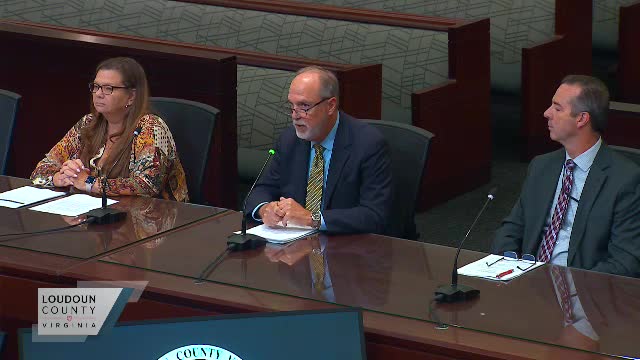
Loudoun County officials presented proposed changes to personal property assessment methods that will apply to the 2026 tax year, including a change in how new vehicles and business equipment (notably data-center computer equipment) are valued.
The presentation by the county’s Revenue, Commissioner of the Revenue deputies and budget staff traced the change to a 2024 General Assembly decision that created a special classification allowing the board to set a separate personal property rate for vehicles and to a consulting study by PFM that recommended more market-based book values for certain asset classes. “When a new automobile is purchased … the used car guides don't have enough sales information,” the county’s revenue deputy said, explaining the recommended shift from 100% of DMV cost to 95% of MSRP for next-model-year cars. For business equipment — including servers and data-center gear — staff proposed extending depreciation schedules (for example, computer equipment moving from a five- to a six-year schedule and a lower floor in later years) and using vendor-provided market book values in place of a percentage-of-cost schedule.
County staff said the methods aim to be more uniform and reflect available market data. The presentation showed sample vehicle and heavy-equipment examples where some values rise and others fall under the new methodology and noted that estimates of fiscal impact vary by class: a modeled change in the computer-equipment schedule would have produced a 2.73% increase in that base in 2025, while furniture and fixtures would have fallen about 3.6% under the new schedule. Staff repeatedly said the changes would take effect for personal property tax year 2026 (billed in 2026).
Why it matters: Loudoun’s economy is closely tied to federal contracting and technology firms, and the county collects substantial revenue from personal property classes. The change will alter tax bills for vehicle owners, businesses with machinery, and data-center operators; supervisors asked for aggressive outreach to taxpayers and businesses to explain the changes before bills are issued.
Board reaction and next steps: Supervisors pressed staff on the potential bill shock for businesses that use heavy equipment or maintain large fleets, and voiced particular concern for small firms that could see large year-to-year increases as schedules change. Supervisor comments asked staff to provide a communications plan that includes a precursor notice and to explore ways to protect small businesses. Staff said a medical timetable would place the new rules into the 2026 assessment and that they will prepare public communications during the renewal cycle and bring the proposals to the November 6 business meeting for broader board consideration.
Quoted: “This is one of the most frequent appeals that we have is relative to valuation of new vehicles,” the revenue deputy said when explaining why the county proposes to use 95% of MSRP for new-model-year cars. On outreach, staff said: “I think the best way to address that might be through a rate. I don't think we could choose one class to make a change and just ignore others,” and committed to provide notice and an outreach plan.
What’s next: The county will present the detailed schedule and modeled fiscal impacts in upcoming public materials and at the November board meeting. Supervisors asked staff to present small-business mitigation options and to follow up with additional analysis about machinery-and-tools and heavy-equipment impacts.