Get Full Government Meeting Transcripts, Videos, & Alerts Forever!
Get email alerts on the Superintendent Evaluation topic
No spam. Unsubscribe anytime.
Results Committee requires explanations for extreme ratings, replaces gap-closure metric with superintendent projects and reweights evaluation
Summary
The Results Committee on Sept. 23 voted to change how it evaluates the district superintendent, approving three measures: require short explanations for extreme ratings, replace the "gap-closure" metric with board‑approved superintendent projects, and reweight measurable components so student achievement carries 30 percent of the evaluation.
The Results Committee on Sept. 23 voted to change how it evaluates the district superintendent, approving three related measures: a new requirement that board members write a short explanation when they give the superintendent an extreme rating; the removal of a “gap-closure” metric and its replacement with superintendent projects selected by the board and superintendent; and a reweighting of measurable components so student achievement carries 30 percent of the evaluation.
The committee unanimously approved a motion that board members who give the superintendent a rating of 1 or 4 must include “a minimum of 2 to 3 sentence explanation.” The motion, read during the meeting, states the requirement will take effect for the 2024–2025 academic year and subsequent years. The motion was adopted by voice vote of members present; online participants did not participate in the voice vote.
Committee members said the explanation requirement aims to make feedback constructive and actionable. Mr. Dallas supported the change, saying, “Part of a performance review is to help guide to greater performance, and that includes some degree of specificity so the person knows what we’ve seen and then what they need to work on.” Other members argued the requirement should apply only to ratings at the extremes so the board is not overburdened with commentary.
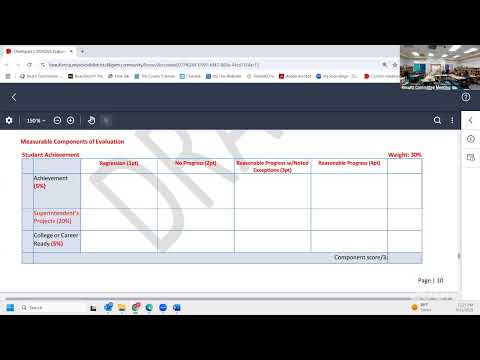
The committee also removed the “gap-closure” measurable component — a metric introduced during COVID-era recovery — and replaced it with “superintendent projects.” Under the change, the board and superintendent will agree on two to three projects at a time to serve as measurable items for the year. The committee’s description of the projects says they may be academic, technology, safety or other initiatives and that a project may carry over into the next year if progress continues.
Committee members debated the merits of project-based measures versus numerical outcomes. One member said projects risk carrying “less value” than outcomes such as standardized scores, while others argued that at least one project should be result-driven rather than purely activity-based. The committee agreed the projects must be defined before the school year begins; online participant Leah Frazier stated, “projects need to be specifically defined before the year starts.”
Finally, members approved a reallocation of weights within the measurable components. The committee decreased the teacher recruitment and retention weight from 15% to 10% and assigned the 30% total for student achievement to the following subcomponents: 12% for achievement metrics, 8% for superintendent projects, and 10% for college-and-career-readiness measures. The committee chair read the motion and the committee adopted it by voice vote of members present.
During discussion, members raised implementation questions and limits of local authority. Several members noted that the superintendent is not directly responsible for every classroom outcome and that some outcome data (the district report card or state measures) are available only after a school year ends. One member suggested phasing multi-year state goals into annual targets so progress can be measured each year. Another member cautioned against “cherry-picking” easy projects or creating perverse incentives if project definitions are not clear.
Committee members asked that at least one project be explicitly result-oriented and that the board and superintendent jointly approve projects and success criteria. The changes were characterized repeatedly during the meeting as an attempt to make the evaluation more measurable and actionable while balancing the limits of the superintendent’s direct authority.
The committee agreed to advance the package of changes for consideration by the full board. Staff and committee members said they will develop the specific project descriptions and the final motion language to present to the board.
What passed - Requirement for explanations: Board members must provide a minimum of two to three sentences explaining a rating of 1 or 4. Effective 2024–2025 academic year and subsequent years. (Motion adopted by voice vote of members present.) - Measurables change: Remove gap-closure component and add superintendent projects (two to three projects at a time, agreed by board and superintendent). (Motion adopted by voice vote of members present.) - Weighting change: Teacher recruitment and retention reduced from 15% to 10%; superintendent projects assigned 8%; achievement 12%; college-and-career readiness 10% (student-achievement section totals 30%). (Motion adopted by voice vote of members present.)
Next steps: Committee members instructed staff to draft motion language for the full board and to develop guidelines so projects and their desired outcomes are defined before each school year.