
Fire department plans staffing trade-offs under hiring freeze; legacy pension and workers'comp costs cited
Get AI-powered insights, summaries, and transcripts
Subscribe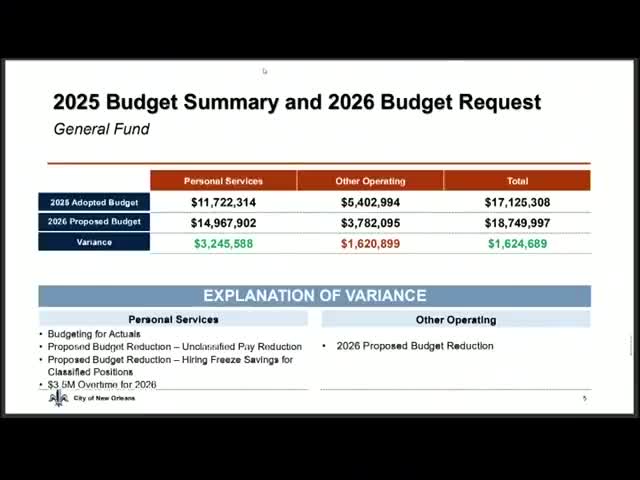
Summary
The New Orleans Fire Department told the budget committee the department will face reduced daily staffing and has identified legacy pension and workers'compensation costs as drivers of long-term fiscal pressure; it plans to complete a new headquarters move and a fire-station alerting rollout.
Superintendent Roman Nelson told the City Council budget committee on Oct. 15 that the New Orleans Fire Department's 2026 budget reflects a hiring freeze, a reduction in overtime and a projected loss of 29.5 full-time-equivalent positions driven by attrition and personnel reductions.
Nelson said the department is operating under the assumption of a hiring freeze and is planning to manage operations through attrition and other internal adjustments. He said the department's overtime for 2025 totaled about $6.7 million (including airport-reimbursed overtime and EMS-support overtime); the 2026 budget assumes $3.5 million for overtime after reductions.
Why it matters: The department emphasized service continuity and maintaining its Insurance Services Office (ISO) class-1 rating — the top fire-protection rating that affects homeowner insurance costs — while acknowledging that legacy pension liabilities and cancer-related workers'comp claims increase long-term costs.
Key details
- Staffing and operations: The 2026 request reduces 29.5 FTEs and budgets for lower unclassified pay and hiring-freeze savings among classified positions. Nelson said the department averages 35—0 attrition per year and will rely on attrition to meet headcount changes while protecting minimum apparatus staffing.
- Overtime: Nelson said the department spent approximately $6.7 million in overtime in 2025, which includes reimbursable airport overtime and about $1.6—.8 million spent supporting EMS operations; the 2026 budget sets overtime at roughly $3.5 million.
- Legacy costs: Nelson and staff said the primary long-term pressures are pension funding and workers'compensation costs tied to cancer and other occupational exposures; addressing the pension gap will require actuarial options and sustained contributions, while workers'comp exposure reduction is an operational mitigation priority (decontamination protocols, replacement bunker gear when possible).
- Capital and one-time items: The department reported recent receipt of six new pumpers that will be deployed after final outfitting and said the long-awaited City Park Fire headquarters move will consolidate leadership and improve operational efficiency.
Ending: Nelson said the department will continue to pursue cost-control options, maintain its public-safety posture, and work with the administration on funding and pension discussions in the transition to the next administration.