Get Full Government Meeting Transcripts, Videos, & Alerts Forever!
Get email alerts on the General Fund Forecast Revenue Options topic
No spam. Unsubscribe anytime.
Finance committee hears general‑fund forecast, staff lays out tiers of revenue and cost options and moves discussion to next week
Summary
City staff presented a multiyear general fund forecast showing widening deficits despite a newly passed sales tax (Measure I). The committee left public comment open and continued the item to next week to prioritize staff recommendations including a possible real‑property transfer tax, fee changes, and enterprise fund reviews.
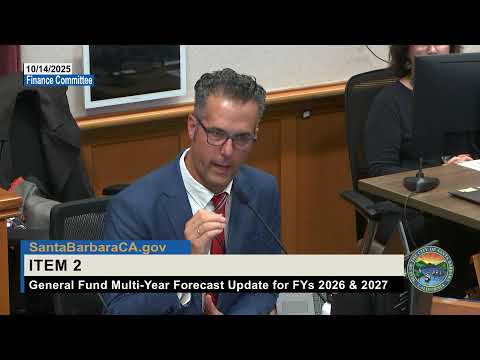
City finance staff presented an updated general‑fund multiyear forecast to the Santa Barbara City Finance Committee on Oct. 14, outlining a projected depletion of reserves in coming years unless the city adopts new revenue measures or expenditure controls.
Finance Director Keith Demartini and Budget Manager Natalia Glusick told the committee that the November 2025 passage of Measure I, a half‑cent sales tax, will generate roughly $15 million annually for the general fund but will not fully close a structural gap. Staff said sales tax has been flat for the last seven to eight quarters and transient‑occupancy tax (TOT) growth has slowed. The committee was also told the recently approved collective bargaining agreements for public safety cost more than the assumptions in the adopted fiscal‑year 2026 and 2027 budgets and that projected MOU costs will accelerate reserve depletion.
Staff presented a layered set of recommendations compiled from more than 200 ideas gathered citywide and boiled down into an attachment listing approximately 70 potential actions. The proposals are organized in three tiers: Tier 1 (actions staff believes can be implemented relatively quickly), Tier 2 (items that require more study), and Tier 3 (longer‑term or ballot‑dependent options). Examples discussed include fee adjustments (including parking and harbor slip fees), reallocating positions to special funds, organizational efficiencies, fleet and purchasing changes, and potential new taxes such as a real‑property transfer tax. Staff noted a vacancy tax principally changes owner behavior and is administratively burdensome, and does not guarantee sustainable revenue.
Staff recommended preliminary prioritization toward a real‑property transfer tax as a feasible revenue source to pursue now, while noting TOT and other tax increases could be considered but would likely require more time and broader stakeholder work before placement on an even‑year ballot. Committee members asked staff to analyze options such as a library parcel assessment, harbor slip‑fee adjustments, and transfer‑tax structures that would better capture private‑to‑private harbor slip transfers. Waterfront staff described the harbor as undersupplied for slips and said higher monthly fees over time could shift private transfer value into city revenue, but also acknowledged legal and administrative complexities around tracking private transfer prices.
Public commenters urged care in reassigning Measure C dollars (earlier voter‑approved capital funding) to general fund needs, expressed support for dedicated revenue for affordable housing, and recommended not making land‑use decisions solely to meet budget shortfalls. Commenters also urged the city to prioritize fee recovery for permitting services, to evaluate impacts on nonprofits and businesses, and to avoid shortening library hours.
Committee members and staff agreed there was too much material for one meeting and that additional study and public engagement were needed. The committee voted to continue the item to the next scheduled finance meeting, keep public comment open for additional input, and asked staff to return with prioritized recommendations and cost estimates. Staff said they will incorporate committee direction into the Q1 fiscal‑year 2026 report to the full City Council, scheduled for Dec. 2.