Get Full Government Meeting Transcripts, Videos, & Alerts Forever!
Get email alerts on the Grocery Tax topic
No spam. Unsubscribe anytime.
Bloomington council approves continuation of 1% grocery tax to cover budget gap
Summary
The Bloomington City Council voted to maintain the municipal 1% grocery tax after staff said losing it would create about a $3 million budget hole and jeopardize planned capital projects. Opponents said the levy is regressive and urged alternatives; the ordinance passed after multiple motions and amendments.
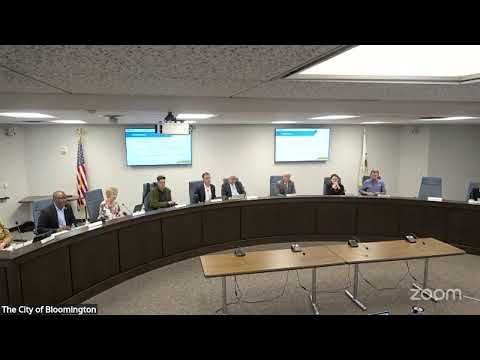
The Bloomington City Council voted to approve an ordinance continuing the city's 1% grocery tax, preserving an estimated $3,000,000 in annual revenue the city says is needed to reduce an anticipated budget shortfall and fund capital needs.
City Manager Jeff Jurgens explained the legal and fiscal background before the council vote, saying the Illinois General Assembly repealed the state's municipal grocery tax in 2024 but allowed local governments to retain the levy. "This is not a new tax," Jurgens said, and staff estimated that losing the city's share would be "about a $3,000,000 hit to the city budget." Jurgens listed capital priorities that rely on that revenue, including the public works campus relocation (Owens Nursery), the East Re Basin flood project, downtown parking needs and police and fire facility space.
The city's Finance Director, Scott Rathbun, presented revenue context and caution about alternatives. Rathbun noted that the city's food-and-beverage tax generates about $6,000,000 annually and that "each 1% then generates $3,000,000," but he and other staff said increases to other taxes might price Bloomington out of some markets or simply shift existing spending rather than produce net new revenue.
Opponents on the council framed the grocery tax as regressive and urged other revenue options. Council member Ward, who moved that the council not approve the tax, said the continuation would "provide a burden on those least able to accommodate that burden" and noted many residents struggle to afford basic necessities. Ward argued the council could raise other, less-regressive revenue streams, citing video-gaming license increases and modest increases to hotel and liquor taxes as partial alternatives.
Council member Mosley and others questioned the reliability of revenue estimates for alternatives such as expanded video gaming and warned that projections can cannibalize existing revenue or be speculative. Several council members said staff had already cut operations, deferred capital and reduced FTEs, and that withholding the grocery tax would force deeper cuts or delay critical projects.
After several procedural motions, discussion extensions and proposed amendments (including a motion to adopt a 0.5% alternative that failed), the council adopted the staff-recommended ordinance to continue the 1% grocery tax. The motion to approve the staff proposal was made by Council member Moseley and seconded by Council member Strazza; the clerk announced there were three nays (Council members Montney, Danenberger and Ward) and the motion carried.
The ordinance retains the existing exemptions described by staff, including exemptions for purchases on certain government benefits such as SNAP and WIC. City staff told the council the deadline to file to retain the tax for the coming year required action before October 1 to avoid losing part of the revenue stream.
Council and staff emphasized the continuation of the grocery tax can be revisited and repealed by a future council vote; staff also said the budgeting process could earmark or prioritize how the revenue is used.
Votes at a glance: - Ordinance to continue 1% grocery tax — Passed; recorded nays: Council member Montney, Council member Danenberger, Council member Ward; remaining voting members voted in favor. (Motion by Council member Moseley; seconded by Council member Strazza.)