Get Full Government Meeting Transcripts, Videos, & Alerts Forever!
Get email alerts on the Trash Collection topic
No spam. Unsubscribe anytime.
Sellersburg hears $162,884 projected refuse shortfall, directs ordinance draft and delays second truck lease
Summary
Town officials reviewed refuse collection finances on Aug. 11, heard a projected $162,884 shortfall for 2025, discussed possible rate increases and truck lease timing, and asked staff to draft an ordinance to adjust fees.
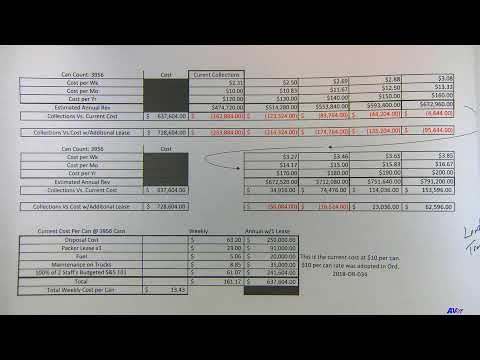
Town of Sellersburg officials on Aug. 11 reviewed the town’s refuse-collection budget and heard from Town Manager Charlie that the program is projected to run a $162,884 shortfall for the 2025 calendar year. Council members discussed several rate options and vehicle-lease timing and asked staff to bring an ordinance draft back at the next meeting.
The matter matters to all households in Sellersburg because current customer fees are below the program’s costs. Charlie told the council the town currently bills residents $2.31 per week per trash can (about $10 per month or $120 per year) and that the town counts roughly 3,956 collection cans. “This conversation will include everything I just mentioned, and that’s all part of our $162,884 shortfall,” Charlie said.
Council members and staff reviewed a spreadsheet showing operating costs that the manager said include landfill or transfer-station dumping fees, truck fuel and maintenance, staff costs, large-item pickup, spring and fall cleanups, and weekly yard-waste collection in the fall. Charlie said the town currently leases one collection truck, owns several others outright and pays about $91,000 a year on the lease. He presented incremental rate examples on a sliding scale, including monthly-per-can amounts shown in the packet (examples included $10.83, $11.67, $13.43, $14.17, $15.35 and $16.67).
Council discussion focused on two linked choices: changing the per-can fee or covering the service out of the town’s general fund (as neighboring jurisdictions reportedly do through higher property taxes), and whether to obtain a second leased collection truck now or wait until the existing lease is paid off. A council member summarized the fiscal goal, saying, “We’re just looking to turn the red into the black and be able to 0 that out with this increase.” That member also said they would be “in favor of the $16.67,” referring to one of the example monthly-per-can figures presented.
Officials discussed the operational tradeoffs of leasing versus owning. Charlie said the town’s current plan is to carry one lease until it is paid off (projected payoff in June 2026), continue using the older blue truck in the interim, and revisit leasing a second truck after that payoff date. He advised council members that the older truck could be used in rotation and that trucks sometimes require expensive, unpredictable repairs.
The council did not adopt any rate ordinance at the workshop. Instead, members asked Charlie to prepare a cleaned-up spreadsheet and to draft an ordinance with the rate lines left blank for the council to fill in at a future meeting. Charlie said the ordinance would require two readings and public notice; counsel suggested an effective date could be set for Oct. 1 or Jan. 1, provided the 30-day publication requirement is met. The council agreed to have the ordinance draft and spreadsheet returned at the next meeting (in two weeks) for further action.
A formal, unrelated procedural motion to adjourn was moved by Matt, seconded by Scott, and approved by voice vote.
Next steps: staff will return a revised spreadsheet and a draft ordinance (with blank amounts) at the council’s next meeting for first reading; the council expects to select rates and schedule second reading after public notice. The town will reconsider the timing of a second truck lease around June 2026 or earlier if the older truck fails.