Get Full Government Meeting Transcripts, Videos, & Alerts Forever!
Get email alerts on the K12 Budget topic
No spam. Unsubscribe anytime.
Lacey Township board adopts 2025–26 budget after heated public comments; grade‑banding, 27 teacher cuts and bus reductions planned
Summary
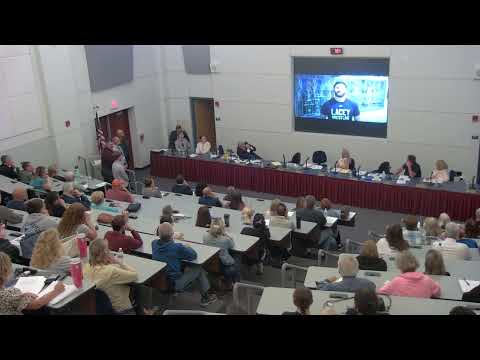
The Lacey Township Board of Education adopted its final 2025–26 school budget on June 16 after hours of public comment and debate over elementary grade‑banding, staff reductions and the elimination of most courtesy busing.
The Lacey Township Board of Education adopted its final 2025–26 school budget on June 16 after more than two hours of public comment about proposed staff reductions, school realignment and transportation cuts.
Superintendent Zelensky said the budget is a “compromise” that “falls short” of what he would choose but preserves core instruction, STEM and honors academies and special‑education placement with age‑level peers. He told the board the district’s total budget is up 1.8% from last year while the property tax levy would rise by 7.57% to help close a multimillion‑dollar gap.
The vote was 3–2 to approve the budget. Board members Bell, Walker and Claus voted yes; Peters and Conaty voted no. The district plans to cut about 27 certificated teaching positions in the package sent to the board and to proceed with grade banding at the elementary level to reduce staff needs. The budget also relies in part on an estimated property sale of $400,000 and other revenue adjustments, the superintendent said.
Why it matters: The budget and the accompanying operational changes would reshape elementary attendance patterns, increase average elementary class sizes and end most courtesy busing in walking zones, decisions parents warned could disrupt special‑education supports and daily routines for students with disabilities. Dozens of parents, district staff and community members urged the board to find alternatives or seek additional state funding before finalizing the plan.
Key facts and proposals
- Tax and revenue: The superintendent said the district’s total spending is 1.8% higher than last year and that the proposed property tax levy increase is 7.57%. He identified an anticipated land sale of $400,000 as part of the revenue plan and noted the district applied for a state tax‑levy incentive that would allow the higher increase.
- Staffing and cuts: The proposed final budget includes the elimination of roughly 27 teaching positions this year; the superintendent said 173 certificated positions have been cut in the district over the past eight years. The draft budget contains no contractual raises for union groups in this iteration, the superintendent added.
- Grade banding/realignment: The administration presented a plan to reorganize elementary schools by grade band so that each building serves a narrow set of contiguous grades (for example: Mill Pond School for pre‑K; Cedar Creek for K–1; Forked River for grades 2–3; Lanoka Harbor for grades 4–5). The superintendent said grade banding makes staffing more efficient and preserves certain programs (fifth‑grade honors math and band) by concentrating enrollment and allowing more efficient course staffing.
- Transportation: The budget removes courtesy busing for students who live inside the walking zone in most elementary attendance areas. The administration said hazardous routes (for example, students who must cross Route 9/Lacey Road to reach school) will continue to receive bus service; Forked River was cited as an example of a route that remains bused even for students in the walking zone.
Public concerns voiced at the meeting
Parents and advocates focused on special education, safety, class size and community impacts of the grade‑banding plan. Several parents of students in the district’s autism program said Cedar Creek Elementary currently houses safety upgrades, sensory spaces and staff trained for those students and that moving those students into other buildings risks legal and safety problems.
- Brandon Hurley, a parent of a child in the autism program, told the board that “under the Individuals with Disabilities Education Act and New Jersey administrative rules” students with IEPs are entitled to a free, appropriate public education in the least restrictive environment and urged the board to ensure continuity of services if grade banding proceeds. He said Cedar Creek families chose the district because of the program’s security and supports and that repeated moves would be disruptive.
- Margaret Saturra, another Cedar Creek parent, warned that “moving autistic students from one school to another every few years is not inclusive” and cautioned the board the changes risk legal challenges, potential out‑of‑district placements and lost progress for students who rely on routine.
Other speakers raised concerns about overcrowded classrooms, emergency evacuations in larger classes, eliminated extracurriculars and the long‑term effect of repeated budget cuts. Several residents said the proposed tax increase would still leave families and seniors strained; others urged the board to press the state for more aid.
Board discussion and legal context
Board members and the board attorney discussed the district’s options if the budget were voted down. The board attorney said that if voters or the board reject the proposed budget, the county office and state Department of Education could impose a budget solution; that outcome would remove some local control. The attorney urged the public to weigh that procedural risk when evaluating whether to support the board’s tentative path.
Board members emphasized the difficult tradeoffs. Superintendent Zelensky said the administration tried to preserve academic programs, special‑education inclusion and co‑curricular activities while meeting fiscal constraints. Business Administrator Sharon Ormsby (identified in the meeting) assisted in the financial presentation and explained revenue and debt‑service trends noted on the slides.
Votes at a glance (board actions taken June 16)
- Adopt final 2025–26 school budget (motion to adopt final budget): outcome — approved; vote 3 yes (Bell, Walker, Claus), 2 no (Peters, Conaty). Tally: yes 3, no 2. Legal threshold: majority met.
- Approve meeting minutes (regular and special): outcome — approved (with recorded abstentions where noted in roll calls).
- Approve list of bills and transfers: outcome — approved (roll calls recorded; committee abstentions/recusals noted at the meeting for specific bills).
- Finance and facilities items, student tuition and transportation resolutions, policies and regulations, HIB (harassment/intimidation/bullying) report acknowledgements, donations, curriculum items, certificated and non‑certificated personnel actions: outcomes — approved (roll calls recorded in the minutes for each block of motions).
What the board said it will do next
The board and administration said they will post the detailed budget documents and the district’s twice‑yearly HIB self‑assessment on the district website. The superintendent invited parents and guardians to contact the district office for specific questions and said the administration will work on logistical details of school transitions, special‑education staffing and safety upgrades where needed.
What remains uncertain
Speakers and board members noted several unknowns: whether additional state aid (including a piece of legislation discussed with local legislators) will arrive to reduce the levy increase; how soon any new revenue could be applied; and how the county office will respond if the budget is rejected by voters or the board. The superintendent said any emergency or supplemental aid would likely carry restrictions and noted the district’s immediate actions are driven by the available one‑time and ongoing revenues now shown in the final budget.
Ending
After the votes, the board adjourned and administrators said they will proceed to implement the budget and the associated staffing and operational changes unless new funding materializes. Parents who oppose the plan said they would continue to press elected officials and use the district’s established channels to seek revisions or additional support.