
MSDE awards $19 million to expand ‘grow your own’ teacher apprenticeship programs; National Center for Grow Your Own to consult
Get AI-powered insights, summaries, and transcripts
Sign Up Free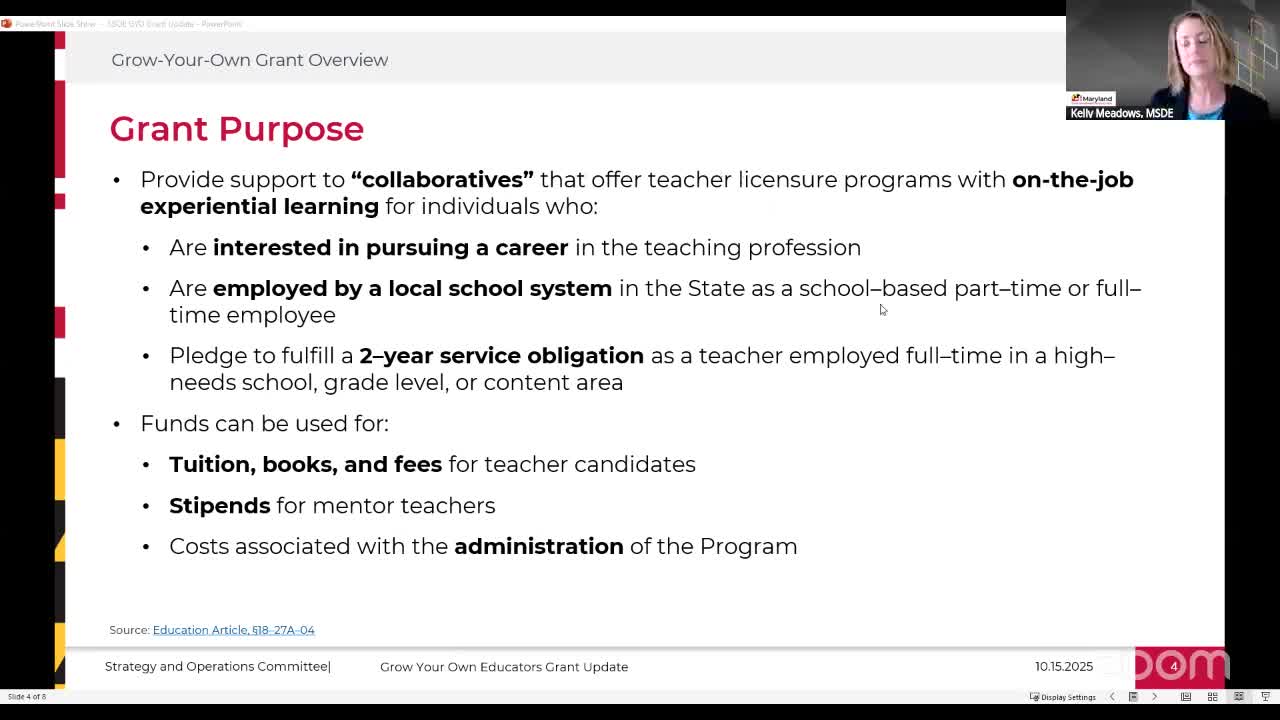
Summary
MSDE staff described a newly awarded multi-year grant to fund local collaboratives to prepare district employees and provisionally licensed teachers for state licensure through registered teacher apprenticeships and other “grow your own” pathways.
The Maryland State Department of Education (MSDE) said it has set aside $19,000,000 this fiscal year to fund local "grow your own" educator programs that must use current district employees as teacher candidates and require recipients to commit to a two‑year service obligation after licensure.
MSDE officials said the funds are intended for collaboratives — partnerships of local education agencies (LEAs), unions and institutions of higher education — to design programs for existing education support professionals (sometimes called paraprofessionals) or provisionally contracted teachers. MSDE listed allowable uses including tuition, books and fees, licensure assessments, stipends for mentor teachers or journey workers used in apprenticeships, and program administration.
MSDE staff said the department prioritized collaboratives that partner with institutions of higher education willing to offer reduced tuition for participants, that include more than one LEA and union, that implement the MSDE‑sponsored registered teacher apprenticeship program (RTAP) approved in September, and that recruit men strategically. MSDE also reported it issued a notice of grant award in August and awarded the consulting contract on October 10 to the National Center for Grow Your Own (NCGYO) to provide technical support for launching registered teacher apprenticeship and residency programs.
MSDE said eligible teacher candidates must hold a high school diploma or equivalent and pursue an MSDE‑approved licensure pathway. Candidates may be noncertified education support professionals or provisionally contracted teachers who hold conditional or resident teacher licenses and are simultaneously working as teachers of record while completing preparation.
In a question‑and‑answer exchange, MSDE officials said they had not yet completed a statewide needs assessment and could not yet project final participation counts. Department staff and the MSDE director of educator preparation development, Dr. Jason Keyes, said the department aims to work with institutions to lower tuition and exhaust other funding sources (scholarships, employer tuition reimbursement) before using grant dollars to reduce remaining costs. Based on preliminary estimates cited during the meeting, MSDE staff said the funding might support on the order of a few hundred participants over time, giving a working estimate of roughly 200–250 people as an illustrative scenario, and emphasized that actual numbers will depend on tuition negotiated with higher‑education partners and other funding that participants can access.
MSDE staff characterized this as a multi‑year program given the time needed to prepare and license educators and said the department expects to post an application for collaboratives in 2026. Dr. Keyes, who MSDE identified as director of educator preparation development, will lead the initiative and will report back to the board on implementation progress.
MSDE staff took questions but no formal board vote was recorded on the award during this meeting.