Get Full Government Meeting Transcripts, Videos, & Alerts Forever!
Staff hearing officer approves soil remediation plan at 3139 Seacliff with added monitoring and notification conditions
Summary
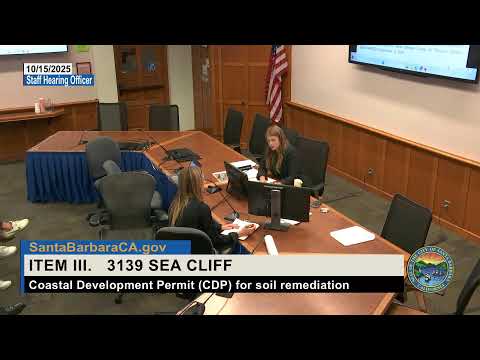
After contested public comment, the Staff Hearing Officer approved a coastal development permit on Oct. 15 to excavate and export contaminated soil from a former greenhouse site at 3139 Seacliff, subject to regulatory oversight and added monitoring, scheduling and neighbor‑notification conditions.
The Staff Hearing Officer on Oct. 15 approved a coastal development permit and affirmed a CEQA exemption to allow excavation and off‑site disposal of contaminated soil at 3139 Seacliff, subject to conditions from city staff and additional conditions the hearing officer added at the conclusion of the hearing.
The project covers a roughly 3.02‑acre parcel in the Campanile neighborhood that formerly hosted a commercial greenhouse operation. City planning staff and county environmental officials described an approved remedial action plan that calls for excavation of contaminated soil to depths between 12 and 36 inches, exportation of about 2,225 cubic yards of contaminated material to permitted landfills, backfilling with clean on‑site soil (the staff presentation summarized balanced cut and fill of roughly 1,350 cubic yards each), and revegetation with native erosion control seed and a tree‑replacement program. An arborist report accompanying the application recommended removal of 17 trees in the front setback and 38 interior trees; the landscape plan calls for planting approximately 55 replacement trees.
Santa Barbara County Environmental Health Services (EHS) and the Santa Barbara County Air Pollution Control District (APCD) were present and described their oversight roles. EHS professional geologist Thomas Rezczyk confirmed the remedial action plan (approved by EHS on 04/30/2019) and described the site sampling history (several hundred samples) used to establish lateral and vertical contaminant limits. Rezczyk said most contamination is shallow (maximum depth reported during the hearing about 3–4 feet), and that excavation and off‑site disposal is the approach EHS required to achieve protective concentrations for residential land use. APCD…
Already have an account? Log in
Subscribe to keep reading
Unlock the rest of this article — and every article on Citizen Portal.
- Unlimited articles
- AI-powered breakdowns of topics, speakers, decisions, and budgets
- Instant alerts when your location has a new meeting
- Follow topics and more locations
- 1,000 AI Insights / month, plus AI Chat