Get Full Government Meeting Transcripts, Videos, & Alerts Forever!
Get email alerts on the Environmental Cleanup topic
No spam. Unsubscribe anytime.
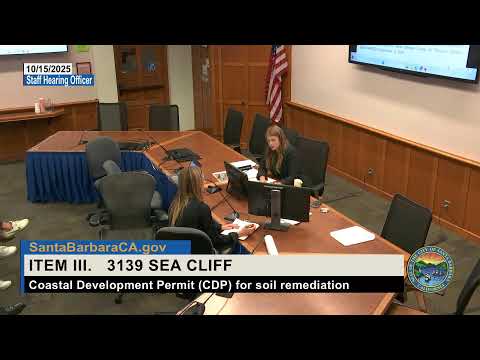
Staff hearing officer approves soil remediation plan at 3139 Seacliff with added monitoring and notification conditions
Summary
After contested public comment, the Staff Hearing Officer approved a coastal development permit on Oct. 15 to excavate and export contaminated soil from a former greenhouse site at 3139 Seacliff, subject to regulatory oversight and added monitoring, scheduling and neighbor‑notification conditions.
The Staff Hearing Officer on Oct. 15 approved a coastal development permit and affirmed a CEQA exemption to allow excavation and off‑site disposal of contaminated soil at 3139 Seacliff, subject to conditions from city staff and additional conditions the hearing officer added at the conclusion of the hearing.
The project covers a roughly 3.02‑acre parcel in the Campanile neighborhood that formerly hosted a commercial greenhouse operation. City planning staff and county environmental officials described an approved remedial action plan that calls for excavation of contaminated soil to depths between 12 and 36 inches, exportation of about 2,225 cubic yards of contaminated material to permitted landfills, backfilling with clean on‑site soil (the staff presentation summarized balanced cut and fill of roughly 1,350 cubic yards each), and revegetation with native erosion control seed and a tree‑replacement program. An arborist report accompanying the application recommended removal of 17 trees in the front setback and 38 interior trees; the landscape plan calls for planting approximately 55 replacement trees.
Santa Barbara County Environmental Health Services (EHS) and the Santa Barbara County Air Pollution Control District (APCD) were present and described their oversight roles. EHS professional geologist Thomas Rezczyk confirmed the remedial action plan (approved by EHS on 04/30/2019) and described the site sampling history (several hundred samples) used to establish lateral and vertical contaminant limits. Rezczyk said most contamination is shallow (maximum depth reported during the hearing about 3–4 feet), and that excavation and off‑site disposal is the approach EHS required to achieve protective concentrations for residential land use. APCD engineering supervisor William Serraff described permit‑to‑operate conditions (permit dated 12/13/2024) requiring dust suppression, continuous monitoring, rapid removal of stockpiles, a written monitoring plan and operational stop‑work triggers if air thresholds are exceeded.
Applicants (property owners and future residents) told the hearing they had met with neighbors and worked with the county to craft a remedial approach that in some areas exceeds regulatory requirements; they also agreed to continuous air monitoring, frequent checks and robust dust suppression measures. Geologist Steve Campbell (Campbell Geo) estimated excavation would take roughly six weeks under normal conditions, and that most excavated soil (an estimated 3,300 tons or roughly 160 truck trips) would go to a permitted landfill in Ventura County (Simi Valley); a small portion of soil that qualifies as hazardous waste would be taken to Kettleman Hills.
The proposal drew substantial public comment both supporting and opposing the plan. Supporters—neighbors who want the contamination removed and the applicants—said timely cleanup reduces long‑term risk. Opponents and nearby residents raised concerns about air emissions, dust control, transport routes and whether the project properly qualified for a categorical CEQA exemption (CEQA Guidelines §15330, the exception for minor hazardous‑waste cleanup actions). Speakers asked for more stringent monitoring (more frequent checks), clearer truck routing and notifications, and independent verification of any impacts to neighboring agricultural operations, including an adjacent organic farm that donates local produce.
City staff presented an analysis explaining why the project qualifies for a categorical exemption under CEQA Guidelines §15330 (minor actions to prevent or eliminate hazardous substance release): the remediation follows an approved remedial action plan, would comply with APCD permit conditions and, based on staff review of the applicant cost estimate, the project cost falls below the $1,000,000 threshold in the CEQA exemption guidance that staff applied. Staff also concluded no exceptions to the categorical exemption applied (no substantial evidence of significant project‑level or cumulative impacts that would require an initial study or EIR), and found the project consistent with applicable coastal policies on biological resources, visual quality and water quality.
Hearing officer Tess Harris acknowledged the neighborhood's divided views and asked for added protections beyond standard conditions. At decision she approved the coastal development permit and affirmed the CEQA §15330 exemption, and added several conditions intended to increase public notice and reduce short‑term risk during work:
- The applicant must schedule excavation to avoid forecasted rain events and to limit grading during wetter months; work must be suspended if rain is expected within a 48‑hour window. - Soil loads that meet hazardous‑waste concentrations must be removed from the site first; the applicant must provide at least seven days' notice to interested neighbors prior to anticipated removal of those first loads. - The applicant must study and, where feasible, shift the construction staging area away from the nearest adjacent residences, and the proposed staging location must be reviewed by Santa Barbara County EHS before work begins. - The applicant agreed at the hearing to monitoring more stringent than the APCD baseline; Harris required 15‑minute particulate/air‑monitoring checks at locations specified in the permit and monitoring plan (APCD will approve the monitoring protocol as part of the permit to operate).
Harris also reiterated standard controls required by APCD and EHS: continuous dust suppression (misting/water), perimeter monitoring with stop‑work triggers if thresholds are exceeded, covering of stockpiles, prompt removal of excavated soil from the site, and tree protection and replacement measures per the arborist report. She noted the project will return to the Single Family Design Board on Oct. 20 for design follow‑up related to grading visibility and that EHS and APCD will oversee remediation per the approved remedial action plan and permit conditions.
Several practical details presented at the hearing: excavation depths planned 12–36 inches; export of about 2,225 cubic yards of contaminated soil; on‑site balance of cut and fill roughly 1,350 cubic yards; tree removals 17 front + 38 interior trees, with roughly 55 replacement trees proposed; excavation duration estimated about six weeks; most soil to Simi Valley landfill (~60 miles, ~160 truck trips estimated); a small hazardous portion (<5% by volume) would go to Kettleman Hills. Staff and the applicants disputed public cost estimates presented by an opponent; staff said reviewed cost estimate put the project under the categorical exemption threshold while a public commenter submitted a higher estimate.
Harris closed by noting the decision is appealable to the Planning Commission within 10 calendar days and thanked county partners for their participation. The permit will be conditioned consistent with staff and EHS/APCD requirements and the extra conditions above; EHS and APCD retain authority to enforce permit conditions and stop work for any exceedance or risk.