Get Full Government Meeting Transcripts, Videos, & Alerts Forever!
Get email alerts on the Solar Ordinance topic
No spam. Unsubscribe anytime.
Board sends proposed solar zoning ordinance back to committee after extended public comment and debate
Summary
After public comment from developers, installers and residents and a lengthy committee-level review, the Jefferson County Board of Supervisors voted to return a draft ordinance regulating solar energy systems to the Planning and Zoning Committee for revision rather than adopt it at the Oct. 14 meeting.
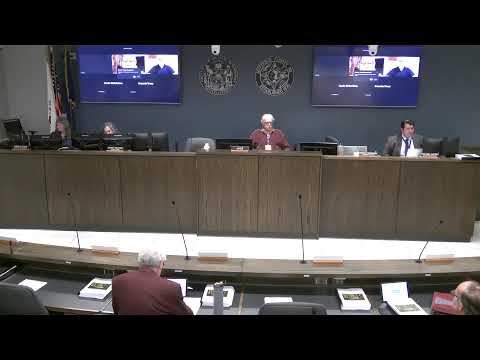
The Jefferson County Board of Supervisors voted on Oct. 14 to return a proposed ordinance that would regulate solar energy systems to the Planning and Zoning Committee for further work after residents, developers and county supervisors raised questions about prime farmland thresholds, wetlands, setbacks and administrative discretion.
During the public-comment period on agenda item 14(c), several speakers representing solar developers and landowners urged the board to avoid overly restrictive rules. Caden Crapp, identified as a field manager for the Wisconsin Land and Liberty Coalition, told the board, “The choice to sign up their land for a renewable energy project is exactly that. It is a choice. No one is forcing them to use their land for something they don't wanna use it for.”
Engineers and project staff with 1 Energy Renewables described practical on-the-ground experience. Truman Kent, senior energy storage engineer at 1 Energy Renewables, said: “Solar energy is right now is the most cost effective way to create electricity. Being able to store it helps it stretch further.” He recommended moving some detailed plan requirements from the conditional-use-permit stage to the zoning permit stage to align with development timetables and argued some of the proposed setbacks for nonparticipating residences were “just veil restrictive.”
Chris Beetle, senior project manager at 1 Energy Renewables, said the draft ordinance contained provisions that could be “very difficult” for landowners and local farmers and specifically questioned restrictions on prime farmland and wetlands as drafted.
Beth Eser, who spoke remotely for 1 Energy Renewables, described a 2023 project in the town of Koshkonong (Swart family) in which solar helped the family “diversify their income and preserve the farm.” She asked the board to allow prime farmland to host solar where the project includes commitments such as pollinator habitat and grazing, to allow farmed wetlands when DNR constructability criteria are met, to permit steeper slopes with approved erosion controls, and to reduce or allow vegetative screening options rather than fixed setbacks.
Opposition and concern about aspects of the ordinance were raised by residents and supervisors. Richard Chamber, a Cambridge homeowner, said the notice he received suggested parts of the draft “go against state law” and warned that if those parts remain, “it's gonna end up in court.” At the board table, Supervisor John Kennard and others expressed concerns the 25% prime-soil threshold for a project footprint would effectively preclude most sites, given the county’s soil map. Council members also questioned multiple provisions that allow broad staff or committee discretion; one supervisor said an ordinance should list clear requirements rather than leave open-ended requests for "any other information requested by the planning and zoning committee or department."
Planning staff and counsel described the ordinance history and legal constraints. Planning staff told the board the committee and staff used model ordinances and local examples from other Wisconsin counties, and emphasized that under state law the county must evaluate permits on a case-by-case basis and may impose conditions that either protect public health and safety, do not significantly increase project cost or allow a comparable alternative. A staff member noted the draft was a framework intended to give local regulatory clarity where none existed previously.
After extended discussion, a motion to send the draft ordinance back to the Planning and Zoning Committee for further work was made and seconded; the motion carried on a voice vote. Chair and committee members indicated they will reconvene to consider suggested changes, including potential adjustments to the prime-farmland threshold, revisiting fixed setbacks and clarifying which application elements are mandatory versus discretionary.
Ending: The board’s referral leaves the proposed local solar rules unsigned and keeps existing procedures in place for now. Planning staff said the committee will continue to refine the draft and consult affected towns before resubmitting a revised ordinance for a future board vote.