
State gaming officials outline central monitoring system options after costly sole-source bid
Get AI-powered insights, summaries, and transcripts
Subscribe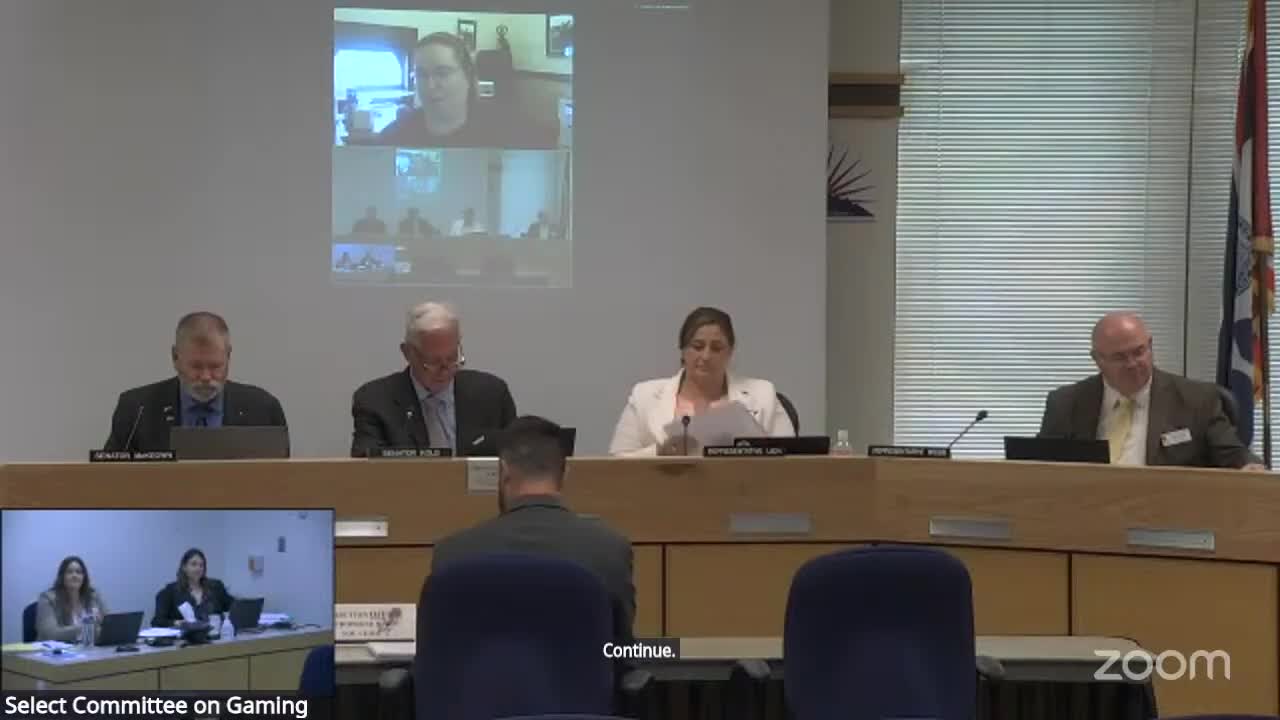
Summary
Wyoming gaming officials described existing real-time access to skill-game and HHR data, said a 2023 RFP for a statewide central monitoring system drew no bidders, and reported a sole-source quote above $2 million per year. LSO staff said a draft bill would require multiple gaming platforms to connect to a central monitoring system.
Chairman Cole and members of the Select Committee on Gaming heard an update on July procurement and legislative activity related to a proposed central monitoring system, or CMS, intended to give regulators real-time visibility across skill-based amusement games, historical horse racing (HHR) machines and online sports wagering.
Nick, director of the Wyoming Gaming Commission, told the committee the commission’s rules permit procuring a CMS specific to skill-based amusement games and that, if the commission does procure a system, vendors would have six months to connect. “We can log in real time and see 90% of the skill games in the market,” Nick said, and added the commission was recently given access by its third-party auditor, the Thoroughbred Racing Protection Bureau, to a system that provides real-time HHR reporting.
The commission issued an RFP in 2023 seeking a CMS to cover online sports wagering, skill-based amusement games and HHR; the RFP drew no responses, Nick said. After being allowed to sole-source, the commission received one quote that was “well in excess of $2,000,000 a year,” and the proposal was put aside as cost-prohibitive. Nick said staff continue to work with vendors and developers to identify lower-cost approaches.
Karen Vaughn, legislative editor and associate fiscal analyst for the Legislative Service Office, told the task force that a committee bill draft under development would require online sports wagering systems, skill-based amusement games and simulcast devices to be connected to a central monitoring system. Vaughn said the draft envisions a CMS able to “provide continuous monitoring of all gaming machines, to have the ability to disable operation and play of any machine that’s not in compliance with the law” and to audit operational, financial or program databases, noting the technical requirement to “interact and link with a broad spectrum of manufacturers and equipment and allow for program modifications and updates.”
Committee members pressed staff on cost and authority. Senator McKeown and others asked whether the commission could charge vendors to cover monitoring costs; Nick said the commission is “currently restrained” by statute and rule on what licensing fees it may impose. Nick also told the task force the commission pays the Thoroughbred Racing Protection Bureau roughly $24,000 per year for third-party auditing of HHR activity.
Industry speakers who addressed the task force during public comment described the existing regulatory framework for skill games and urged coordination among committees drafting related bills. Catherine Wilkinson of Cowboy Skill and Paysomatic and Leslie George, a Wyoming-based skill-game vendor, said the state’s skill-game statutes were intentionally specific about machine and location limits (gameplay and payout caps, age limits and authorized locations) and described the market’s size: vendors reported 315 skill locations when regulation began in 2020, a drop to 296 during a moratorium, growth to 354 after a 2023 expansion and 362 locations in 2024; total net proceeds for skill games in 2024 were reported as about $31.1 million.
The task force did not take formal action on procurement or the bill drafts during the session. Members directed staff to continue monitoring related committee work, to bring updates on bill drafts (including further amendments) at future meetings, and to coordinate with other legislative committees already considering related proposals.