
Vacaville council backs Phase 1 of new homeless action plan, directs staff to proceed
Get AI-powered insights, summaries, and transcripts
Subscribe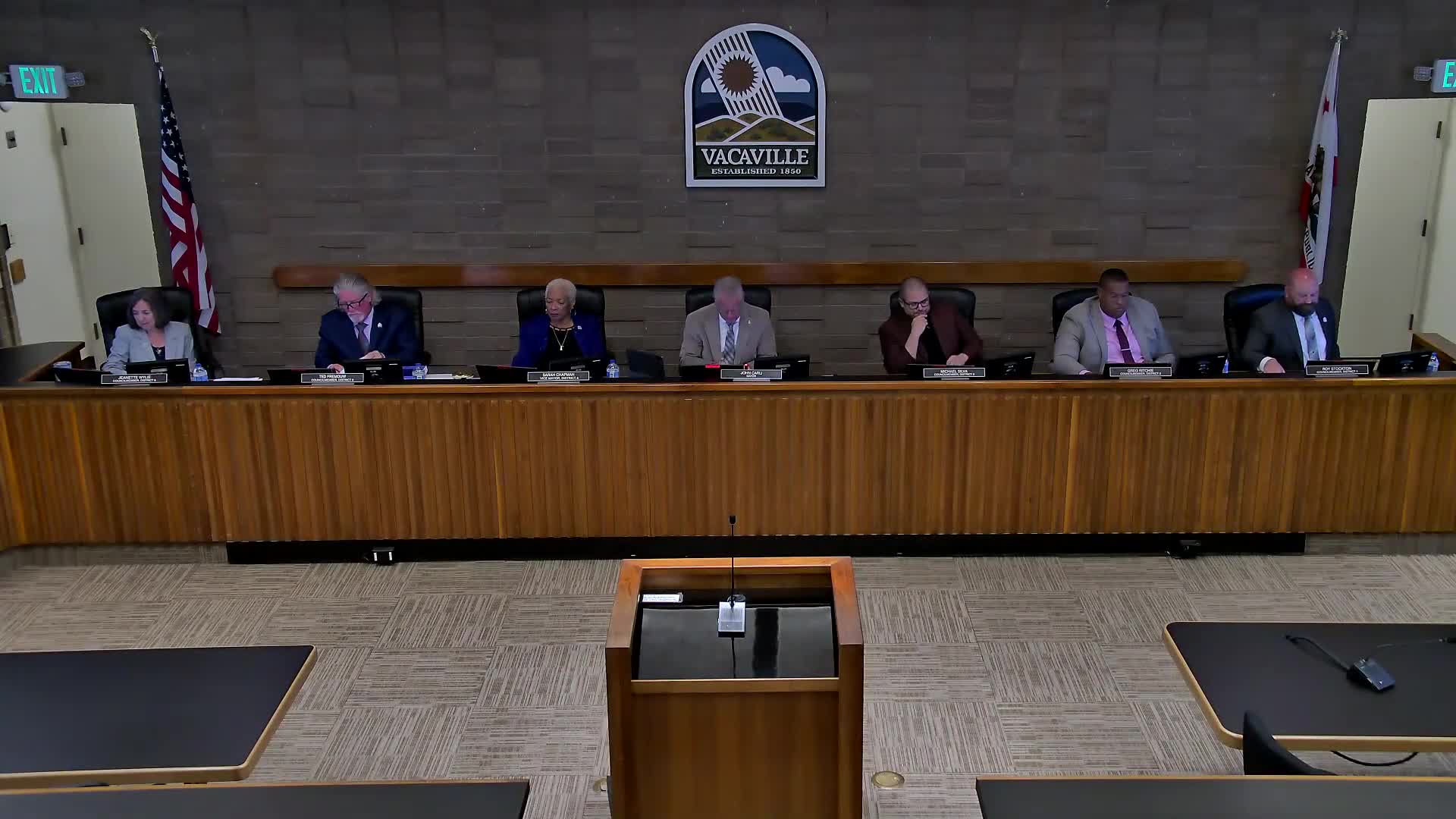
Summary
City staff laid out a two‑phase homeless action plan focused first on achievable steps this fiscal year, including a pilot transitional housing project and a permanent warming/cooling site; councilors broadly supported moving Phase 1 forward and asked staff to coordinate with regional partners.
The Vacaville City Council on Oct. 25 directed staff to begin implementing Phase 1 of a new Homeless Action Plan that prioritizes short‑term, fundable steps and regional coordination while a broader Phase 2 study evaluates longer‑term system changes.
The plan, presented by Housing and Community Services Director Tamara Holden, singles out eight near‑term actions — from improved participation in the countywide homeless roundtable and a mapping of local services to issuing requests for proposals for a small transitional housing pilot and for a permanent warming/cooling site. Holden told the council: "The 2024 point in time count identified 194 unsheltered residents in Vacaville," and emphasized the need to match local interventions to that scale.
Why it matters: Council members and community providers said the city has for years lacked a coherent local system for navigation, prevention and transitional housing. The new plan aims to use one‑time and grant funds now available to stand up basic services and to test models that could be scaled with additional funding in future years.
City staff framed the plan as two linked stages. Phase 1 (this fiscal year) focuses on items staff said are achievable with existing or targeted funds: resume consistent council/staff participation in the county homeless roundtable; map how people move from outreach to shelter to housing; identify sustainable funding sources; issue an RFP for a 2–4 unit pilot transitional housing project with supportive services; issue an RFP for a permanent warming/cooling location or partner; work with the housing authority on a "move‑on/move‑up" voucher pathway; and evaluate relaunching a clean‑streets workforce program.
Phase 2, staff said, would run in the next fiscal year and examine whether the city needs a larger navigation/day center, whether to expand the transitional housing pilot, how to secure long‑term funding sources, and whether to leverage city‑owned land or motel conversions for permanent affordable units.
Council reaction and public input: Council members repeatedly urged coordination with regional partners and nonprofits rather than creating duplicate systems. Mayor John Carley said Phase 1 "absolutely" is overdue and urged staff to use existing county and JPA resources where possible. Vice Mayor Chapman and other council members asked staff to look for models and grants used successfully by other California cities.
Service providers and residents urged the plan to incorporate addiction and mental‑health treatment. Wanda Cook, executive director of Archway Recovery Services, told the council: "This is... a substance use disorder problem in large part, and we absolutely have to address what this is." Opportunity House representatives said their organization would present a fuller program report to council in two weeks and urged that transitional housing include case management and workforce elements.
Next steps: Council direction was to move forward with Phase 1 actions while continuing to coordinate with regional partners and the homeless roundtable. Staff will return with RFP language, proposed funding sources and timelines for Phase 1 items. The council did not take a roll‑call vote on a binding ordinance or budget appropriation at the Oct. 25 meeting; the direction recorded was a policy/direction to proceed.
Ending: Staff said Phase 1 actions are intended to be low‑cost, funded through a mix of existing local grants, ARPA dollars and targeted state/federal grants; Phase 2 will require new, sustainable funding commitments and will be brought back to council for further policy direction and potential appropriations.