
Palatka reviews fourth draft of FY2025–26 budget, considers cuts and grant-funded options
Get AI-powered insights, summaries, and transcripts
Subscribe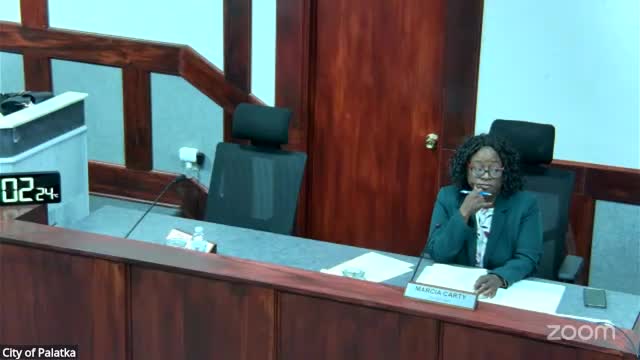
Summary
City staff presented a fourth-draft budget showing a $3 million shortfall in the general fund and recommended a mix of rate increases, grant pursuit and targeted reductions; commissioners discussed trimming decision-unit requests, fire equipment priorities and changes to commissioner and events allocations ahead of an August balance deadline.
Palatka City Commission convened a budget workshop on Aug. 6, 2025, to review the fourth draft of the fiscal year 2025–26 budget and discuss options to close a general-fund gap. Finance staff presented a budget that shows $25,000,000 in general-fund revenues against $28,000,000 in general-fund expenses, leaving a $3,000,000 shortfall; the overall city budget presented totaled $86,370,042.
The finance director outlined proposed revenue adjustments and expenditure changes aimed at narrowing the shortfall. Staff recommended a 4% across-the-board increase in utility billing rates, citing a June 2025 Consumer Price Index change of 2.28% and prior years without an increase. The packet also showed optioned millage-rate scenarios (rollback/6.4 mills, 6.8 mills and 7.0 mills) with corresponding revenue projections; staff noted the commission had certified a maximum option of 7 mills earlier in the process.
Why the discussion matters: the commission must adopt a balanced budget before the August deadline while minimizing new tax or assessment burdens. Commissioners and department heads used the workshop to test adjustments to spending requests (“decision units”), pursue grant funding for personnel, and prioritize capital purchases that have safety or regulatory urgency.
Key budget figures and staff options presented - General fund: revenues $25,000,000; expenses $28,000,000; gap $3,000,000. - Water utilities and other enterprise funds were presented with their own revenue/expense balances; total budget presented: $86,370,042. - Proposed 4% rate table increase for residential garbage and other utility charges (example: a non-metered residential garbage charge shown at $27.10 increasing by $1.08 to $28.18). - Millage options shown at 6.4, 6.8 and 7.0 mills with estimated revenue above rollback of roughly $118,000, $414,000 and $562,000 respectively. - Fire-assessment options: staff displayed variable-rate alternatives (shown in the packet as $2.00, $1.75 and $1.50 per thousand) and fixed-rate options; revenue estimates for those choices were included and staff said the methodology still needed attorney confirmation.
Decision-unit requests and department priorities Finance and department staff walked commissioners through “decision units” — requests from departments for new equipment, personnel or projects. The largest single capital request under discussion was a ladder truck for the fire department, shown at approximately $1,800,000. Fire leadership and staff agreed that the ladder truck represents the more urgent capital need than a new engine; the engine purchase could be deferred one to two years, staff said.
Fire department personnel requests originally listed multiple new positions (a request totaling several positions), and staff reported a grant application that — if awarded — would cover personnel costs entirely in year one and decreasing shares in subsequent years (first year 100% federal, second year 75%, third year 50%). Because the grant outcome is pending, commissioners discussed reducing the city-funded portion of personnel requests (one staff suggestion was to reduce a six-person request to two city-funded positions while seeking grant support for the remainder).
Other suggested reductions and revenue actions Commissioners and staff identified several options to reduce the budget gap: hiring freezes or elimination of vacant positions (staff estimated 4–5 vacant positions totaling about $365,000 in salaries with fringe benefits raising the fiscal effect to roughly $530,000), postponing or reducing capital outlays, and pursuing grants and public–private partnerships to fund infrastructure and programming. Staff also noted opportunities to increase fee collection for planning and development (including new plan-review fees) and to pursue additional grant applications related to infrastructure projects.
Service, department and community issues raised - Water and reclamation: department staff said plant equipment is aging; commissioners were told components are near end of life and that decision-unit requests tied to the water system address risk of near-term, potentially catastrophic failures. - Interns and workforce development: the budget includes a line for interns (shown in the packet at $31,500); commissioners discussed whether that level is sufficient given growing demand and asked staff to consider a plan for internship capacity tied to hours and department placement. - Special events and commissioner discretionary funds: staff presented a notional sponsorship grid (class A/B/C events) that produced an estimate near $100,000 if the city funded all events by the proposed tiers. Commissioners discussed consolidating existing commissioner event allocations (previously $5,000 per commissioner) into a centralized special-events sponsorship fund and debated lowering the commissioners’ conference/training allocation from $10,000 to $7,500 as a partial savings measure. - Pool and recreation: commissioners discussed options for community pool access, possible memoranda of understanding with local providers, and state funding opportunities to support swim instruction. - Animal services mobile clinic: commissioners asked staff to confirm scheduling and local days of operation for a spay/neuter mobile trailer that the commission previously funded.
Next steps and deadlines Staff told commissioners they would provide clearer spreadsheets with column and row headers and back-up documentation requested by commissioners, and they set an internal deadline to receive commissioner input by Aug. 20 to allow preparation of a balanced budget for the August 28 meeting. Staff also said they would follow up with the city attorney about the legal permissibility of stratifying fire-assessment charges by parcel type and would report back on the pending federal grant for fire personnel.
Ending Because the session was a workshop, no formal votes were taken. Commissioners and staff left the meeting with a list of follow-ups: (1) confirm legal mechanics of the fire assessment proposals, (2) supply clarified budget tables and decision-unit details, (3) continue pursuing grant and public–private partnership options, and (4) return with a balanced-draft proposal with suggested cuts and revenue options before the August 28 budget meeting.