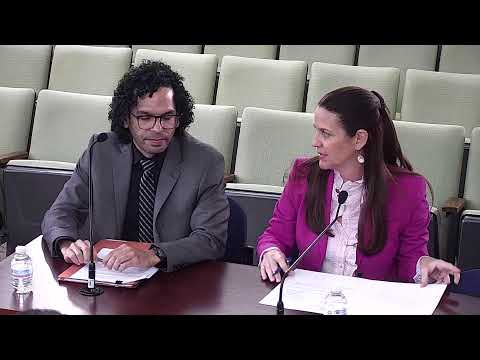
Puerto Rico hearing on bill to require third payment option draws banks, retailers and consumer agency
Loading...
Summary
Puerto Rico’s House of Representatives Commission on Consumer Affairs heard testimony Oct. 15 on House Bill 710, which would amend Law 42 of 2015 to require merchants to offer a third payment option via electronic platforms validated in Puerto Rico.
Puerto Rico’s House of Representatives Commission on Consumer Affairs heard testimony Oct. 15 on House Bill 710, which would amend Law 42 of 2015 to require merchants to offer a third payment option via electronic platforms or applications validated in Puerto Rico.
The hearing brought representatives from the Asociación de Bancos de Puerto Rico, the Centro Unido de Detallistas and the Department of Consumer Affairs (DACO), among others. No vote was taken; committee members asked several witnesses to submit additional documentation to the committee record.
Bill and context
House Bill 710 would add a requirement to Law 42 of 2015, which currently requires persons and businesses that provide services to make at least two payment alternatives available to consumers. Proponents say the change would ensure consumers can use modern, mobile and platform-based payment methods such as ATH Móvil, PayPal or similar services validated for use in Puerto Rico.
Why it matters
Supporters say broader electronic payment options increase convenience and financial inclusion. Opponents warned the change could increase costs for merchants — especially small businesses that cannot negotiate lower processing fees — or duplicate existing regulatory categories. The committee sought more detail on how transaction processing works and on the scale of fees.
What witnesses said
Zoime Álvarez Rubio, president of the Asociación de Bancos de Puerto Rico, told the commission the association had submitted written testimony and that its member banks are largely excluded from the statute as written and thus are not the primary entities affected by HB 710. Álvarez Rubio said many modern payment alternatives still rely on bank accounts and underlying payment rails, and that merchant processing includes several cost components and regulatory safeguards. She offered to provide “a diagram of all the components” behind electronic transactions and other documentation and said she would submit that information to the committee within five business days.
Agnes Martínez, adviser to the Centro Unido de Detallistas and speaking for the retail association, urged caution. Martínez said Regulation 88-51 (2016), promulgated by DACO, already contains exceptions — including for businesses with annual gross receipts under $50,000 and for certain licensed services, bona fide farmers and government payment collectors — and recommended those exceptions be carried forward. Martínez argued the bill should instead amend Law 42 to broaden what counts as the statutory “second” alternative to explicitly include electronic or platform‑based payments, rather than imposing an additional mandatory third option that could burden small retailers.
Yasiris Torres Rivera, appearing for the Department of Consumer Affairs (DACO) on behalf of Secretary Valery Rodríguez Erazo, urged updating Law 42 to reflect current payment behavior. DACO’s written testimony recommended that the statute require a modern electronic payment method (such as ATH Móvil, PayPal, Apple Pay or similar) as part of the required two alternatives, and consider a phased approach so smaller merchants can comply over time. DACO also suggested that existing administrative data (for example, Hacienda’s SURI records) could be used to identify which merchants exceed thresholds and require compliance.
Points of technical and policy disagreement
Witnesses and committee members discussed merchant processing fees, interchange fees and the difference between card networks and newer platform-based payments. Banks and their counsel described multiple fee components — issuer fees, network fees, acquiring fees and fraud‑prevention costs — and noted that merchant fees vary with volume and contract terms. Retail representatives emphasized that small merchants typically pay higher per-transaction costs and can be disadvantaged by mandatory new acceptance requirements.
Follow-up and next steps
Committee members asked the Asociación de Bancos de Puerto Rico to submit the requested transaction‑component diagrams and related documents within five business days. The Centro Unido of Detallistas accepted a request to provide an approximate schedule or summary of processing fees by merchant category but said it would need more than 10 days to assemble itemized data across its 6,000 members and 169 business categories. DACO reiterated its willingness to work with the committee on a phased implementation and on enforcement mechanisms.
No formal vote was taken at the hearing. Committee members said they would review the submitted materials and consider amendments that could widen the statutory definition of acceptable “electronic” payments or that would preserve targeted exceptions for micro‑businesses.