Get Full Government Meeting Transcripts, Videos, & Alerts Forever!
Get email alerts on the Local Control Hhr Hb85 topic
No spam. Unsubscribe anytime.
County, city officials press for clearer local authority over historic horse racing; 100-mile rule, court cases and HB 85 loom large
Summary
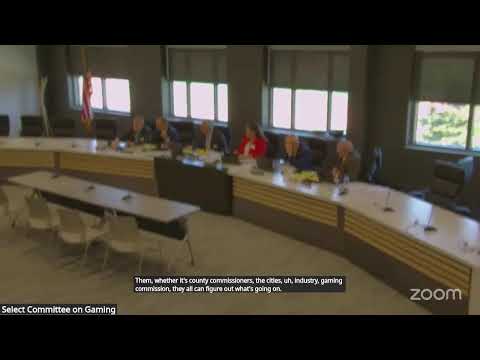
County commissioners and municipal leaders told the Select Committee on Gaming they want clearer local authority to approve, condition or revoke historic-horse-racing (HHR) permits. Witnesses cited a 2014 Sweetwater County case, a 2023 Campbell County decision, disputes over a 100-mile rule and last session’s House Bill 85 as central to confusion.
Wyoming county commissioners, municipal officials and industry representatives told the Select Committee on Gaming that local governments need clearer statutory tools to control where and how historic horse racing and related off-track betting operate in their communities.
Jeremiah, representing the Wyoming County Commissioners Association, traced disputes over local authority back to a Sweetwater County case in 2014 and a Campbell County case whose Supreme Court decision came in 2023. He told the committee the issue hinges on a statutory framework that gives county commissioners initial approval authority but delegates ongoing permit issuance, administration and revocation to the Wyoming Gaming Commission.
“We know from Campbell County that you can't modify or revoke a permit once you've authorized it. The only entity that can do that is the Wyoming Gaming Commission,” Jeremiah told the panel, describing how county boards have uncertainty about whether they can impose conditions, require renewals, or revoke approvals once given.
Municipal leaders and municipal association representatives told the panel they are often the service providers when a gaming facility sits inside city boundaries and they want a formal seat in the approval process. Ashley Harpstreet, executive director of the Wyoming Association of Municipalities, said 38 of 41 active permit locations are within municipal borders and asked for notice and an ability to impose “specific conditions on permits such as hours of operation or location restrictions.” Dr. Mark Rene, president of the Cheyenne City Council, said in Cheyenne many approvals went through a board of adjustments rather than the city council, leaving elected officials without clear responsibility when residents complain.
Operators and investors disputed some characterizations and urged predictability. Will Edwards, developer of the Thunder Plains racetrack, and Kyle Ridgeway, president of Wyoming Downs and 3 07 Horse Racing, described multi-million-dollar investments intended to grow live racing and said local operators’ contributions to purses were part of the business model that supported live meets.
Nut graf: The practical dispute is this — county boards currently grant initial approvals, the Gaming Commission administers state permits, and municipalities frequently provide services to facilities but have limited statutory power to deny, condition or revoke simulcast/HHR operations inside city limits. Witnesses told the committee that unresolved questions — most prominently the “100-mile rule” that links off-track locations to a live racing track’s market area — have repeatedly produced litigation and policy stalemates.
Speakers urged a narrowly focused legislative fix to clarify which local bodies may approve or deny simulcast and HHR permits, whether counties may impose and enforce conditions, how transfers or expansions are reviewed, and whether a 100-mile restriction should remain, be reduced to the county border or be repealed. County representatives described four practical priorities: (1) explicit authority to revoke or modify permits for cause, (2) a clearer notice and hearing process for municipalities and counties, (3) workable rules about transfers and expansions so municipalities can engage earlier, and (4) reconsideration of the 100-mile rule — some county officials suggested eliminating it.
Ending: Committee members said they intend to pursue detailed draft options before the next meeting. Co-chairs asked the Legislative Service Office to produce a table of alternatives showing possible local-authority models (for example: increased municipal notice and conditioning power; county permit renewal authority; preservation of Gaming Commission oversight; or a home-rule/opt-in model). The task force also agreed to circulate materials to stakeholders in advance of the next meeting so city councils, county boards and industry representatives can comment.