
LSO outlines legal history of HHR and county approval; gaming commission details terminal counts and licensing limits
Get AI-powered insights, summaries, and transcripts
Subscribe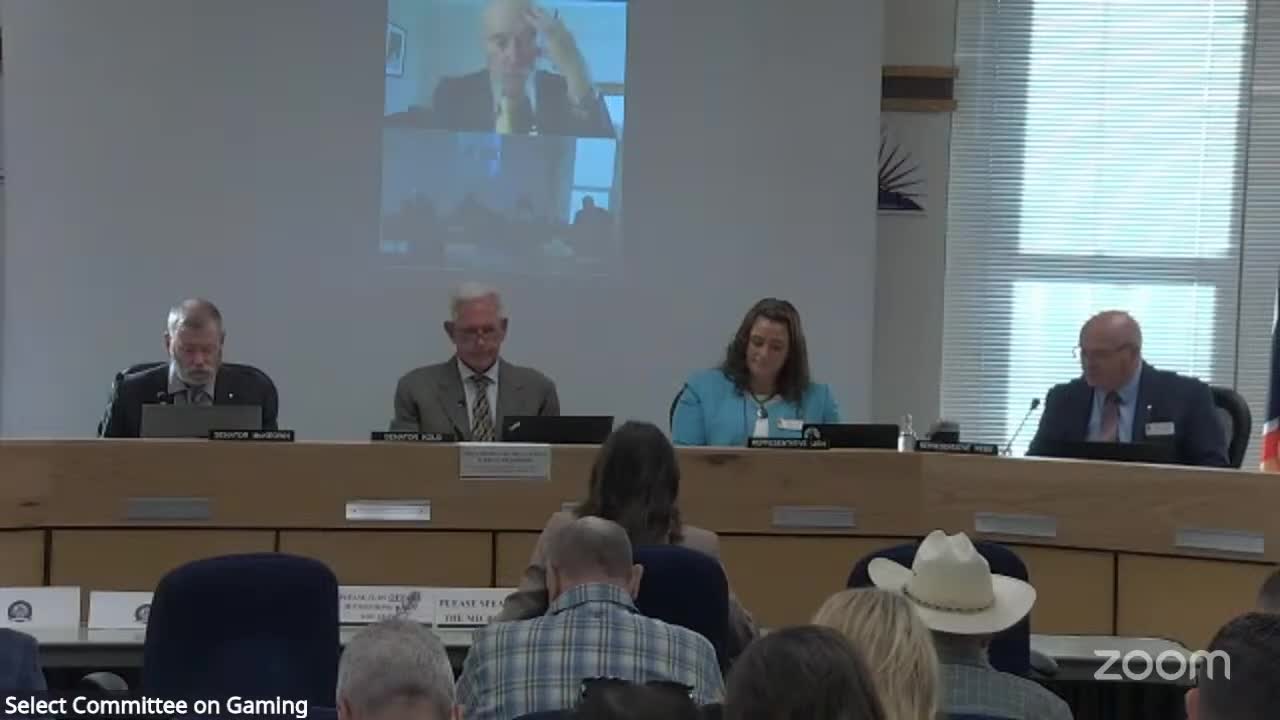
Summary
LSO counsel told the Select Committee on Gaming on Aug. 7 that Wyoming's statutes, agency rules and court rulings have produced a narrow county‑approval process for pari‑mutuel wagering and have limited counties' ability to revoke prior approvals.
The Legislative Service Office (LSO) told the Select Committee on Gaming on Aug. 7 that Wyoming's statutory framework for pari‑mutuel wagering, simulcasting and historic horse racing (HHR) has produced a pattern of legislative choices, agency rules and judicial rulings that constrain local control where counties previously granted approval.
Tamara Reveley, an LSO attorney who prepared a briefing memo for the committee, reviewed four decades of legal and administrative history and recent court decisions. "The memo is a high level overview of the legal history related to off track betting, to simulcasting, and historic horse racing," Reveley said. She summarized successive legislative changes, commission rulemaking and court rulings, including a 2006 district‑court and Wyoming Supreme Court decision that initially found some HHR terminals to be illegal gaming devices and later legislative action in 2013 that amended statutory definitions to authorize HHR.
Why it matters: Reveley's memo traced how the state's 100‑mile rule, county approval requirement and judicial interpretations have left counties with authority to approve pari‑mutuel wagering but, in several court decisions, without clear power to revoke previously granted approvals. That legal history constrains both county action and the commission's enforcement discretion when new permits are sought.
Court rulings and county approvals: Reveley summarized litigation that shaped the field. A 2006 district‑court decision (affirmed on appeal) held some HHR terminals were illegal under the statutes then in force, prompting a 2013 legislative response to exempt properly authorized HHR from the illegal‑device provisions. Later court fights addressed county denial or revocation of approvals: a 2014 Sweetwater County denial was overturned for being arbitrary and capricious in the district court; and a 2022 case involving Campbell County found counties lack authority to revoke prior approvals absent clear statutory language.
Commission rules and the 100‑mile waiver: Wyoming Gaming Commission staff said commission rules mirror state statute for the so‑called 100‑mile rule (intended historically to encourage attendance at live racetracks). Commission director Nick Laramendi told the committee the statute permits the commission to waive the 100‑mile restriction when the live operator and off‑track operators enter a written agreement; the commission's rule mirrors that requirement and does not prescribe the content of the agreement. Laramendi described operational practices the commission uses to enforce waivers: when a live track races, off‑track locations within 100 miles are required to close 15 minutes before the first post and may reopen only after the races are official unless a written agreement is in place.
What the commission requires from applicants: Laramendi outlined the application packet the commission reviews for off‑track wagering or HHR. Applicants must submit the simulcast/HHR application, the prior year's financial statements, proposed location photos, a county resolution granting local authority (or other county legal authorization), floor plans showing machine layouts and surveillance, leases or host‑facility agreements if the operator does not own the property, fingerprints for background checks, and a feasibility study showing expected revenues, operating costs and probable impacts on local tax receipts and breeders' awards. Commission staff said they encourage operators to provide municipal letters of support as a practical matter although statute requires only county approval.
Terminal counts and operational status: Laramendi provided the committee with current terminal approvals and operational numbers by operator (figures provided to the committee during the meeting): - Wyoming Downs: approved for 20 off‑track wagering locations and 2,310 terminals; 1,146 terminals currently operational; 18 of 20 locations operational and two pending openings. - Wyoming Horse Racing: approved for 13 off‑track wagering locations and 2,804 terminals; 952 terminals currently operational; 10 locations open and 3 pending. - A third operator (referred to in commission materials) was approved for 14 OTB locations and up to 1,289 terminals and was operating 1,043 terminals at the time of testimony; one location was pending opening in Sweetwater County.
Licensing cadence and flexibility: The commission may issue permits for up to three years; operators choose whether to apply for one‑year or three‑year permits. Laramendi told the committee that most operators prefer three‑year cycles while one operator historically requested a one‑year permit because it was new. The commission said it awards race dates on an annual cycle even where a multi‑year permit exists, and commission rules link simulcast/HHR privileges to the operation of live race dates: a failure to run required live race dates can lead to suspension of simulcasting privileges for the remainder of the year and the following calendar year.
Background checks and timing problems: Commission staff described practical delays in criminal‑history processing: local DCI (Division of Criminal Investigation) offices forward fingerprints to the FBI, and during peak seasons DCI backlogs occasionally cause FBI checks to arrive after statutory licensing deadlines. The commission has used conditional licenses when the statutory decision clock expires before criminal‑history results are available.
Policy options LSO presented: Reveley told the committee she had compiled a matrix of approaches other states use, including: - Local zoning or accessory‑use limits that place gaming devices as incidental to a primary business (for example, limits on video poker as accessory uses in some municipalities), - Host‑community agreements or franchise‑style licensing that require developers to enter agreements with local governments (Massachusetts casino host‑agreement examples), - Voter approval models, where voters either must approve each new facility or authorize a local opt‑in/opt‑out process (examples include Virginia, Alabama and other states), and - Time‑limited opt‑outs or moratoria used by some states when video gaming was introduced.
Public comment and county perspective: Local speakers were split. Loretta Kalas, the elected Uinta County attorney, told the committee she believed local businesses and the live racing industry benefit and that existing problem‑gambling treatment needs in Uinta County do not appear to be driven primarily by gambling. By contrast, citizen Carl Allred urged clearer local authority to reject new terminals; he and other residents said HHR has different economic and social effects than the pari‑mutuel wagering citizens approved decades ago.
What the committee did not decide: No statutory changes were adopted at the Aug. 7 hearing. Committee members asked staff to return with options, and gaming commission staff offered to produce draft rule language and prior draft rules the commission had considered that tie terminals to live race‑day obligations.
Sources: LSO memo (dated 07/28/2025) on the legal history of simulcasting, OTP and HHR; testimony of Tamara Reveley (LSO); testimony by Nick Laramendi (Wyoming Gaming Commission); public comments from Loretta Kalas (Uinta County attorney) and Carl Allred (Evanston resident).