Get Full Government Meeting Transcripts, Videos, & Alerts Forever!
Get email alerts on the Education topic
No spam. Unsubscribe anytime.
Teaneck Board of Education swears in trustees, elects officers and adopts new meeting rules
Summary
At its Jan. 7 reorganization meeting, the Teaneck Board of Education swore in newly elected trustees, elected board leadership, adopted a code of ethics and approved changes to its meeting calendar and procedures including limits on public comment and an initial executive-session cap.
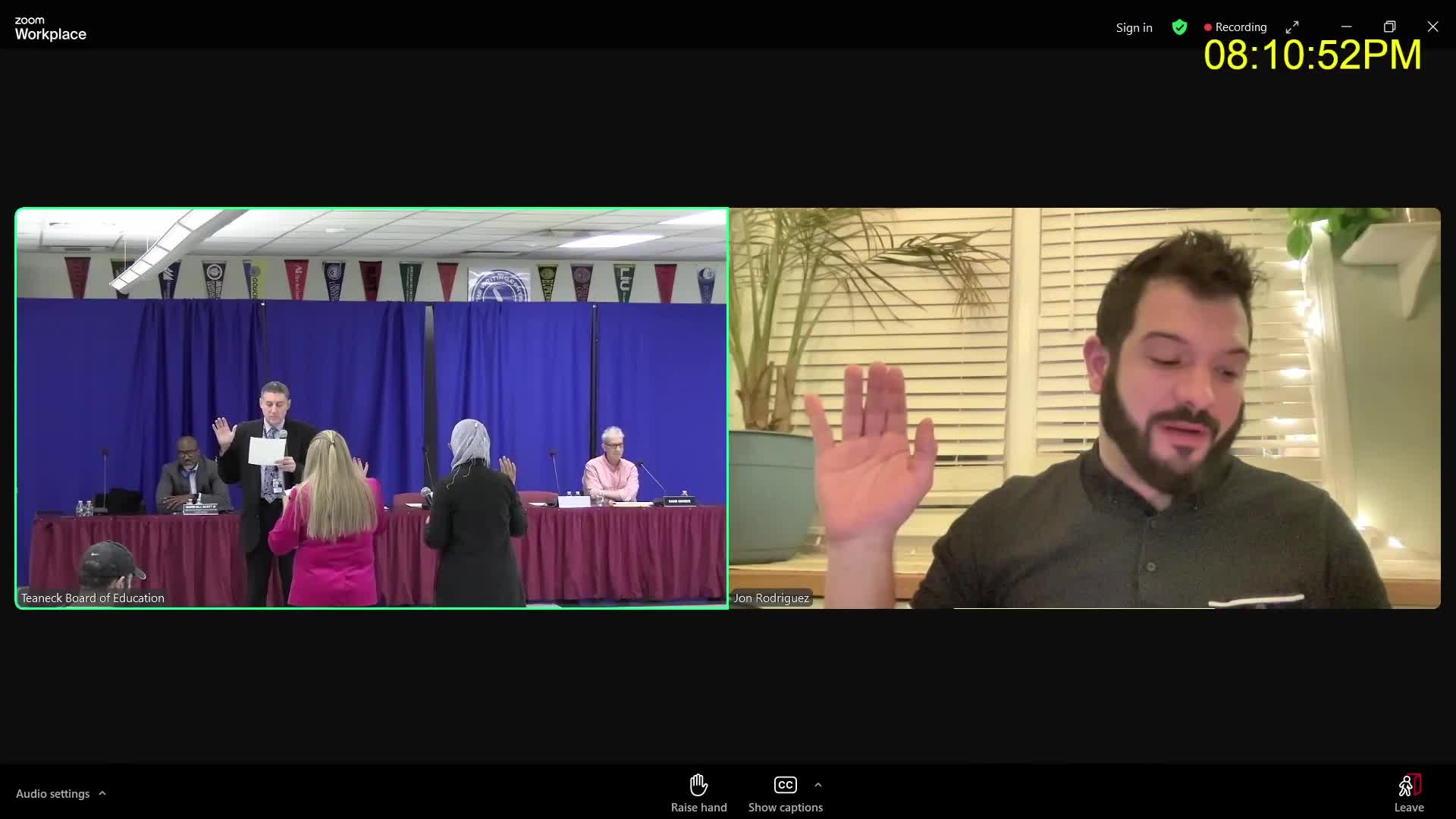
Teaneck — The Teaneck Board of Education met in reorganization session Jan. 7 at Teaneck High School, swearing in newly elected trustees, electing board officers and approving a package of organizational items that included a code of ethics, calendar adjustments and new meeting procedures.
The board administered oaths to newly elected trustees and then conducted nominations and roll-call votes for board leadership. After nominations for president and vice president, the board elected Ed (first name recorded as Ed in the meeting) as president and Cassandra Reyes as vice president. Trustees also agreed to adopt a code of ethics and to ask the policy committee to draft a formal decorum policy for future board consideration.
Why it matters: Reorganization meetings set the board’s officers, annual calendar and procedural rules that guide public meetings and district oversight for the coming year. The actions taken affect how and when the public can comment, how the board notices meetings and how the board will address internal conduct and committee work.
Key details and outcomes
- Oaths and election results: The board administered the oath of office to the newly elected trustees (election results were read into the record). After nominations, the board elected Ed as board president and Cassandra Reyes as vice president following separate roll-call votes.
- Code of ethics and decorum: Trustees read and adopted the board’s code of ethics (the board read items 1–10 as part of the reorganization). At the meeting trustees also approved a motion to have the policy committee draft a formal decorum policy to address expectations of member conduct at meetings; that drafting will be handled by the policy committee and may include attorney input.
- Meeting calendar and public-notice changes: The board amended meeting dates to avoid conflicts with Jewish holidays in October and adjusted June dates; it also voted to add a digital (online) publication option in addition to the print newspaper for required public notices for the coming 12 months (board members discussed which counties/districts are eligible under recent state law changes). The board approved consolidating October meetings into a single combined workshop/regular meeting for October to avoid conflicts with the New Jersey School Boards Association conference and holiday observances.
- Professional services and contracts: The board confirmed its slate of professional service providers on the consent agenda, including authorization of certain law firms and a pediatrician contract. Trustees discussed the vendors and asked that the district pursue Requests for Proposals (RFPs) for some services in the future; trustees questioned scope and cost for the pediatrician contract (one board member referenced about $83,000 as the approximate annual amount under discussion).
- Meeting procedures and public participation: The board approved a set of procedural changes affecting public comment and executive session. Specifically, trustees: - Moved the principal executive-session block to occur after the first public-comment period for agenda items (so the board can consider public input before some closed discussions); - Agreed to limit the first executive-session block to a maximum of 45 minutes, with the ability to return to executive session later if needed; and - Adopted a 30-minute limit for combined public-comment sessions (with the board retaining the authority to extend that time by motion).
What trustees said
Clara Williams, outgoing president, summarized the board’s role: “The Board of Education plays a vital role in ensuring every student receives a high quality education, overseeing the district's resources and collaborating with the superintendent to achieve our shared goals.”
Superintendent David Spencer told the board, “I do not have a superintendent's report for this meeting,” when asked earlier in the session.
Public comment and community concerns
During the public-comment period several residents congratulated new trustees and urged transparency and better calendar/meeting practices. Deborah Blayberg, a resident, said: “I hope that our budgets are gonna be organised. I hope there's going to be full transparency.”
A caller identified as Shanaz raised concerns about representation and made allegations about a trustee: the speaker alleged that a trustee had submitted falsified financial documents and said she had requested the trustee’s resignation; the board did not act on that allegation at the meeting and treated the remarks as public comment. (The article reports the speaker’s allegation; it is not a finding or a statement of fact by the board.)
Votes at a glance (selected final outcomes reported at the meeting)
- Election of board president: Ed — elected by roll-call vote (majority). (See actions array for vote details.) - Election of vice president: Cassandra Reyes — elected by roll-call vote (majority). - Consent agenda (remaining items after several items were pulled for discussion): approved by roll-call; the board removed items 2, 3, 7, 17, 18, 20, 22 and 24 from the consent motion for separate discussion and votes. - Item 2 (publication/notice language amended to add a digital option alongside print): motion to amend and approve passed by roll-call. - Item 3 (calendar amendments to address holidays and association conference): motion to amend calendar dates approved by roll-call. - Item 4 (adopt code of ethics; refer decorum policy to policy committee): approved by roll-call; policy committee charged with drafting a formal decorum policy. - Item 17 (confirmation of listed law firms and other professional services): approved (majority; one abstention recorded). - Item 18 (approval of pediatrician/medical services contract): approved (majority; one abstention recorded); trustees requested further details and discussion about scope and cost and said the district should consider issuing an RFP in the future. - Item 20 (insurance/broker/benefit services, consent item): approved by roll-call; trustees discussed rising healthcare costs and interest in exploring wellness programs and future RFPs for brokers. - Item 22 (designation of school business administrator as public-agency compliance officer/custodian of records — name to be corrected in the minutes to list Doctor Ayala): approved by roll-call with the requested name correction. - Item 24 (changes to order of agenda items, executive session timing and public-comment limits): the board approved moving the main executive session to follow the first public-comment period, limiting that first executive session to 45 minutes, and adopting a 30-minute cap on public-comment sessions with the board retaining authority to extend the time by motion.
Background/context
The reorganization meeting is the board’s annual organizational meeting required by law. Trustees discussed both long-standing procedural items (code of ethics, calendar publication) and the mechanics of public engagement (where public comment sits in the agenda, how long public comment may run, and how executive session is scheduled). Several trustees urged an RFP process for recurring professional services so the district can compare vendors and costs.
What’s next
The policy committee is expected to draft the formal decorum policy for the board’s consideration. Trustees asked administration to provide follow-up information on vendor scopes and contract amounts when available, and several members said they would pursue RFPs for services such as pediatric medical services and brokers in future procurement cycles.
Ending
The board adjourned after the second public-comment session; multiple residents used the public-comment period to congratulate incoming trustees and raise issues for future board consideration.