Get Full Government Meeting Transcripts, Videos, & Alerts Forever!
Downtown commissioners back recommendation to council after debate over SB 8 40, CBD base‑height and affordable housing funding
Summary
After staff presentations on State Bill 8 40 and a proposed Central Business District base‑height limit, the Downtown Commission voted to forward a recommendation to City Council opposing the council proposal and urging removal of downtown FAR/height caps with a dedicated revenue stream to fund affordable housing.
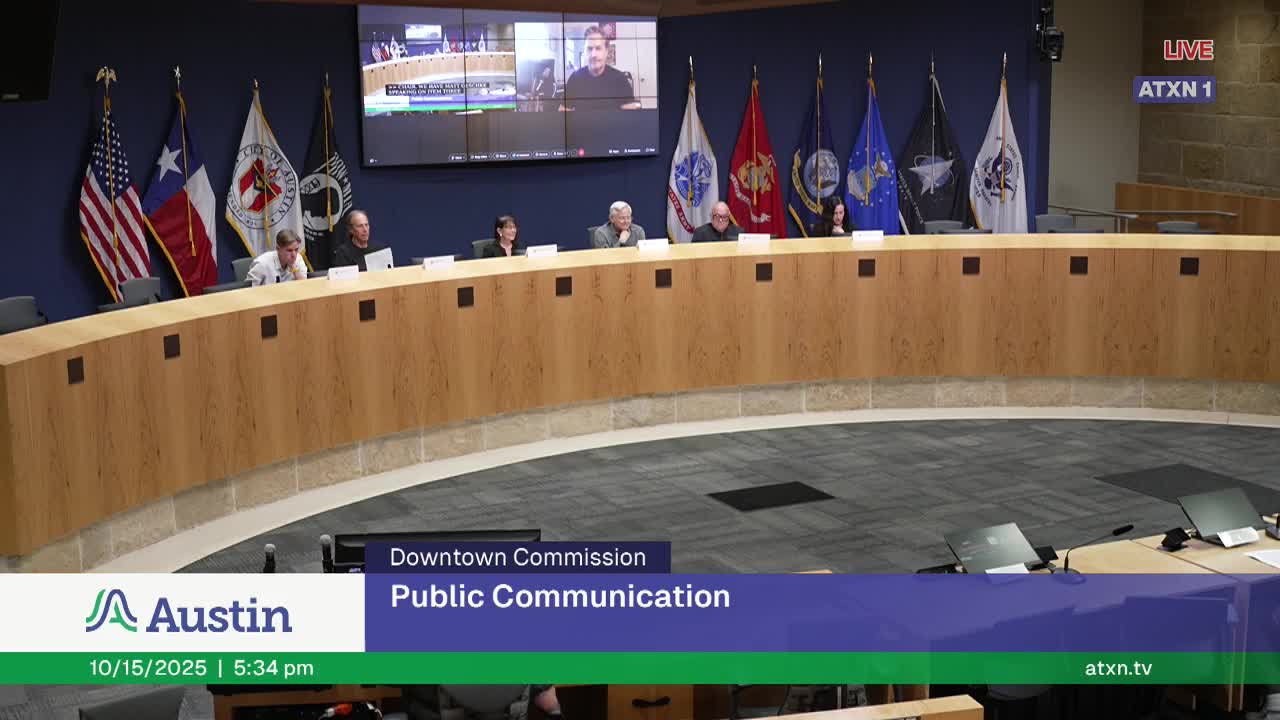
The Downtown Commission voted Oct. 15 to forward a recommendation to City Council opposing the currently proposed downtown density bonus amendment and to pursue an alternative that removes floor‑area‑ratio (FAR) and height caps in exchange for a dedicated, recurring share of incremental property tax revenue for the city’s affordable housing trust fund.
The commission’s action followed two staff briefings on State Bill 8 40 and a narrowly targeted code amendment to add a base height limit in the Central Business District (CBD). Commissioners heard a public comment from Matthew (Matt) Geske, vice president of public affairs for the Downtown Austin Alliance, who asked the commission to delay the Council vote for 120 days to allow “time to conduct a financial analysis and modeling to test the full impacts of the proposed amendment.”
City and planning staff told the commission SB 8 40, which “went into effect on September 1,” allows by‑right mixed‑use and multifamily development in many commercial zones and prevents the city from regulating FAR for qualifying residential or mixed‑use projects. Alan Pani, principal planner with Austin Planning, and Alan Pappe presented analysis showing SB 8 40 establishes minimum residential entitlements (the greater of 36 dwelling units per acre or the highest residential density already allowed, in Austin’s case 54 units per acre), sets a floor on required allowed height (the greater of 45 feet or the site’s existing nonresidential height), and limits setbacks to the lesser of 25 feet or the current nonresidential setback.
Staff described how those changes reduce the distinctiveness and attractiveness of voluntary downtown density bonuses that previously required added community benefits in exchange for additional FAR or height. Pappe said the downtown density bonus historically produced the city’s “highest density and heights” and the greatest fees‑in‑lieu for affordable housing; with FAR limits removed for qualifying projects, staff said CBD parcels could have effectively unlimited FAR, which in turn would reduce participation in the bonus program and could shrink the fee revenue used for affordable housing and public realm improvements.
To…
Already have an account? Log in
Subscribe to keep reading
Unlock the rest of this article — and every article on Citizen Portal.
- Unlimited articles
- AI-powered breakdowns of topics, speakers, decisions, and budgets
- Instant alerts when your location has a new meeting
- Follow topics and more locations
- 1,000 AI Insights / month, plus AI Chat