Spokane County seeks continued Aquifer Protection funding for school field‑trip programs
October 01, 2025 | Spokane County, Washington
This article was created by AI summarizing key points discussed. AI makes mistakes, so for full details and context, please refer to the video of the full meeting. Please report any errors so we can fix them. Report an error »
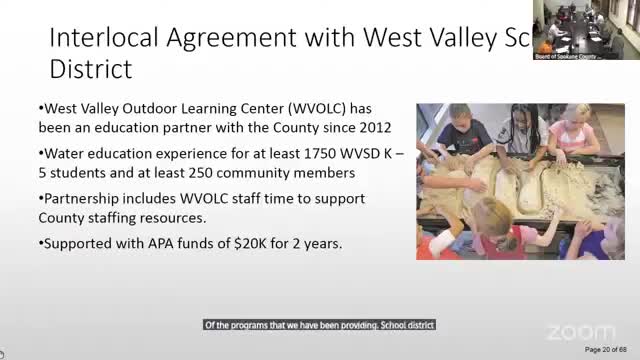
Goff said the ILAs are with West Valley School District (continuing partnership with the West Valley Outdoor Learning Center), East Valley School District (transportation support and on-site liaison for a fifth-grade wetland program) and Mead School District (restoring Bear Lake fifth-grade field trips after park construction). Goff said these ILAs together bring roughly 4,200 students to Water Resource Center programming annually and that the programs also reach hundreds of adults and chaperones.
The requested APA amounts reported to the board were $20,000 over two years for West Valley (to support programming and outreach reached about 1,750 students and 250 community members), $4,000 over two years for East Valley (for bus funding and in-district printing of student field journals and a dedicated liaison), and $5,000 for one year for Mead (to cover bus funding for Bear Lake trips while the program restarts). Goff described the Mead ILA as a one‑year commitment to ensure the program runs smoothly before a multi‑year funding decision; she said Mead will commit some district funds to meet part of the transportation estimate.
Goff framed the spending as cost‑effective outreach: she provided a per‑student APA cost figure and said the programs typically cost about $22,000 a year in total (the presentation said "about $22,000 a year per student" but clarified that figure was a spreadsheet total divided across students, and she also gave a per‑student APA share of about $5.74). Goff used an example story of a former West Valley student who later pursued environmental science to illustrate program outcomes.
Commissioners asked operational questions about staffing and long‑term partnerships. Goff said the partnership with Mead will include committed staffing from Spokane Conservation District and the Washington Department of Fish and Wildlife for Bear Lake field days. No formal vote was recorded in the briefing; staff requested board approval to proceed with the three ILAs and to return any final agreements for signature and inclusion in grant reporting.
Staff noted the programs are funded through the Aquifer Protection Area funding and emphasized the ILAs' role in county education and watershed stewardship.
View the Full Meeting & All Its Details
This article offers just a summary. Unlock complete video, transcripts, and insights as a Founder Member.
30-day money-back guarantee
Sponsors
Proudly supported by sponsors who keep Washington articles free in 2026

