
Montgomery County educators present revised student code of conduct, expand restorative practices and mandatory reintegration plans
Get AI-powered insights, summaries, and transcripts
Subscribe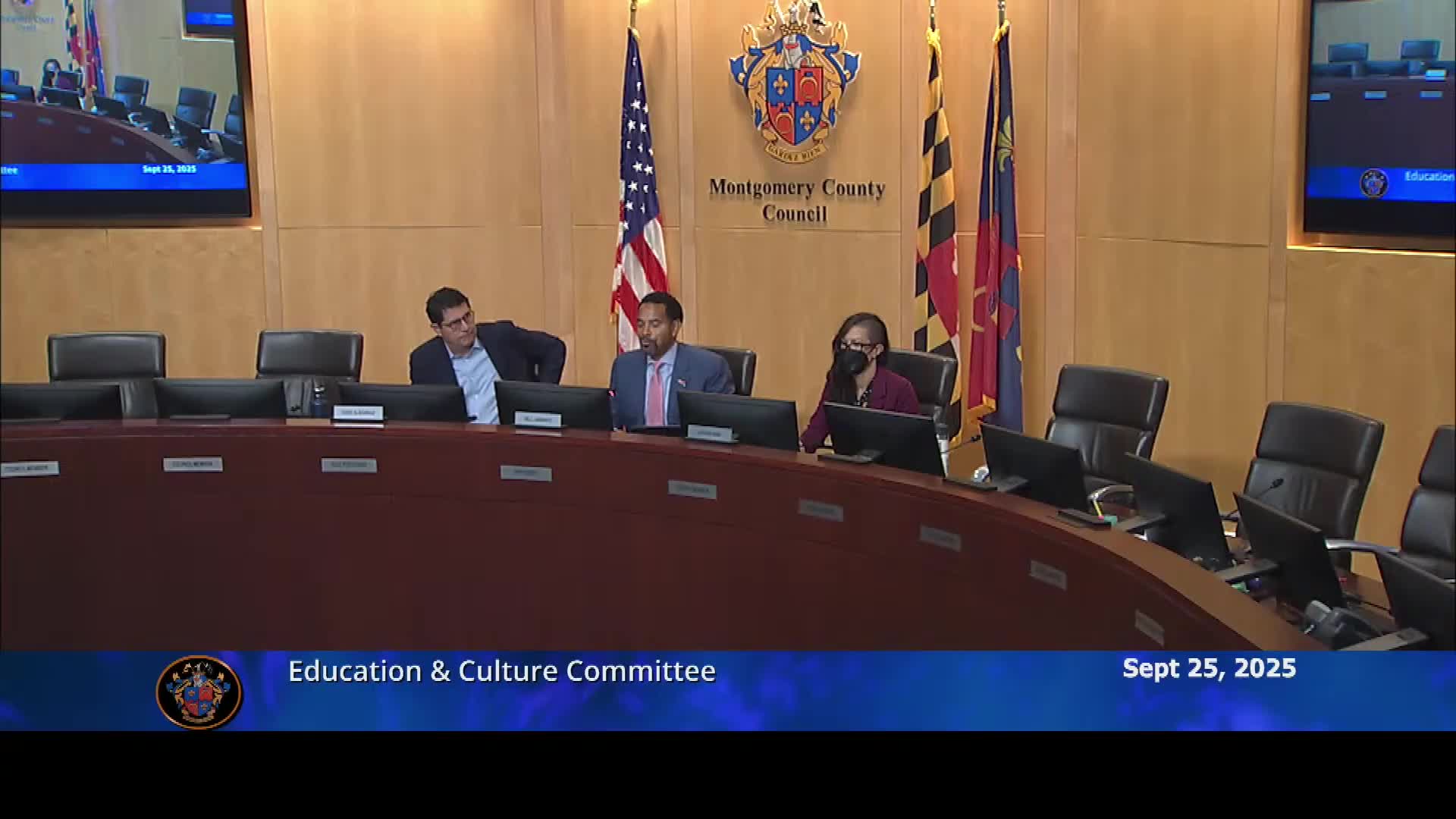
Summary
Montgomery County Public Schools briefed the County Council’s Education and Culture Committee on Sept. 25 about revisions to the Student Code of Conduct and the district’s expanding restorative justice work, including a new requirement that all schools create reintegration plans and mandatory reentry conferences after exclusionary discipline.
Montgomery County Public Schools officials briefed the Education and Culture Committee on Sept. 25 on updates to the district’s Student Code of Conduct and the expansion of restorative justice practices across the district, including a new requirement that all schools create reintegration plans and hold reentry conferences when students return from exclusionary discipline.
The presentation said the 2025–26 code narrows and clarifies behavior categories and response levels, elevates restorative approaches as the district’s primary disciplinary strategy, and explicitly mandates reintegration planning at all 211 schools. MCPS officials also described a new cell-phone regulation that requires elementary and middle school students to keep personal devices powered off and put away during the school day "bell to bell," while high school students may use devices during lunch and between classes but not during instructional time.
MCPS Chief of Schools Peter Moran told the committee the revisions are intended to make discipline more consistent across schools and to emphasize rehabilitative, educational and restorative goals. "We are teaching responsibility, repairing harm, and keeping students engaged in their education," Moran said.
Why it matters: MCPS officials said the changes are intended to reduce exclusions and instructional loss while keeping safety central. The district presented multi-year rubric results it said show growth in restorative practice implementation: 3% of schools rated "reactive," 30.5% as "early implementers," 58% as "intermediate," and 8.5% as "mature." MCPS framed reintegration plans and required reentry conferences as a corrective step aimed at welcoming students back and minimizing lost instructional time.
Key details and implementation steps - Reintegration plans and reentry conferences: The revised code requires these plans districtwide; MCPS said they are mandatory and tied to the disciplinary matrix. - Restorative scaling and supports: The central office will shift support so school-based restorative approaches (RA) coaches are supported by professional learning specialists aligned to school clusters. The district will continue stipends for RA coaches for the 2025–26 year and run monthly PLC meetings for new coaches and quarterly meetings for returning coaches. - Professional development: MCPS reported principals and assistant principals received training in June and August on the revised code, fact-finding, mandatory intake after suspension, and scenario-based application of restorative practices. - Data monitoring: MCPS staff said the district now receives weekly suspension data and reviews disproportionality each Monday, and that central staff deploy professional learning specialists when elevated numbers or disparities appear. - Cell-phone regulation: For elementary and middle schools devices must be off and stored during the school day; high school students may use devices at lunch and between classes; misuse consequences are tiered with restorative options for lower tiers and exclusionary discipline reserved for serious technology violations in grades 6–12.
On-the-ground example: Forest Oak Middle School Forest Oak Middle School Principal Dr. Dacia Sewell described on-site implementation, saying restorative practices at her school have become part of the daily routine. She reported that the raw number of students suspended fell — she cited a decline from approximately 112 incidents in the year she arrived (March 2023) to 18 incidents by the end of the last year, and she said the school’s suspension rate declined from 7.9% in 2023 to 1.7% in 2025. "You can't restore something you didn't build in the first place," Sewell said, describing daily relationship-building, in-school interventions that allow students to keep up with schoolwork, and team-level restorative leads.
Equity, data and outstanding questions Committee members repeatedly pressed MCPS on racial disparities and consistency across the district. Councilmember Mink and others asked how discretionary or aggravating criteria — such as prior misconduct and disruption — will be applied without baking-in disproportionality. MCPS officials said they review data weekly, deploy targeted supports where disparities appear, and plan principal-to-principal professional learning so schools at more advanced restorative stages can mentor other schools.
Translation and outreach: MCPS said the revised code was sent into translation last week and copies in multiple languages should be released by the end of the month; the district acknowledged the public-facing English-only publication was not ideal and cited technical issues found during review as the reason for the delay. MCPS staff said they will expand outreach, including in-person opportunities for families to complete climate surveys.
Security staff training and searches Committee members raised questions about how security staff were trained on the revised code. MCPS said security personnel received preservice training on key code components — including criteria around attacks on staff, weapons and incident response — but that security staff do not make disciplinary decisions; principals do. On searches, committee members asked whether routine searches are used in alternative and special education schools. An MCPS official said such searches have been "utilized," and that the district is reviewing the practice to ensure compliance with board and state regulations.
Climate survey and other monitoring MCPS reported the district will administer its climate survey in November and again in April to produce multiple data points during the school year rather than a single end-of-year snapshot. Officials said response rates for the recent survey were lower than desired: roughly 44% for students (goal 80–90%), about 51–52% for staff (goal 70%), and about 5% for families (goal 40–50%). MCPS said it will take steps to raise participation, including in-person collection at school and community meetings and language interpretation assistance.
Hate-bias incidents and external coordination Dr. Norman Cohen, director of student conduct and appeals, told the committee his office coaches schools on hate-bias incidents using a tiered system and works with Montgomery County Police Department units on serious cases. He said hate-bias incidents were trending downward and that his office provides daily response support to schools.
What the committee did: closed-session vote Before the open discussion, the Education and Culture Committee voted unanimously to go into a closed session to discuss public security planning and to consult with counsel under Maryland Code, General Provisions Article §3-305(b)(10)(i)–(ii) and §3-305(b)(6). The motion was moved by Councilmember Mank; the second was not recorded by name in the transcript. The committee reconvened in open session to hear the code and restorative practice briefing.
Outlook and follow-up MCPS officials told council members they will return with disaggregated implementation data (including by race and by students receiving special services), and members requested regular quarter-by-quarter briefings on low-level disciplinary infractions as well as suspensions, absenteeism, and academic outcomes tied to the code changes. Officials also said they will report back about the review of student-search practices at alternative and special schools and will accelerate translation and family outreach for the new code.
Ending: The committee closed the meeting after the briefing and questions, with members signaling a desire for continued reporting on implementation, equity metrics and the district’s efforts to standardize practice across its 211 schools.