
Sheriff’s office presents $21 million in budgets; commissioners press on $800,000 overtime line
Get AI-powered insights, summaries, and transcripts
Subscribe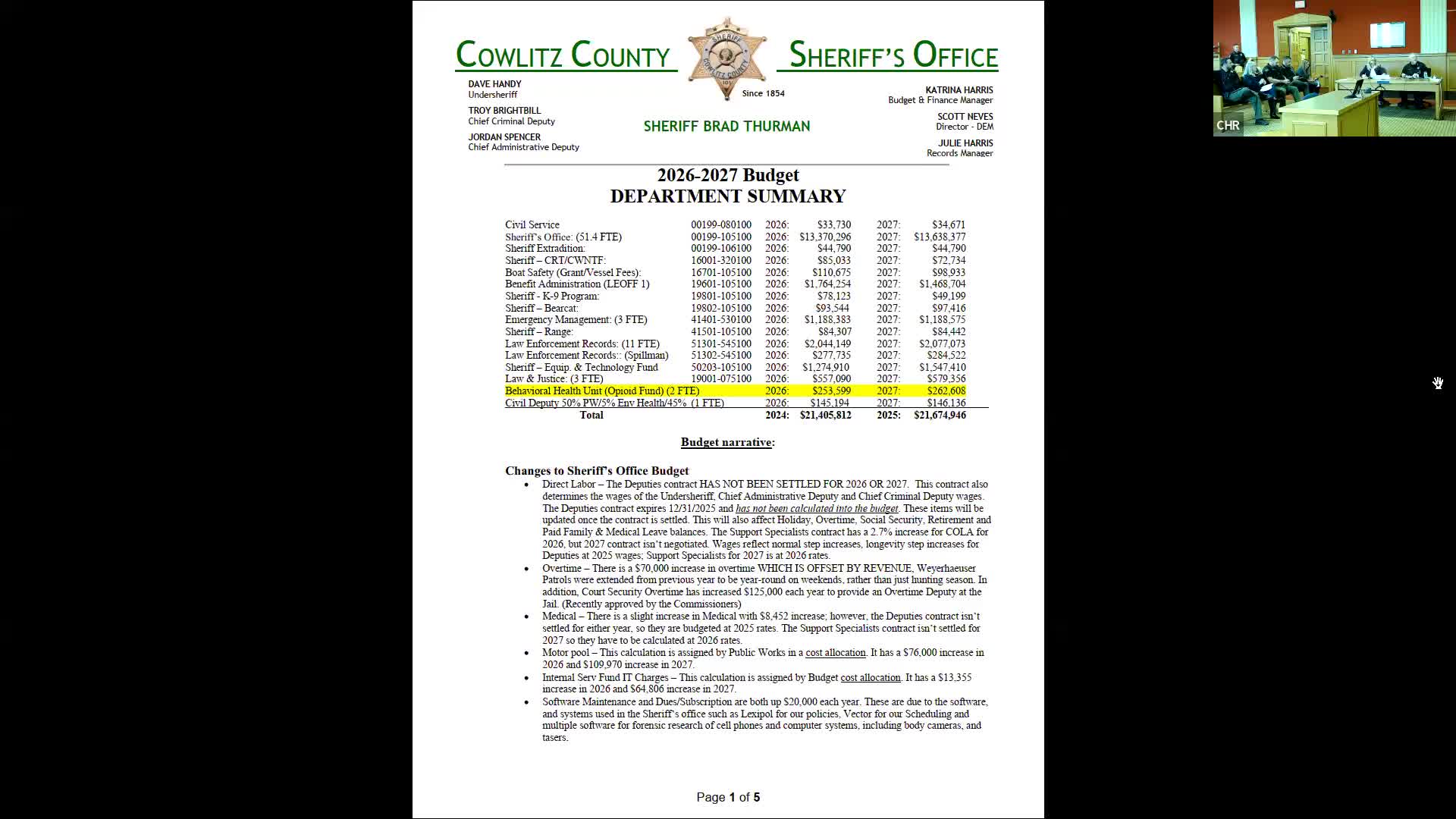
Summary
Cowlitz County finance and sheriff’s office staff outlined 14 sheriff-related budgets totaling about $21 million and defended large overtime and cost-allocation increases; commissioners pressed for analysis on when hiring additional deputies would be more cost-effective than sustained overtime.
County finance staff and sheriff’s office leadership presented detailed budgets for 14 sheriff-related funds totaling roughly $21 million for 2026–27 and laid out major cost drivers including overtime, interfund cost allocations and several reimbursable contracts.
Why it matters: The sheriff’s budgets encompass patrol, court security, grant-funded units, animal control and multiple special funds. Large overtime lines and rising IT, motor pool and facilities cost allocations increase pressure on general-fund and special-fund resources and were the subject of sustained commissioner questioning.
Brad Thurman, the county finance and budget manager, said the combined sheriff-related budgets include regular patrol, the crime-reduction team, boat-safety grants, a benefit-administration fund for retirees, K-9 donations, the BearCat vehicle bond and a planned sheriff equipment and technology fund. He reported 14 budgets with an aggregate total near $21 million, and said some funds are reimbursable or grant-backed.
Katrina Harris and Katrina Funk Baxter (county finance) walked commissioners through notable figures: a Weyerhaeuser contract that reimburses overtime and motor-pool costs (about $215,000 in reimbursable overtime historically), a year-round warehouse/patrol contract, an estimated $110,000 for boat-safety patrols (overtime-based and reimbursed through a state grant), and roughly $100,000 expected from concealed-pistol and fingerprint revenues. The presentation listed roughly $2 million in non-general revenues projected to offset some costs.
Commissioners focused on overtime. A headline line in the workshop documents budgeted approximately $764,000 in sheriff overtime for 2026 (separate from a $225,000 court-security overtime line); presenters later clarified that about $215,000–$285,000 of the overtime budget is reimbursable through contracts with Weyerhaeuser and Pacific Corp, leaving approximately $375,000 budgeted for patrol overtime that is not contract-reimbursed.
Commissioner Farrell asked whether it would be more cost-effective to hire additional full-time deputies rather than budgeting large overtime amounts. Deputy chiefs and commanders explained that hiring more deputies carries upfront vehicle and training costs and that hiring and training can take 12–24 months; they also emphasized the unpredictability of overtime needs for major incidents, leaves and staffing shortages. Chief deputy Troy Wrightville said, “A lot of these are unpredictable costs. ... It can be very long hours,” describing major cases and minimum-staffing requirements that drive overtime.
Presenters also described rising county cost allocations that affect sheriff budgets: motor-pool allocations increased by tens of thousands, IT allocations rose (forecast increases of $13,300 in 2026 and about $64,806 in 2027), and facilities/janitorial allocations rose materially after a recalculation of building charges. The sheriff’s team proposed creating and funding a new “sheriff’s equipment and technology” fund with transfers of $330,000 per year to centralize reserves for radios, body cameras, vehicle-mounted cameras and other platforms; budget documents show the fund target expanding to $1.2 million in 2026 and $1.5 million by 2027.
Other points presented: - The county maintains a benefit-administration fund for sheriff retirees (11 members remain) supported by a $300,000 general-fund transfer. - K-9 costs are funded by donations and a $15,000 annual transfer from the sheriff’s budget; a new dog and training recently cost nearly $20,000. - The BearCat armored vehicle is on a 10‑year bond; maintenance and quarterly payments are shared among participating cities.
No formal vote was taken. Commissioners asked staff to provide a tighter, data-driven analysis of how additional straight-time FTEs would change overtime spending and to continue work on the proposed new technology/equipment fund and pending personnel workshop items (including whether two behavioral-health unit positions can be funded by opioid settlement funds).