Get Full Government Meeting Transcripts, Videos, & Alerts Forever!
Get email alerts on the Veterans Services topic
No spam. Unsubscribe anytime.
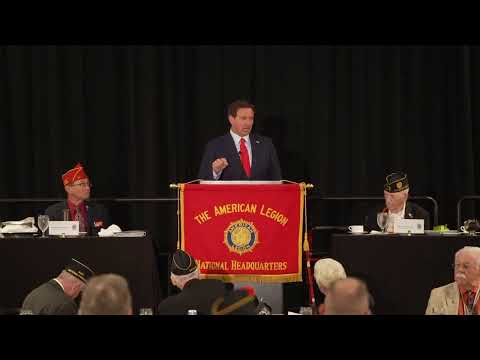
Gov. Ron DeSantis highlights veteran services and 'Hope Florida' model at American Legion event
Summary
Gov. Ron DeSantis told American Legion attendees that Florida has expanded services for veterans through interagency coordination and a community-linked 'Hope Florida' care portal, and he credited the state's rapid disaster response and rescue missions overseas as evidence of that approach.
Gov. Ron DeSantis, speaking at an American Legion event in Tampa, said Florida has expanded services for veterans by linking state agencies with community groups through a care-portal model he calls "Hope Florida." He described the approach as a way to reduce bureaucratic barriers and connect veterans to services including mental-health clinics, employment opportunities, legal help and service-dog programs.
The governor said the system funnels needs submitted at state offices to a network of churches, charities, businesses and veterans groups that volunteer help. "When someone goes in for assistance, their needs are put into what we call a care portal," DeSantis said. He said the model has been used to reduce long-term reliance on means-tested welfare and to deliver targeted help to veterans at different life stages.
DeSantis cited broader results he attributed to the model and related reforms, saying Florida has saved taxpayers "over a $100,000,000" and helped "over 30,000 people off of means tested welfare." He framed the approach as using non-governmental resources to supplement agency services and as an alternative to "punishing bureaucracy" veterans sometimes encounter at federal Veterans Affairs offices.
The governor described specific programs for veterans, including expedited teacher-certification pathways for veterans to enter classrooms, specialized mental-health clinics, expanded homelessness assistance and donated service-dog programs. He said those services are provided across state agencies and by external partners rather than by a single state office.
DeSantis also connected the veteran-support model to Florida's emergency response operations. He highlighted rapid restoration of power after major hurricanes and cited the state's decision to stage tens of thousands of linemen before storms as planning that reduced outage durations. He described rapid bridge repairs after Hurricane Ian, saying the state reopened access to Pine Island and reconnected the Sanibel Causeway faster than originally scheduled.
The governor credited Lieutenant Governor Jay Collins's personal history of service and disaster response, and he introduced Collins to speak. Collins, a retired Green Beret and the state's lieutenant governor, urged veterans to use their voices in public life and stressed that "Quiet and silent aren't the same thing," encouraging veterans to share their experiences.
DeSantis also noted Florida's recent initiatives to promote civic education and the state's plan to mark the nation's 250th anniversary with additional commemorations. He framed those efforts as part of a broader emphasis on civic knowledge for young people, and he listed multiple veterans-focused priorities he said the state has emphasized, such as education, workforce entry, mental health care and homelessness assistance.
No formal actions or votes were recorded in the transcript excerpt provided. The remarks were delivered as a speech and introduction at an American Legion gathering, and much of the content described programs, results claimed by the governor, and appeals for community involvement rather than announcing new legislation or adopted policies.