
Augusta asks state for help as corrections facility rebuild estimate rises to $22 million
Get AI-powered insights, summaries, and transcripts
Subscribe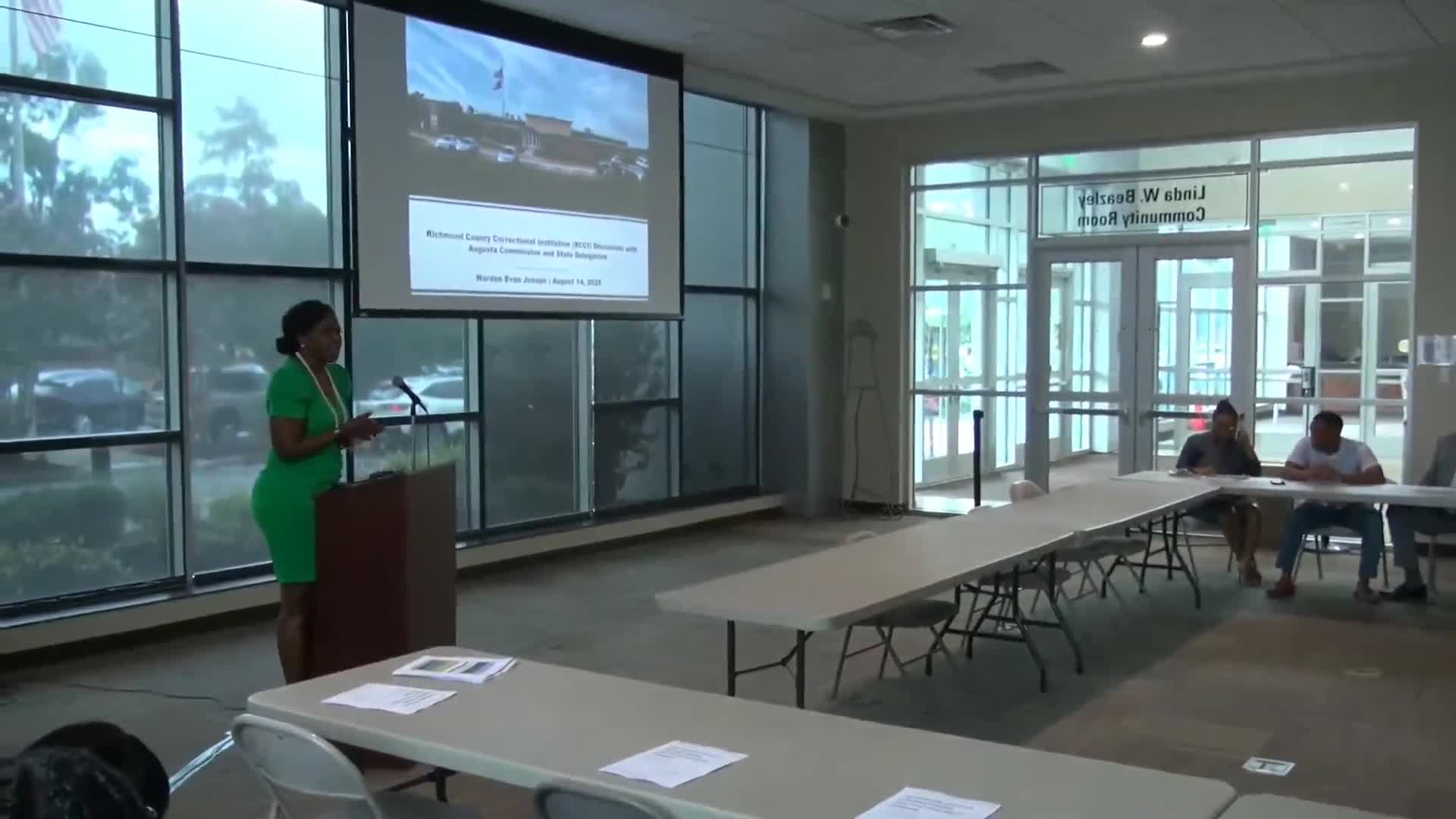
Summary
Augusta and Richmond County officials met with members of the local state legislative delegation to request state assistance for major capital work at the Richmond County Correctional Institute (RCCI), including a potential new facility after engineering and design updates pushed the estimated cost to roughly $22 million.
Augusta and Richmond County officials met with members of the local state legislative delegation to request state assistance for major capital work at the Richmond County Correctional Institute (RCCI), including a potential new facility after engineering and design updates pushed the estimated cost to roughly $22 million.
The meeting, convened by Augusta city and county leadership with representatives from the state delegation, centered on the facility’s aging infrastructure, a 2017 assessment that identified at least $4,000,000 in needed electrical and plumbing work, and a more recent design estimate that nearly doubled earlier cost projections. Officials said the city secured $11,000,000 in SPLOST 8 funding after initially requesting $15,000,000 but that inflation and updated design scope have increased the total projected cost to about $22,000,000.
The issue matters to local and state officials because RCCI houses state-sentenced, male inmates under a contract with the Georgia Department of Corrections and provides a labor force that city departments rely on for maintenance and other services. Warden Joseph, who led RCCI’s presentation to the delegation, said the jail is an older facility (in use since 1963), is funded for 80 staff positions (73 full-time), has a physical capacity of about 350 but holds 230 beds under its state contract, and was operating near a 225-inmate census on the day discussed. Warden Joseph said, “We are now at $30 a day per inmate,” when describing the current state reimbursement rate.
Officials described recurring infrastructure problems: collapsing non‑PVC pipes, frequent plumbing failures, leaks, lack of insulation, a failing boiler room and kitchen systems, and roofing and HVAC needs. The 2017 assessment covered electrical and plumbing only and estimated costs in excess of $4,000,000 for those systems alone; replacing buried utility piping and related work was described as “hundreds of thousands of dollars” in individual repair areas. Design-team cost updates and inflation account for the jump from the SPLOST-funded $11,000,000 figure to an estimated $22,000,000 to fully rebuild or meet the modernized design scope.
State lawmakers at the meeting urged staff to pursue multiple avenues rather than a single request. One legislator noted that last year’s high‑profile state budget initiative (House Bill 67) that allocated about $600 million was directed to state-owned facilities and did not provide capital funds for locally run county jails; officials said any request for local facility capital would require a separate line item or a different grant. Delegation members also recommended the county work with lobbyists and state Department of Corrections staff to identify programmatic grants (for workforce development or operational programs) and any infrastructure or corrections-specific capital grants that might be available.
City and county leaders said RCCI’s operations provide measurable savings to municipal departments through inmate labor: mowing, light construction, cemetery and ditch work, interior moves and similar tasks. Officials and commissioners asked for a clearer cost‑benefit analysis to compare the current RCCI labor model with outsourcing those services to contractors or hiring additional city staff. Finance staff provided an operating figure for RCCI of about $5.7 million annually, with roughly $3.7 million paid by the state and about $2.0 million covered locally, and officials committed to delivering a more detailed one- to five-year cost comparison.
Asked about next steps, staff and delegates requested that Augusta and Richmond County send the original facility design package and the updated cost breakdown (square-foot cost, line-item estimates) so legislators and their budget staff could review the scope and timing. Delegation members also offered to coordinate a site visit so legislators and relevant state staff could inspect RCCI in person.
No formal funding commitment or vote was taken at the meeting. Officials said they will pursue several parallel actions: provide updated design and cost documents to the delegation, research eligibility and applications for Department of Corrections program and infrastructure grants, and consider using existing SPLOST funds for prioritized renovations (plumbing, electrical, roofing and HVAC) if a new‑build appropriation is not secured. City and county leaders said that if upgrades are not completed the facility could pose health and safety risks for staff and inmates and that closing the facility would be an alternative of last resort.
Officials closed the meeting with an agreement to continue collaboration and to return with more detailed budget materials for the delegation to review ahead of the next state budget cycle.