
Former mayor Hardy Davis urges committee to empower mayor, clarify lines of authority
Get AI-powered insights, summaries, and transcripts
Subscribe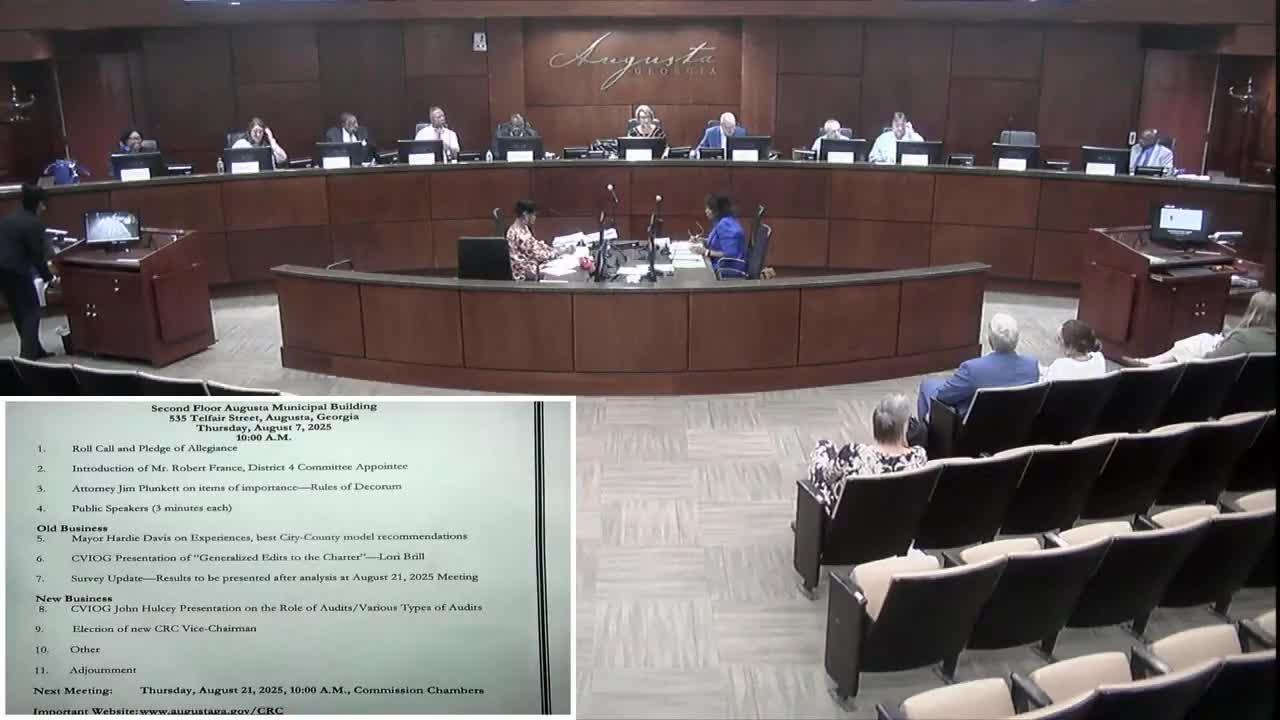
Summary
Former Augusta mayor Hardy Davis told the Charter Review Committee the central question is whether the city wants a mayor with authority; he urged clearer executive authority, accountability and protection from factional politics.
Hardy Davis, former mayor of Augusta, told the Charter Review Committee on Aug. 7 that the central question for the charter review is simple: "Does Augusta want a mayor or not?" He urged the committee to define a chief executive with authority, accountability and responsibility rather than only ceremonial powers.
Davis described the charter-review task as consequential and procedural as well as structural, saying clear lines of governance are essential so officials know "who decides, who answers and who acts." He said that when executive authority is unclear, "blurred governance lines ... invite dysfunction, not unity, and oftentimes, chaos." He urged designing government for growth rather than fear.
Why it matters: Davis said the mayoralty has eroded since consolidation and that restoring clear executive authority does not remove the commission’s legislative role. He recommended the committee ensure the mayor has tools to lead and be held accountable, including a veto power rather than an additional vote, and said charter design should be resilient and forward-looking.
Context and examples
- Role of mayor: Davis said a strong executive should be empowered to lead policy and response in crises. He gave examples of other Georgia consolidated governments (Columbus and Athens-Clarke County) that structured strong executive roles while retaining legislative bodies.
- Race and governance: Davis cautioned against framing the debate as exclusively racial, saying the charter should represent a future-oriented governance structure and avoid being frozen in the "racial politics of the nineties." He urged inclusiveness and competence across the city.
- Practical governance: Davis recalled calling commissioners together in March 2020 during the COVID-19 pandemic to make rapid decisions; he used that example to argue the city needs a named leader who can act in emergency situations.
Q&A
A committee member identified as the gentleman from District 1 asked whether the mayor should retain a vote on the commission versus a veto. Davis replied that the current charter provides the mayor a vote but that "if there's an executive branch of government" then a veto may be a more important power than a vote. He also said that the commission already has tools (including the ability to make changes with an eight-vote supermajority) and that the issue is often how elected officials use those tools.
Next steps
Davis recommended the committee focus on defining authorities, responsibilities and accountability in the charter so that future officeholders — regardless of race or political affiliation — have clear lines to lead, be held responsible and enable government that can adapt over the next 10 to 20 years.