
Charter review committee hears audit rules, single-audit requirements and case for internal audit function
Get AI-powered insights, summaries, and transcripts
Subscribe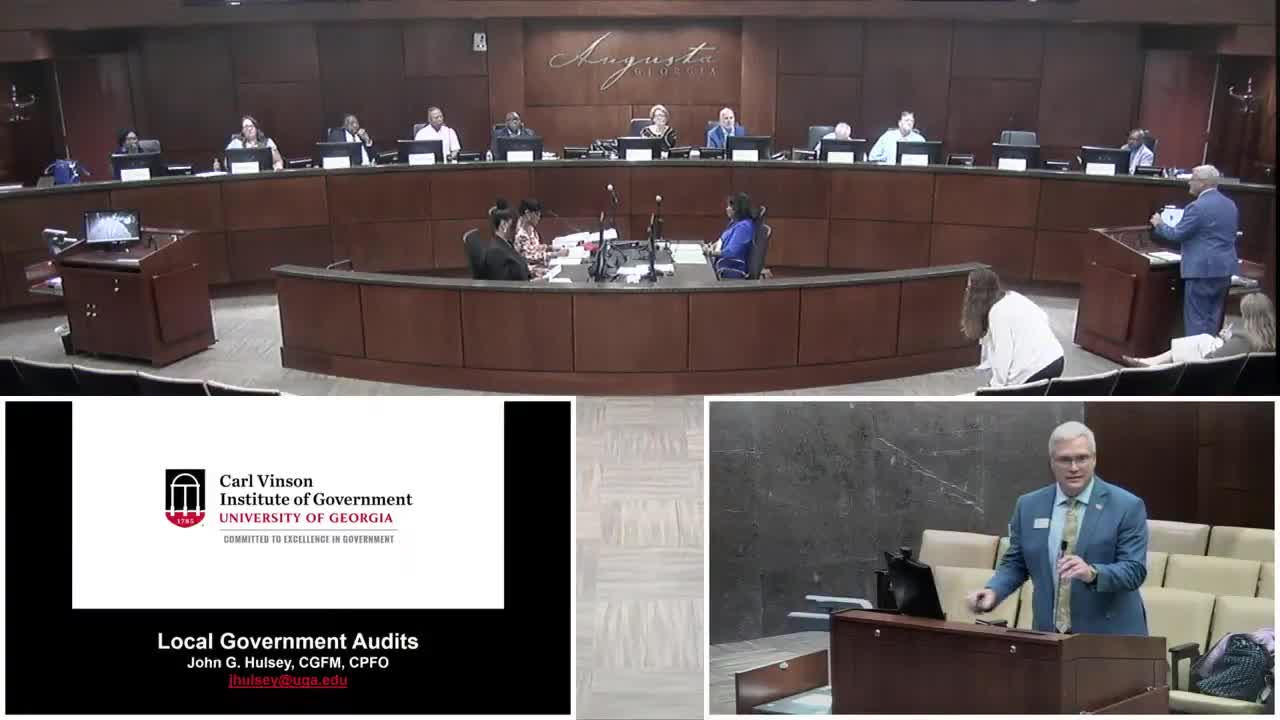
Summary
John Halsey of the Carl Vinson Institute told the Charter Review Committee that Augusta must meet Georgia audit law, prepare audited financial statements annually and consider an internal audit function and audit committee to strengthen controls and detect risk earlier.
John Halsey, a financial-management instructor with the Carl Vinson Institute of Government, told the Augusta City Charter Review Committee on Aug. 7 that the city must follow state and federal auditing rules and that the annual financial statement audit is a tool — not a substitute — for ongoing internal control and risk management.
Halsey outlined audit requirements in Georgia law and federal rules, including the ‘‘yellow book’’ Government Auditing Standards and the single-audit rules in 2 C.F.R. part 200. He said Augusta meets the thresholds that require an annual external audit and, when federal expenditures exceed $1 million, a single audit with additional compliance testing.
The presentation explained audit mechanics and timing: management prepares financial statements, an independent certified public accountant issues an opinion after fieldwork, and the completed report must be filed with the Georgia Department of Audits and Accounts within 180 days of the fiscal-year end. Halsey said, "everything starts with the budget, but it ends with the audit," emphasizing the audit's role in stakeholders’ confidence in financial reporting.
Why it matters: Committee members raised accountability and public-trust concerns after recent federal grant issues reported publicly. Halsey recommended strengthening internal controls and said the independent financial-statement audit cannot, by itself, eliminate fraud or serve as continuous monitoring.
Key points from the presentation and Q&A
- Scope and standards: Halsey noted external audits are performed under generally accepted government auditing standards and that auditors must be yellow-book qualified. He said auditors perform tests of samples, not every transaction, and may report internal-control deficiencies as findings that require corrective action plans.
- Single-audit rules: When federal funds expended exceed $1 million annually, a single audit is required. That audit combines financial-statement work with federal compliance testing and uses a risk-based sampling approach to select which federal programs are audited.
- Internal audit and audit committee: Halsey recommended that Augusta consider reestablishing an internal audit function or, at minimum, an audit committee. He said an internal audit office or contracted internal-audit services can provide continuous monitoring, vulnerability assessments (for example, IT security reviews), program or performance audits, and earlier detection of control breakdowns. Halsey said the Government Finance Officers Association lists an internal audit function as a best practice regardless of government size.
- Use of audits for accountability: Committee members cited community concerns over returned federal funds and other questions about program oversight. Halsey said a proactive internal audit program can test controls before problems surface, while the annual external audit tends to be retrospective.
Discussion highlights and follow-ups
- Committee members asked about whistleblower channels and whether a revived internal-audit function would report to an audit committee rather than directly to the city administrator. Halsey recommended that internal auditors have administrative ties for budget/personnel purposes but direct reporting lines to an audit committee for programmatic independence.
- Several members asked whether an internal audit could have detected recent federal-grant issues. Halsey answered that detection depends on the specifics of the case and the nature of the control breakdowns; he recommended targeted performance or forensic reviews when circumstances suggest program-level problems.
- Halsey noted that Augusta’s 2023 audited financial statements were publicly available and carried an unmodified opinion but said the 2024 audit files were not yet posted at the time of his remarks.
Next steps and context
Halsey suggested the committee consider charter language that preserves statutory audit requirements and gives the governing authority tools to require an internal audit function, an audit committee, and clearer audit-reporting responsibilities. Several committee members indicated they would take the recommendation to the finance subcommittee for further discussion and to consider language for the draft charter.