
Council affirms hearing officer's recommended order in zoning nonconforming-use appeal; denies request for oral argument
Get AI-powered insights, summaries, and transcripts
Subscribe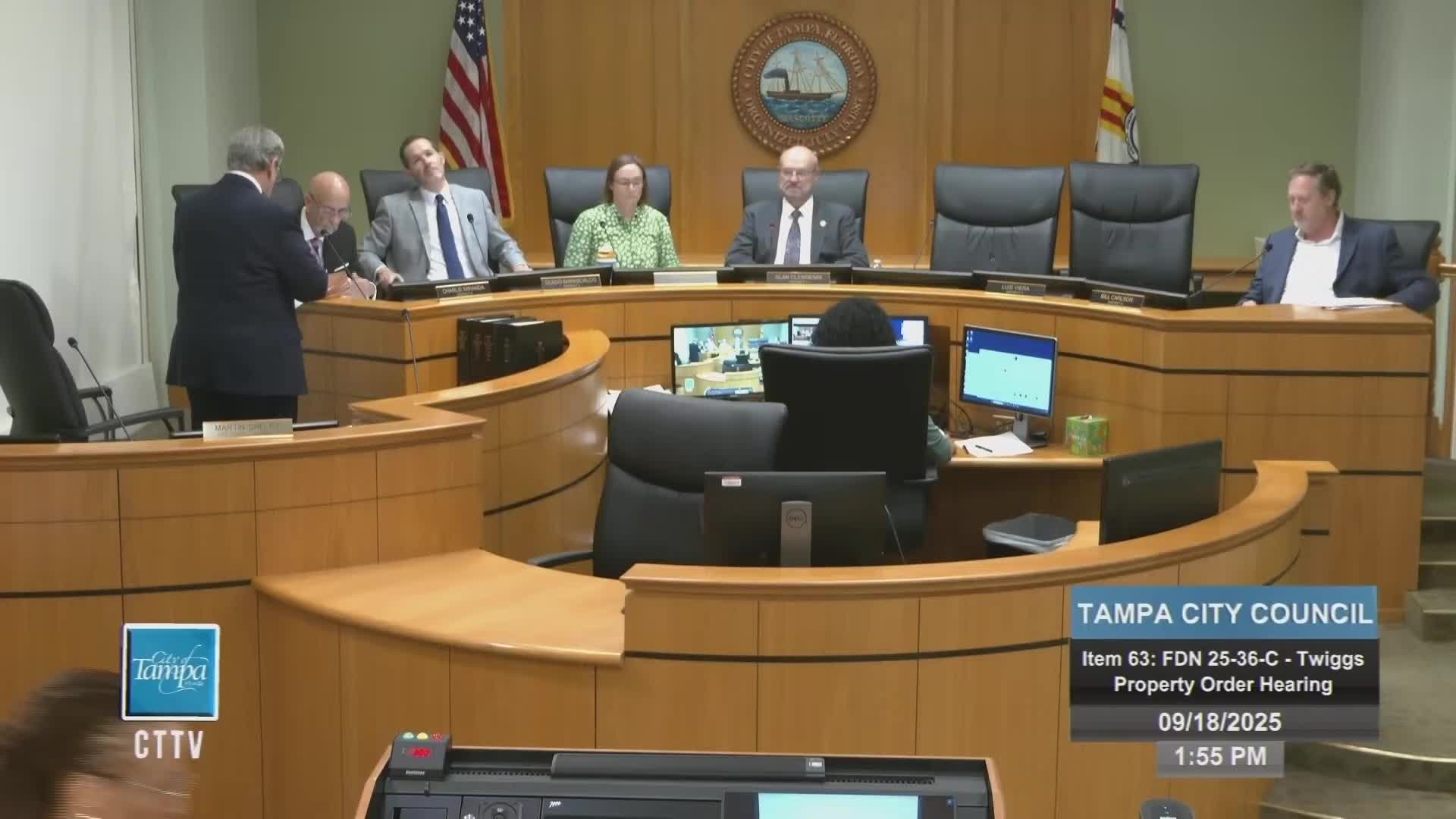
Summary
City Council considered exceptions to a hearing officer's recommended order in file FDN2536 under City of Tampa Code section 27-61, denied a request for oral argument, and voted to adopt the recommended order as final with one member voting no.
City Council voted to adopt the hearing officer's recommended order in a zoning appeal (file FDN2536) after considering exceptions filed by the petitioner and denying a request for oral argument.
Kamaria Pettisnacko, a city attorney in the legal department, summarized City of Tampa Code section 27-61 and told council the body may adopt, modify or reject a hearing officer's recommended order but may not change findings of fact without remanding for additional fact finding. Pettisnacko told council the options available under the code and the narrow circumstances under which the council may permit oral argument.
Martin Shelby, city council attorney, distributed the exceptions filed by the petitioner and the request for oral argument and told council he could not recommend the oral-argument request met the code's criteria. Shelby reiterated that council may only open for oral argument if it finds the hearing officer omitted consideration of a matter introduced into the record or if the recommended order contains an ambiguity; if council allows oral argument, its scope must be limited to those items and no new evidence may be introduced.
Council considered whether the record lacked relevant factual detail about historical zoning and nonconforming use. Councilman Carlson said concerns remained about whether prior zoning changes in 1984 and subsequent grandfathering requests were reflected in the record. Council attorneys noted portions of the petitioner's objections and the hearing officer's findings addressed those issues and that council's authority is limited to the record and the recommended order.
Councilman Escalco moved, seconded by Councilman Miranda, to deny the request for oral argument. The motion passed unanimously.
Councilwoman Hertek moved to accept (affirm) the hearing officer's recommended order and deny the petition for review; Councilman Maniscalco seconded. The roll call vote to affirm the recommended order carried with Councilwoman Carlson voting no and the remaining voting members in favor. City attorneys advised the final order will be transmitted to parties and nonparty participants, and that the council's final order may be appealed to a court of competent jurisdiction.
After the vote, counsel for the petitioners, Jane Graham, objected on due-process grounds, saying parties had limited time to review materials. The objection was noted for the record.