Get Full Government Meeting Transcripts, Videos, & Alerts Forever!
Get email alerts on the Solid Waste Management topic
No spam. Unsubscribe anytime.
Landfill staff report higher tonnage, improved airspace efficiency and urge careful approach to tipping‑fee changes
Summary
Landfill management reported daily tonnage increases and a sizeable surplus in 2024; staff highlighted operational improvements that extended landfill life and advised caution about raising tipping fees for neighboring jurisdictions to avoid losing commercial volume.
City solid-waste and landfill staff briefed the Engineering Committee on the financial and operational status of the Augusta-Richmond County Landfill, including tonnage trends, remaining airspace estimates and options for addressing outside haulers.
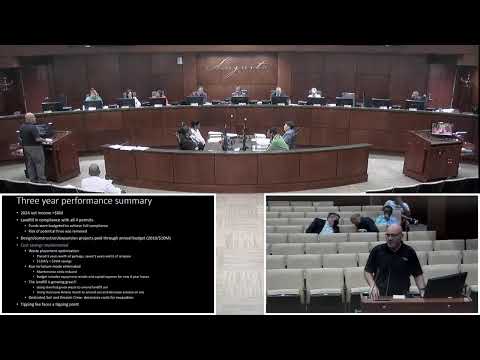
Staff said daily municipal waste tonnage has increased from about 800 tons per day (2010-era baseline) to about 1,800 tons per day currently. The landfill's Phase 3 was designed with a projected 100‑year life; a recent capacity estimate placed the remaining life at roughly 93 years. Staff credited improved placement practices for extending usable airspace, noting the city has realized operational efficiencies that have the effect of conserving volume and deferring capital costs.
Landfill staff reported about $6 million in positive operating results at year-end 2024; however, staff noted part of that figure included debris-management receipts and special hurricane-related activity. Staff described capital investments paid in cash over the last three years and a current lease-to-own equipment plan to reduce maintenance costs going forward.
Commissioners asked whether the city could impose a surcharge on waste hauled into the landfill from outside Augusta-Richmond County — in particular haulers originating in neighboring counties — to better align the cost burden with users of the facility. Staff cautioned that neighboring haulers and waste-management companies could redirect material to other landfills or establish transfer stations if regional tipping fees diverged materially, which could reduce revenue and not necessarily prolong airspace on net. Staff also noted limitations in scale measurement to identify a load's county of origin when private haulers service multiple jurisdictions.
Operational changes staff highlighted included dedicating crews to soil and erosion control, beneficial reuse of hurricane-origin mulch as a slope amendment instead of trucking topsoil, and better maintenance programs to reduce equipment downtime and longer-term costs. These practices, combined with careful placement, explained how the landfill could both accept more tonnage and still preserve expected life.
Staff said nonprofit haulers account for a small share (about 6.2%) of incoming tonnage; a hypothetical 10% surcharge on that segment would yield modest additional revenue (staff estimated roughly $46,000) and would not materially change overall capacity estimates.
The committee asked staff to return with more detail on unit operating cost per ton and historic net position for prior years so commissioners can evaluate options to align user charges with costs and potential policy changes affecting outside haulers.