Get Full Government Meeting Transcripts, Videos, & Alerts Forever!
Get email alerts on the Municipal Budget topic
No spam. Unsubscribe anytime.
Finance director reports $65M in Helena recovery spending; commission debates 2026 budget strategy after community survey
Summary
City finance staff reported $65 million spent on Hurricane Helena recovery and identified $7 million in over-budget employee health care and related concerns. Commissioners reviewed a 771‑response community budget survey and began a budget strategy discussion including modeled cuts and NGO funding review.
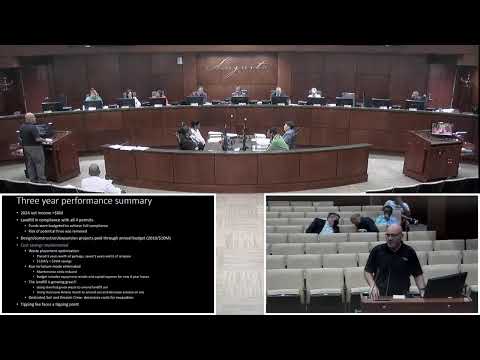
City finance staff presented the June 30, 2025 financial reports and used the quarterly update to frame the commission's early budget discussions for 2026, while staff and commissioners also reviewed results from a recent community budget survey and a standing list of nongovernmental organization (NGO) funding.
Finance director Tim Schreier told the Finance Committee the city had spent about $65 million on Hurricane Helena recovery as of June 30 and had received roughly $35 million in FEMA proceeds. Schreier highlighted several budget pressures: employee health care costs running approximately $7 million over budget for the entire government; prisoner housing costs projected about $1 million over budget; and changes to projected salary savings (lapsed salaries) due to improved retention in some departments.
Schreier said the city held roughly $800 million in cash across funds, about $350 million of which are bond trust funds restricted to specific uses. Sales tax receipts through May trended about 9% over budget, with staff projecting a 3–4% increase for the year. The 2024 audit is on extension through Dec. 31, 2025; staff said they aim to complete it earlier. Schreier said his office will seek adjustments to make departments whole where treasury repayments reduced departmental balances.
Maddie C. Stevens from the administrator's office presented the results of a six‑week budget priority survey that received 771 responses. Survey highlights: 46% of respondents ranked public safety and the justice system as their top priority; the most-cited areas for improvement were streets and sidewalks repair (selected by 56% of respondents), law enforcement, parks and recreation, grass mowing/public areas, and economic development. Stevens cautioned that the survey is not a statistically valid random sample of the full Augusta population and noted strong, recurring write-in support for the Augusta Canal.
Commission discussion shifted to 2026 budget strategy. Administrator Allen and Finance staff asked the commission for direction on key choices: whether to consider a millage-rate increase, model across-the-board cuts, accept or decline new program requests, reduce or eliminate subsidized services (for instance transit or housing programs), and whether to continue discretionary NGO funding. Mayor Johnson asked departments to model a 10% across-the-board reduction to show options for cutting expenses without raising taxes. Several commissioners said they supported modeling cuts to better understand impacts; others emphasized protecting frontline services and legal/charter-mandated obligations.
Administrator Allen and staff provided an overview of the city's current NGO/external agency funding. Staff reported total allocations of about $7.7 million for 2025 across discretionary and multiyear contract funding: approximately $3.3 million in discretionary funding and $4.3 million in mandated or multiyear contracts. Agencies named in the provided materials included the Department of Public Health, mosquito control, recreation partners, the Augusta Canal Authority, the Augusta Public Library, the Development Authority of Augusta and others. Allen said staff has begun asking legal and finance to identify which allocations are mandated by state law or charter and which are discretionary and recommended a work session so the commission can evaluate adjustments or prioritization.
Commissioners asked staff to present modeling and hold a workshop to dig into NGO contracts, mandated obligations and the effect of different cut scenarios. The commission voted without objection to schedule a workshop on nongovernmental funding and to begin budget work sessions in September.