
Polk County board receives Central Iowa source-water assessment; board approves multiple resolutions
Get AI-powered insights, summaries, and transcripts
Subscribe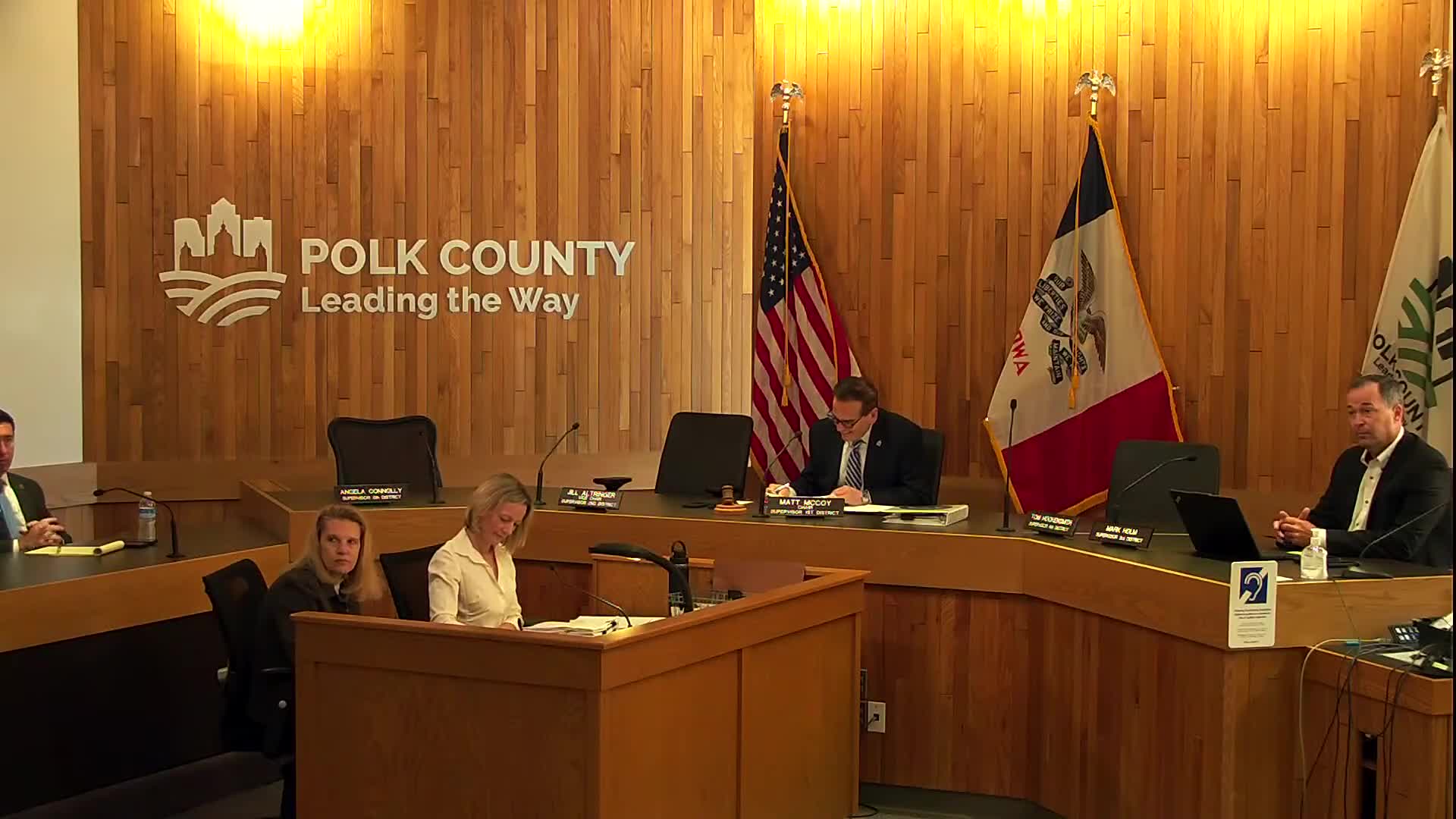
Summary
Polk County supervisors received and filed the Central Iowa Source Water Research Assessment, heard about the report from scientists and dozens of public commenters, and approved a package of routine county agreements and permits during the same meeting.
The Polk County Board of Supervisors on Tuesday received and filed the Central Iowa Source Water Research Assessment (CISWRA), a multi-part scientific review commissioned by the county, and approved a slate of routine contracts, permit renewals and project agreements.
The report — which the board said was produced by 16 scientists who contributed roughly 4,400 hours of independent review and analysis — was funded in part with American Rescue Plan Act (ARPA) dollars. Supervisors said the board did not edit the report and that it stands as presented.
Why it matters: Commenters and county staff said the report documents continued high nitrate and bacterial contamination in the Des Moines and Raccoon river watersheds and recommends watershed-scale monitoring, numeric nutrient criteria, contingency plans and broader conservation practices. County officials said the findings will inform local programs and advocacy for state and federal resources.
Public comment opened the board’s discussion. Mike Tramontina, representing the Sierra Club, told supervisors that recent mandatory drinking-water restrictions affecting about 600,000 central Iowans were caused by pollution in the Des Moines and Raccoon rivers, not a shortage of water. "It doesn't have to be this way," Tramontina said, urging broad, watershed-scale policy changes rather than small-scale demonstration projects alone.
Adam Schreiber, director of wellness and nutrition at the Harkin Institute, said policy matters for public health and offered the institute as a venue for presenting the report’s findings. "We don't have a date set yet, but we are in the process of planning for an event and would be thrilled to help bring these important findings to Polk County," Schreiber said.
Project manager Jennifer Terry, who coordinated the science team for CISWRA, told the board the assessment drew on hundreds of peer-reviewed sources and grouped findings around drinking-water security, recreation, stream flow and ecological health. "The science advisors invested almost 4,400 hours of analysis, review and discussion to produce the findings and assessment report," Terry said.
Jonathan Swanson, Polk County’s water resources supervisor, described county programs that have deployed conservation practices and monitoring. He noted Polk County’s "batch and build" and wetland wave efforts and that the county owns and operates a cover-crop seeder used across multiple counties. "We are the only county in Iowa with a full water resources division of professionals dedicated towards improving water quality and reducing flooding," Swanson said.
Several commenters urged the board to use the report to press for statewide funding and legal changes. Speakers included representatives from the Iowa Farmers Union, the Iowa Environmental Council, the Iowa chapter of the Sierra Club, the Isaac Walton League of Iowa, the Harkin Institute and the Environmental Law & Policy Center. Concerns raised by members of the public included long-term health risks from nitrate exposure, the limits of voluntary nutrient-reduction strategies, the need for numeric nutrient criteria tied to health outcomes and expanded manure-management and conservation funding.
Board response and next steps: Chair McCoy said the county will post the executive summary and technical report on the Polk County website and recommended public presentations; several supervisors asked that Jennifer Terry present the report to neighboring counties and community groups. Supervisors also noted resource constraints and said advocacy for state-level funding and implementation of voter-proposed programs would be essential.
Votes at a glance: During the same meeting the board moved a large package of permit approvals, contracts and resolutions. The board approved the majority of items by roll call; one personnel position modification was deferred and one employment agreement drew two no votes but passed.
Ending note: The CISWRA files (summary and technical report) were made available on Polk County's website after the meeting; supervisors said the report is intended to inform local programs and to support collaborative work with cities, other counties and state agencies.