Get Full Government Meeting Transcripts, Videos, & Alerts Forever!
Get email alerts on the Municipal Finance topic
No spam. Unsubscribe anytime.
Roswell council advances 4.949 millage first reading, authorizes DDA bonds and Hill Street land closing to fund downtown parking deck
Summary
At its Sept. 8 meeting, the Roswell mayor and council approved first-reading adoption of a 4.949 millage rate, authorized up to $25 million in Downtown Development Authority revenue bonds to finance the Hill Street parking deck and approved city closing for the Hill Street land exchange; all votes were unanimous.
The Roswell mayor and city council on Sept. 8 approved the first reading of a millage ordinance that sets a combined tax rate of 4.949 mills for tax year 2025, authorized the Downtown Development Authority (DDA) to issue revenue bonds of up to $25,000,000 for a planned Hill Street parking deck, and authorized city staff to close on the Hill Street land-exchange agreement that is a key step toward the project.
The actions, taken during a regularly scheduled council meeting, were unanimous where recorded. Chief Financial Officer Bill Gottschall, who presented the millage ordinance, said, "the property tax rate will not increase in 2025." The first reading of the ordinance passed 6-0; the council scheduled a required public hearing Sept. 15 at 6 p.m. and a second reading and adoption for Sept. 22.
Why it matters: the millage sets how much Roswell collects from property owners for operations and debt service; the DDA bond authorization and land-exchange closing together enable a public-private redevelopment in downtown Roswell that officials say will add parking, support mixed-use development and generate long-term revenue to offset debt service.
Most important facts
- Millage ordinance: The combined 4.949 mill rate is split into a 4.049 mills maintenance and operations component and 0.900 mills for debt service. City staff used a sample calculation showing a homeowner of a $550,000 fair-market-value property (40% assessed value = $220,000) would pay about $1,088 in city property taxes before exemptions; about $198 of that would fund debt service for the bond program.
- DDA revenue bonds: Assistant City Attorney Joseph Cusack presented a resolution approving the issuance of Downtown Development Authority revenue bonds "in an amount not to exceed $25,000,000" and an intergovernmental contract between the city and the DDA to finance the Hill Street mixed-use development parking project. Cusack described a multi-source revenue plan to service the bonds: (1) developer obligations to purchase parking spaces (staged to increase from 143 spaces in year 1 to up to 220 spaces in later years), (2) office parking commitments, (3) ground-lease revenue tied to the development, and (4) paid, public parking using a dynamic pricing model. The DDA bonds are revenue bonds (not general obligation bonds) because the project includes private components.
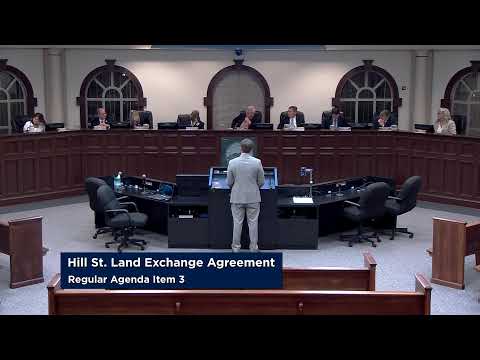
- Hill Street land exchange/closing: The council authorized the mayor or city administrator, working with the city attorney, to close on the previously approved Hill Street land-exchange agreement so the city and development partners can proceed toward an October 15 target for additional approvals and construction milestones.
Council discussion and clarifications
Council members and staff spent time clarifying how revenue will back the DDA bonds and what a city "pledge" of mills means. Joseph Cusack explained that the DDA, as a development authority, has limited assets and that state law allows a city to pledge up to 3 mills of taxing authority to help secure revenue bonds and obtain a more favorable interest rate; the pledged mills enable lower borrowing costs but Cusack and council members clarified that the project is structured so the first sources of repayment are the parking revenues and contractual payments, not a direct transfer of general-tax receipts.
Council member Alan Sells pressed for precision about the developer payments, and Cusack confirmed those take the form of recurring annual payments rather than a one-time purchase. Council members also emphasized use of scopes of work, milestones and intergovernmental agreements to keep the development on a disciplined schedule; staff said the project has progressed through multiple negotiated milestones, including a land-exchange agreement previously approved by the council.
Votes at a glance
- Approval of consent agenda: Motion made by Council Member David Johnson, seconded by Council Member Alan Sells; vote recorded 6-0 (consent agenda passed).
- Appointment of Gertaj Narang to the Planning Commission: Motion made by Mayor Pro Tem and Council Member Lee Hills; final vote recorded as 6-0 (appointment approved).
- First reading, ordinance to adopt a millage rate of 4.949 for tax year 2025: Motion to approve made by Council Member Christine Hall; seconded by Council Member David Johnson; final vote recorded 6-0 (first reading approved). Public hearing (special called) set for Sept. 15 at 6:00 p.m.; second reading and adoption scheduled for Sept. 22.
- Resolution authorizing issuance of Downtown Development Authority revenue bonds and intergovernmental contract with the DDA (Hill Street parking deck), not to exceed $25,000,000: Motion made by Council Member Alan Sells; seconded by Council Member David Johnson; vote recorded 6-0 (resolution approved).
- Resolution authorizing the mayor or city administrator with the city attorney's office to close on the Hill Street land-exchange agreement: Motion made by Council Member Alan Sells; seconded by Council Member David Johnson; vote recorded 6-0 (resolution approved).
Context and background
City staff said the combined millage rate would not increase from 2024 and 2023 levels and that the operations portion funds public safety, parks and transportation. Gottschall provided a summary of the city's property tax digest: residential property value rose from approximately $6,800,000,000 in tax year 2024 to about $6,950,000,000 in 2025, a roughly 1.4% change.
On economic development, Mayor Pro Tem Lee Hills noted broader downtown work tied to the Hill Street project. Assistant City Attorney Cusack and council members described the distinction between general obligation bonds, which are typically voter-approved and backed by taxing power, and revenue bonds issued by development authorities when projects include private components. Cusack said legal steps after the council's authorization will include verification and court processes required for issuance.
What happens next
The council will hold the required public hearing on the millage Sept. 15 at 6 p.m., then reconvene for a second reading and potential adoption of the millage ordinance Sept. 22. For the Hill Street project, staff said the next steps include completing closing documents and a planned set of approvals leading to an Oct. 15 milestone when additional documents will be brought to council.
Ending
Council members praised staff, the city attorney's office and the development team for lengthy negotiations and said they expect the Hill Street project to spur additional downtown investment. The votes taken Sept. 8 move the city closer to both setting the 2025 property-tax rate and enabling the downtown parking project to advance to construction.