Get Full Government Meeting Transcripts, Videos, & Alerts Forever!
Get email alerts on the Accessory Dwelling Units topic
No spam. Unsubscribe anytime.
Lafayette planning commission recommends ADU ordinance updates, including option for second deed‑restricted junior unit
Summary
The Planning Commission voted 4-0 to recommend the City Council adopt amendments to Lafayette’s accessory dwelling unit (ADU) ordinance to comply with state law and to add a program allowing a second junior ADU if deed‑restricted for low‑income occupancy.
The Lafayette Planning Commission voted 4-0 to recommend the City Council adopt updates to the city’s accessory dwelling unit (ADU) ordinance that staff say are required by state law and would add a new program allowing a second junior ADU if the unit is deed‑restricted for low‑ or very‑low‑income households.
The changes, presented by Sonia Rizzo, Assistant Planning Director, and Anna Toll, Assistant Planner, would bring Lafayette’s ADU code into compliance with recently amended state ADU requirements and the city’s revised draft housing element. "This is a city‑initiated zoning text amendment to update our ordinance that regulates accessory dwelling units and junior accessory dwelling units," Assistant Planner Anna Toll said during the presentation.
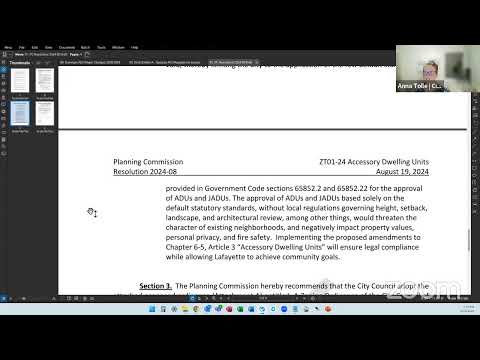
Commissioners were asked to find the ordinance exempt from CEQA, find it consistent with state law and the Lafayette General Plan as amended by the revised draft housing element (submitted to the California Department of Housing and Community Development on 05/13/2024), and to forward Resolution 2024‑08 recommending adoption to the City Council. The motion passed on a roll call vote (4‑0); one commissioner was excused.
Why it matters: Staff told commissioners that failing to update the local code to match state ADU statutes could render Lafayette’s ordinance invalid and limit the city’s ability to apply its existing objective development standards. The update aims both to ensure legal compliance and to preserve Lafayette’s ability to manage ADU development through objective rules, staff said.
Key points of the ordinance update
- State compliance and citations: Staff identified the updates as required by state law and by the revised housing element; they cited Assembly Bill 22 21 and Senate Bill 8 97 (as referenced in the staff report) as part of the legislative basis for the changes.
- Height and location rules: Existing category limits remain for Class A (detached) and Class B (converted) ADUs, while some height allowances are increased in limited circumstances to conform with state rules. Under the proposed language, detached ADUs on single‑family or multifamily lots may be allowed up to 18 feet (or up to 20 feet where added height is needed to match an existing roof pitch) if they are located within a half‑mile of a "high‑quality transit stop" (in Lafayette, staff said, only the BART station meets that definition). Attached ADUs may be allowed up to 25 feet where consistent with state code.
- Unit types and sizes: Class A ADUs remain defined as detached units up to 800 square feet and up to 16 feet tall; Class B ADUs are conversions and may include up to 150 additional square feet to provide required ingress/egress; Class C covers ADUs that do not meet A or B criteria (class C examples can include larger or attached units and remain governed by objective development standards).
- Owner occupancy and junior ADUs: Staff said the ordinance would remove the owner‑occupancy requirement for standard ADUs (consistent with state law) but would retain owner‑occupancy requirements for junior ADUs (JADUs). The new city program would allow an additional second JADU on a single‑family parcel if the second JADU is deed‑restricted to remain affordable to low or very low‑income households for a fixed term (staff identified 5 or 10 years in the revised housing element as the policy options presented to encourage uptake).
- Deed‑restriction verification and enforcement: Staff said the city would verify income eligibility using approaches similar to current below‑market‑rate unit verification (income limits published annually by the state, household size considerations, and review of income documentation such as tax filings and account information). Staff described the deed restriction as running with the land (i.e., remaining in effect if the property is sold) for the specified term.
- Fees and nonconforming units: The staff report notes a 50% reduction in ADU development fees through 2026 (and that state law generally prohibits local impact fees on ADUs under 750 square feet). The draft also formalizes existing staff practices, such as concurrent review of demolition permits needed to replace existing space with ADUs and a 60‑day requirement to provide detailed comments if an application is incomplete.
Commissioner questions and clarifications
Commissioners asked staff to clarify how the state definitions of "high‑quality transit" affect height and parking standards; staff explained that only the BART station currently meets the state definition in Lafayette and that the code treats proximity to transit differently for parking reductions versus increased height allowances. Commissioners also asked about deed‑restriction terms, enforcement and occupancy after property sale; staff said verification would follow existing below‑market‑rate unit processes and that deed restrictions run with the land for the prescribed term.
Action and next steps
The commission voted to find the ordinance exempt from CEQA, consistent with state law and the General Plan, and to recommend adoption of Resolution 2024‑08 by the City Council. Staff also noted that final ordinance language may be refined in collaboration with the city attorney before it returns to Council. The Planning Director said tree ordinance revisions and other projects remain underway and that two commissioner vacancies will be filled after candidate interviews are scheduled.
The Planning Commission’s recommendation will go to the City Council for final consideration; staff told commissioners the draft ordinance and resolution will be provided to the council with any attorney refinements before that hearing.