Get Full Government Meeting Transcripts, Videos, & Alerts Forever!
Get email alerts on the Ethics topic
No spam. Unsubscribe anytime.
Norwalk Board of Ethics explains complaint procedures, timelines and standards
Summary
A member of the Norwalk Board of Ethics delivered a recorded presentation detailing Chapter 32, Section 12 of the city code, including board membership rules, advisory-opinion procedures, complaint filing requirements, confidentiality rules, investigation and hearing timelines, and evidentiary standards.
Pat, a member of the Norwalk Board of Ethics, reviewed Chapter 32, Section 12 of the Norwalk code of ethics in a recorded presentation describing how the board is organized and how ethics complaints are handled.
The presentation outlined who may serve on the board, how advisory opinions are issued, what a valid complaint must contain and the timelines and standards that guide investigations and public hearings. "The complaint must be confidential," Pat said, and must be "in writing, on the required form" and "signed under penalty of false statement." Pat also advised that advisory opinions are public, are filed with the city clerk, and that good-faith reliance on an advisory opinion is an absolute defense to a subsequent ethics complaint.
Key membership and governance rules explained include: the board has seven members (five full members and two alternates); members must be registered voters in Norwalk and may not be city employees or officers; no more than two full members and one alternate may be registered in the same political party; members serve three-year terms; the board elects a chair; minutes are filed with the city clerk; and a quorum requires four members. One board member may request that a meeting be scheduled, but the full board sets the meeting date and time; monthly meetings are scheduled but may be altered as needed.
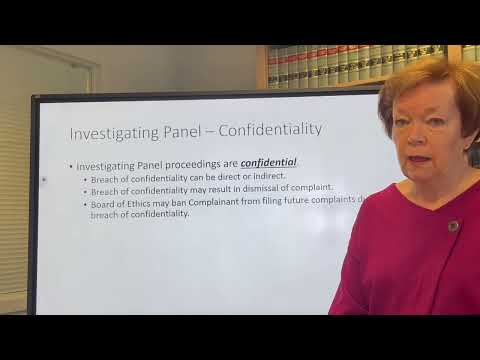
On filing a complaint, Pat said it must state specific acts alleged to violate the code, be submitted in good faith, and be timely. The board will review complaints in executive session to decide whether to accept or reject them; stated reasons to reject include bad faith, vexatious filings or breaches of confidentiality. Breach of confidentiality—direct or indirect, including, for example, public discussion on social media—may lead to dismissal of the complaint and a prohibition on filing future complaints.
If accepted, an investigating panel is appointed within 21 days; the panel must notify the complainant and the respondent within 10 days of its formation and is expected to complete its initial investigation within 60 days. The investigating panel may receive oral and written testimony, retain legal counsel or investigators if appropriate, and may narrow, expand or defer parts of a complaint. A finding of no probable cause results in dismissal. A finding of probable cause requires two affirmative votes by the investigating panel and is referred to a hearing board; the hearing board must be appointed within 45 days of the investigating panel—s written report.
Hearings before the hearing board are public. Pat said the investigating panel presents evidence to the hearing board and that both complainant and respondent may be represented by counsel, present evidence, examine and cross-examine witnesses, and request subpoenas for witnesses or records. The investigating panel has the burden of proof; violations must be established by clear and convincing evidence. A two-thirds vote of the hearing panel is required to find a violation. The hearing board must render a decision within 120 days of appointment, and must file a written memorandum of decision stating findings of fact and conclusions of law within 30 days of rendering that decision. Pat said penalties for violations are set forth in Chapter 32, Section 13 of the code.
Pat closed by noting that respondents may seek a settlement at any time during the process, that the board provides educational programs and a "citizen's guide" on the city's website, and by directing inquiries to Brian Candela, the board's legal counsel.