Get Full Government Meeting Transcripts, Videos, & Alerts Forever!
Get email alerts on the Ethics Conflict Of Interest topic
No spam. Unsubscribe anytime.
Norwalk City reviews rule barring employees from soliciting jobs tied to city matters over $1,000
Summary
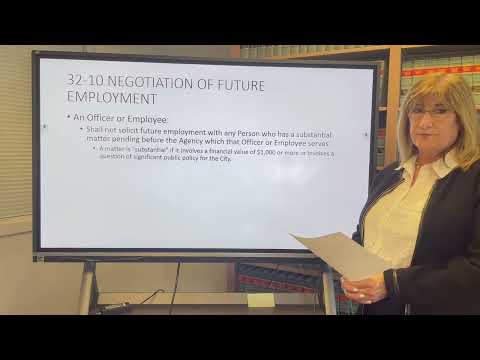
At a Norwalk City meeting, a staff member reviewed Section 32-10, which prohibits city officers and employees from soliciting future employment with parties that have a substantial matter pending before the city; "substantial" was defined as a financial value of $1,000 or more or a significant public-policy question.
A staff member for Norwalk City reviewed Section 32-10 on negotiation of future employment, saying, "You shall not solicit future employment with any person who has a substantial matter pending before the agency with which that officer or employee serves." The staff member added: "A matter is considered substantial if it involves a financial value of $1,000 or more or involves a question of significant public policy for the city."
The presenter said the section applies to "any officer or employee of the city" and referenced the city code section, the citizen's guide, and the legal department as supporting sources. No formal vote or action was recorded during the remarks; the item was presented as an informational reminder of the code and related guidance.
Why it matters: The rule is intended to limit conflicts of interest by preventing city employees or officers from seeking employment with parties who have active, substantial matters before the city. The presentation emphasized two ways a matter can be "substantial": a monetary threshold ($1,000) or issues that raise significant public-policy questions for Norwalk City.
Details noted in the presentation included a reference to the citizen's guide for further discussion of the code section and the legal department as an additional resource for staff and officials seeking clarification. The meeting record does not show any follow-up directives or votes related to Section 32-10 during the remarks.