Get email alerts on the Housing Code topic
No spam. Unsubscribe anytime.
City to consider co-living code changes to implement state law; plan commission sets hearing
Summary
Staff presented draft approach to implement state law (HB 1998) requiring local allowance for co-living/sleeping units; commissioners voted to take the proposal to a public hearing, and staff said they will present draft code language at an October workshop.
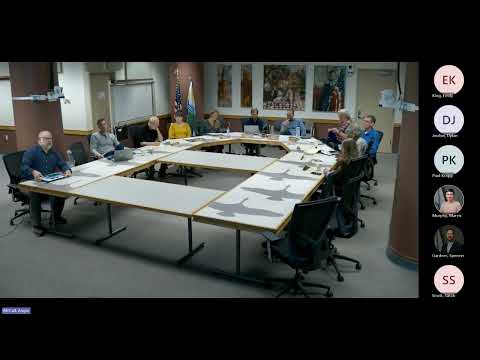
Planning staff described a proposed code update to implement the state’s co-living requirement and commissioners unanimously approved a motion to send the item to a public hearing.
Brandon Whitmarsh, a planner leading the code effort, told the commission the city must allow “co‑living” or “sleeping units” in zones where six or more residential units are permitted to comply with state House Bill 1998. He explained key state-driven requirements: sleeping units are independently rentable, lockable units that share a cooking facility; for density calculations sleeping units may be counted as a quarter of a dwelling unit; cities cannot impose more-restrictive development or design standards on co-living than on comparable residential development; and jurisdictions must provide conversion flexibility for existing structures. Whitmarsh said the bill includes a requirement that sewer connection fees for sleeping units be no more than half of a full dwelling-unit connection fee and that many of the city’s existing water‑meter–based connection rules already meet the intent of that provision.
On policy choices where the city retains discretion, Whitmarsh recommended aligning short-term-rental limits with existing code (removing a separate short-term cap currently applied specifically to single-room-occupancy), eliminating a conventional open-space requirement (the state’s per-unit math would yield a negligible square-foot requirement), and applying most other development standards equally to sleeping units and dwelling units; staff also flagged potential accommodations to encourage conversion of office buildings and other existing structures.
Commissioners asked about distinctions between co-living and uses already regulated as group living or community services (for example, dormitories, shelters or tiny-home villages) and Whitmarsh said that where services are provided (medical care, treatment, training) the use will likely remain regulated as group living; residential long-term co‑living would be grouped with residential household living for zoning and permitting purposes.
After the staff presentation Whitmarsh asked the commission to set a hearing; a commissioner moved to send the draft code to hearing, a second was recorded and the motion passed on a voice vote. Whitmarsh said he will return with published draft code language and that staff intend to request a hearing date on Oct. 22 and will provide notice and supporting materials in advance of the hearing.
AI generated
The text on this page is AI generated. Summaries, highlights, analysis, and video transcripts are all produced from the original source material.
AI can make mistakes, so if you spot one, and we will fix it for everyone.
Note: the source content is unaltered by us. Any content source we link to, be it a video, an audio recording, or a document, is presented exactly as its publisher released it. That publisher is usually a government body, sometimes an individual official or another organisation.