Get Full Government Meeting Transcripts, Videos, & Alerts Forever!
Get email alerts on the Infrastructure topic
No spam. Unsubscribe anytime.
Panama City outlines post‑Hurricane Michael infrastructure priorities, funding and timelines
Summary
A city staff member briefed the Panama City Commission on how data-driven assessments and restricted federal and state funding streams shaped project priorities after Hurricane Michael, including sewer and water upgrades, lift station hardening and timelines tied to loans and grants.
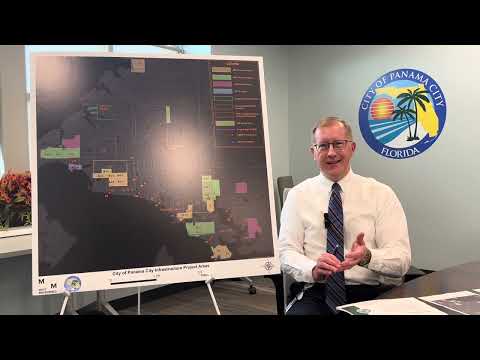
A city staff member briefed the Panama City Commission in a recorded update on the projects chosen to rebuild Panama City after Hurricane Michael, explaining how technical assessments and specific funding rules determined where work is happening and when. The presentation covered pavement and sewer inspections, the city’s use of the State Revolving Fund (SRF) loan program, hazard-mitigation and community development grants, lift-station upgrades and a 2027 deadline that shapes many project schedules.
The staff member said the commission and staff began by pausing projects immediately after Hurricane Michael to reassess the city’s infrastructure using what the presenter called a “heat map” of most-vulnerable areas. That review included service-request histories, pavement condition index (PCI) surveys, camera inspections of sewer lines to identify pipe materials, and fire-department data on water pressure and flow to help set priorities.
The presentation stressed that visible road condition was not the primary factor in selecting project areas. “The problem is the road condition did not drive or initiate that project. It was rather the underground utilities,” the staff member said, describing how sewer and water line condition, frequency of service calls and water-pressure data informed selections.
Funding sources and their restrictions were a major theme. The staff member described the State Revolving Fund — administered in Florida by the Department of Environmental Protection and originating with the U.S. Environmental Protection Agency — as a primary financing tool the city has authorized for roughly $106,000,000, with about $20,000,000 more under consideration pending a rate-study. The presenter said SRF financing is structured so the city’s first repayment is deferred until 2027, 25% of the loan amount is forgiven up front, and the remaining 75% carries a 0% interest rate for the life of the loan. The staff member said SRF funding covers water and sewer replacement and allows the city to restore road surfaces disrupted by that work; SRF funds can also allow adding a sidewalk on one side of a corridor when the right-of-way is sufficient.
The staff member explained that other funding streams carry strict geographic or programmatic limits. Community Development Block Grant (CDBG) funding, which the presenter tied to the U.S. Department of Housing and Urban Development, is typically restricted to low- and moderate-income (LMI) areas. Hazard Mitigation Grant Program (HMGP) money from FEMA is targeted to specific facilities and infrastructure identified for hardening, the presenter said. Those restrictions, plus program rules from the state and federal partners, help determine which neighborhoods receive particular types of work.
The presentation outlined a multi-part lift-station program. The staff member said Lift Station No. 45 on Beach Drive will be relocated to Garden Club Drive to move it away from St. Andrew Bay. A broader initiative called “Project Storm” is slated to affect roughly 40–50 lift stations citywide: roughly 30–40 will receive permanent bypass pumps (mounted on concrete slabs and driven by diesel or natural-gas–powered motors so they can run during commercial-power outages), and the remainder will receive remote communications packages so staff receive immediate alerts if a station begins to experience problems.
The staff member also described state efforts to remove septic tanks from coastal communities and said appropriations have been secured to help connect affected areas to city water and sewer lines. The presenter thanked Sen. Trumbull and Rep. Griffiths, and noted earlier support from former Sen. Gaynor, for appropriations that helped extend sewer service into areas that still rely on septic systems.
Sidewalk and school-access funding was addressed separately: the staff member said the state legislature and the Florida Department of Transportation provide limited sidewalk funds and noted a legislative rule that students living within 2 miles of a school typically are not eligible for busing; that policy supports a push for sidewalks in walking corridors to schools. The presenter emphasized that DOT sidewalk funds cannot be repurposed to repair water or sewer infrastructure, and that each funding source generally must be used only for the purposes and geographic areas specified by the grant or program.
The staff member said many projects must be completed by 2027 because of timelines attached to the funding sources. City staff are preparing a pavement and repaving assessment and plan, which the presenter said will be presented to the city manager and then to the City Commission by the end of the calendar year or in early 2026. The presenter noted the city is coordinating across multiple departments and with state and federal partners to meet the deadlines and to limit redundant work — specifically, replacing underground utilities before repaving roads.
The presentation acknowledged the disruption to neighborhoods undergoing reconstruction — describing the work as “short-term pain, long-term gain” — and said public-works staff, contractors and engineering firms are communicating with affected residents. The staff member closed by inviting residents to the monthly town-hall meetings held the first Saturday of every month in the rotunda, where the city manager, commissioners and staff receive questions from citizens and offer updates; the presenter said those sessions have no formal agenda and that coffee and donuts are served.
No formal motions or votes were recorded during the update; the presentation was informational and intended to explain prioritization, funding rules and schedules rather than to adopt new policy or approve contracts.