
Nantucket boards meet to align housing priorities, flag permitting and communication bottlenecks
Get AI-powered insights, summaries, and transcripts
Subscribe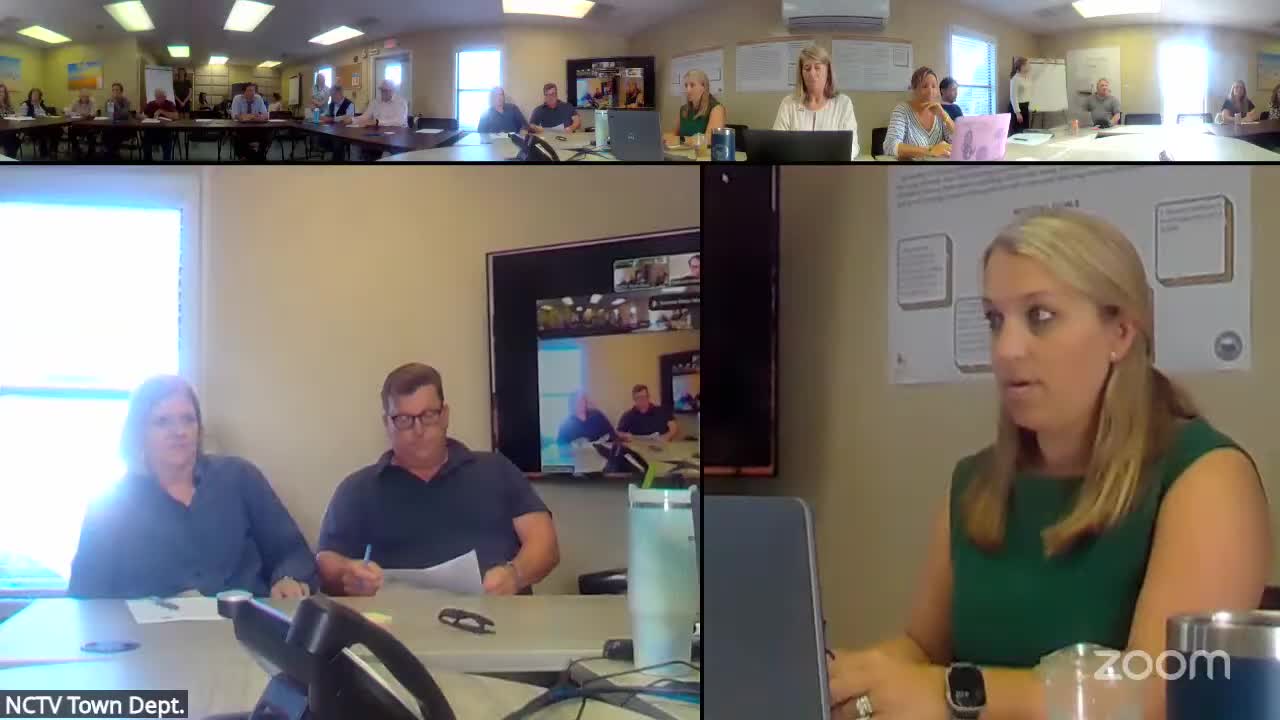
Summary
A joint meeting of Nantucket municipal boards brought town managers, planning, health and housing officials together to discuss values for housing, permitting delays and coordination among boards, and next steps for workforce, senior and deed-restricted housing.
A group of Nantucket elected officials, municipal staff and housing advocates met in a joint session on local housing policy and permitting to say the town needs clearer coordination across boards and stronger, targeted actions on “missing middle” and municipal-employee housing.
Facilitator Judy Barrett opened the discussion asking participants to surface their values on housing and to propose practical fixes for permitting and communication. “I just wanna make sure everybody gets a chance to talk,” Barrett said, laying out ground rules for the two-hour session.
Why it matters: Nantucket is wrestling with a long-running shortage of year-round housing and rising property values that residents said push essential workers out of the community. Participants described a multi-decade problem that now includes a land constraint, high construction and permitting costs, and a need to translate existing programs into visible, usable options for homeowners and small developers.
Most participants described three priorities: (1) protect and expand housing for municipal employees and other local workers, (2) create more pathways for downsizing seniors so units free up for families, and (3) simplify the permitting pathway for small-scale, year-round housing production. Christie Ferantella, the town’s housing director, told the group the meeting was intended to “have a chance for all boards to meet and discuss kind of how we're all working together and advancing goals around housing.”
Permitting and coordination were the day’s most detailed topic. Multiple speakers described a fragmented permitting pathway that commonly requires applicants to engage several boards (health, Historic District Commission, planning, building) and to hire multiple consultants, adding time and cost. Don Hill, the Select Board chair, said that complexity “has eliminated the ability for a private person to just do something for themselves,” and others echoed that projects have become more expensive in part because of staffing shortages and layered reviews.
Several practical fixes were discussed. A town employee said the administration plans to pursue an OpenGov permitting platform that would allow applicants and staff to track multi-department applications in one place; she said the system would route tasks to each relevant department and let applicants monitor progress. Planning and board members suggested a library of preapproved ADU and small-house designs, clearer checklists that tell applicants which department to visit first, and a staff “navigator” or coordinator to guide homeowners through concurrent reviews.
Speakers also debated what types of housing to prioritize. Several board members pressed for policy attention to the “missing middle” — households earning too much to qualify for deeply subsidized units but too little to purchase on the open market — and for stronger municipal-employee housing. Brian Sullivan of the Affordable Housing Trust said the scale of the financial problem is large: “The cost of the solution is expensive. It's a half a billion dollars. It's $500,000,000 to go in and create a bifurcated market,” he said, emphasizing constraints on public budgets and the need for targeted strategies.
The Affordable Housing Trust reported past deployment of its funding and recent project planning: trust members noted approximately 59 units proposed across three sites in a recent RFP, with the intent that many units serve workforce households (60–120% AMI) and some units serve higher incomes up to roughly 240% AMI in specific conservation/land-trust models. Trust members and planning board participants urged clearer public explanation of which programs already exist, how many deed-restricted units have been created, and the intended beneficiaries of new funding.
Speakers repeatedly returned to outreach and public trust. Several participants recommended regular joint briefings for town meeting warrant articles so boards speak with a shared explanation of trade-offs before voters. Participants suggested targeted direct mail or outreach to homeowner cohorts likely to downsize (owners who purchased in the 1985–2000 window), parcel-based analyses to show where modest additional density or covenanted lots could be feasible, and use of visuals — site sketches and photo examples — to show how proposed changes would look in neighborhoods.
On climate and infrastructure limits, the Board of Health cautioned against allowing density or bonuses that would stress water and septic capacity. Board of Health members emphasized that approvals for additional bedrooms and innovative septic systems must still meet public-health rules.
Adjournment: The meeting ended with a motion to adjourn and a roll-call-style agreement; board members recorded a series of “Aye” responses and the facilitator closed the session.
What’s next: Participants agreed to follow up with staff-level meetings and to consider a repeat joint session after the town’s special town meeting. Several concrete next steps were named for the short term: advance an OpenGov permitting pilot subject to budget approval; prepare a targeted parcel analysis and visual examples for the public; and assemble a staff navigator proposal or checklist for streamlined ADU/small-project processing.
Contacted participants requested that any formal proposals return to each board for review and that the community be given plain-language materials explaining options, trade-offs and likely impacts of proposed zoning and program changes.