
City staff outline utility tax and B&O options as budget savings near $960,000
Get AI-powered insights, summaries, and transcripts
Subscribe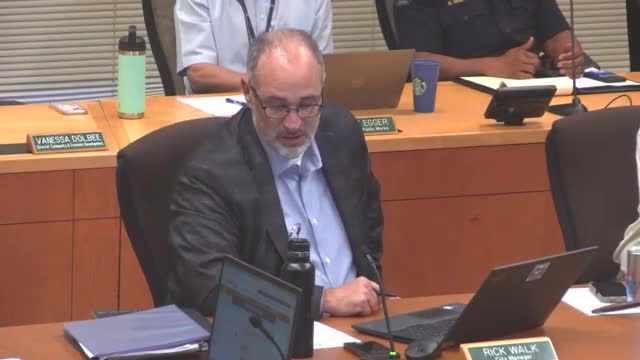
Summary
Finance and city staff presented potential revenue options including utility tax increases (water, sewer, stormwater, cable, solid waste) and business & occupation taxes for manufacturing and wholesale. Staff also reported internal budget savings of about $960,000 from line‑by‑line reviews and described utility assistance programs.
City staff reviewed a menu of potential revenue options at the Sept. 9 work session, including utility tax increases and expanded business & occupation (B&O) taxes; staff also reported nearly $960,000 in identified internal budget adjustments.
City Manager Rick said staff had performed a line‑by‑line review of recent spending and identified roughly $960,000 in budget savings from fiscal refinements. “Through that process, we did reach a savings, in our budget process our budget document of about $960,000,” he said.
Shannon, a finance presenter, led a review of utility‑tax options that could be implemented at the council level. Staff described that state law limits taxes on some utility types (electric, phone, natural gas) to 6% without voter approval, while water, sewer, solid‑waste and stormwater have no statutory 6% cap. For each half‑percent utility tax increase staff estimated order‑of‑magnitude revenue: about $108,000 per 0.5% on water, $125,000 per 0.5% on sewer, $25,000 per 0.5% on stormwater, and roughly $40,000 per 0.5% on solid waste (estimates rounded by staff). Cable was flagged as a lower‑administration option because Lacey already collects a franchise fee; staff estimated roughly $60,000 per 0.5% on cable but noted fragmentation of streaming and cable billing complicates forecasts.
Staff reviewed two city assistance programs for residential utility relief: the LACI discount program (50% discount for eligible low‑income seniors or disabled residents; staff reported roughly 281 approved households as of 2024) and the LACE Utility Assistance Program, a donation‑supported fund administered by Community Action Council that offers limited one‑time payments (staff said $75 twice a year is the current benefit and typical recipient counts range from about 50–150 households per year). Councilors raised equity and accessibility concerns about the assistance program and encouraged staff to review eligibility and outreach.
On business and occupation tax options, staff noted Lacey currently charges B&O on retail and services at low rates (retail 0.001, services 0.002) and does not levy manufacturing or wholesale B&O. Using Department of Revenue NACIS‑based proxies and a 2019 study updated for inflation and growth, staff presented a broad estimate that applying a 0.001–0.002 B&O rate to manufacturing or wholesale could yield tens of thousands to low hundreds of thousands annually; increasing retail B&O toward the statutory maximum could, in high‑end estimates, generate multiple millions of dollars, although staff emphasized the figures required further detailed analysis and that B&O work carries greater administrative effort and is referendum‑exposed.
Staff recommended further stakeholder outreach and technical work; a follow‑up council discussion was tentatively scheduled for Oct. 14 with lodging tax and new state House Bill 2015 items on the agenda.
Why it matters: Utility taxes and B&O changes can produce recurring revenue but are regressive in effect and shift costs to customers and businesses; staff urged weighing revenue potential, administrative capacity and equity mitigations before any council action.