Lafayette council objects to MTC transit-oriented communities policy, will send letter asking reconsideration
Loading...
Summary
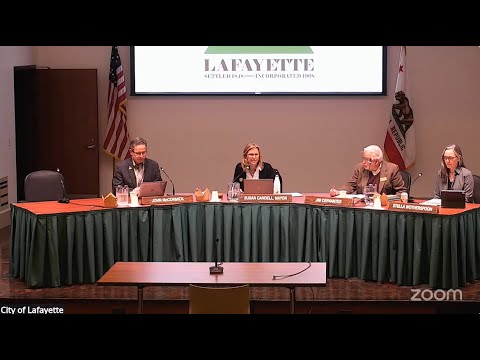
The Lafayette City Council on Oct. 14 voted to send a letter to the Metropolitan Transportation Commission asking the agency to reconsider its recently adopted Transit‑Oriented Communities policy and associated grant rubric.
The Lafayette City Council on Oct. 14 voted to send a letter to the Metropolitan Transportation Commission asking the agency to reconsider its recently adopted Transit‑Oriented Communities policy and associated grant rubric.
City staff told the council the MTC policy, while described as voluntary, ties eligibility for One Bay Area Grant (OBAG) funding to a points‑based menu of land‑use, parking and housing measures. The city manager said the policy would “encourage higher density development around transit stops” and that “funding…is tied to compliance with that policy.” Staff reported that reaching the 85 percent points threshold MTC set would require changes inconsistent with Lafayette’s General Plan and would impose significant financial and regulatory burdens on a smaller jurisdiction.
The council’s move came after several council members described the policy as a one‑size‑fits‑all approach that does not account for Lafayette’s topography, parcel patterns or existing development north of the freeway. Councilmember McCormick said the policy “drew a circle around the BART station and they wanted basically, there was no really no way to adjust within the circle,” and pointed to parking and floor‑area‑ratio requirements as problematic for Lafayette’s residential areas. Councilmembers also raised concerns about minimum density thresholds discussed in MTC materials (roughly 30–35 units per acre in some zones) and about how the policy treats commercial floor‑area ratios and parking limits.
Councilmembers said they had met with MTC staff and with neighboring jurisdictions that share similar concerns. According to the staff report and discussion, MTC’s policy options include parking maximums, minimum commercial FARs that imply multi‑story buildings near transit, and a menu of housing‑related measures, some of which (such as rent stabilization and anti‑displacement tools) were described as impractical for smaller cities.
Council discussion also focused on timing and enforcement. The city manager said staff found the outreach and implementation timeline “rushed,” and council members warned that if MTC implements the rubric as written, Lafayette and similar small cities could be forced to choose between making large land‑use changes or losing eligibility for regional transportation grants. Councilmembers said they remain interested in competing for OBAG funds but objected to a rubric that they said effectively converts a grant incentive into a requirement.
Councilmember McCormick reported that MTC Chair Hadar Nowak (mayor of Pleasant Hill) heard similar concerns and is planning a retreat to reassess the policy. After further discussion the council voted to send a strongly worded letter to MTC requesting reconsideration and asking staff to convey Lafayette’s specific concerns. The motion was seconded and carried by voice vote; no roll‑call tally was recorded in the meeting minutes.
Staff said the letter will reflect the points in the staff report and that the city will follow up with Supervisor Anderson (who serves on the MTC board). The council asked staff to coordinate with neighboring jurisdictions and report back as MTC considers revisions or alternative rubrics.
The city manager and council emphasized they want to remain eligible for regional funding while seeking a more tailored approach for small jurisdictions. No ordinance or land‑use change was approved at the meeting; the action was limited to sending a letter of objection and requesting that MTC reconsider its policy approach.