
Ventura County supervisors split over immigrant legal-defense package; $250,000 county contribution fails
Get AI-powered insights, summaries, and transcripts
Subscribe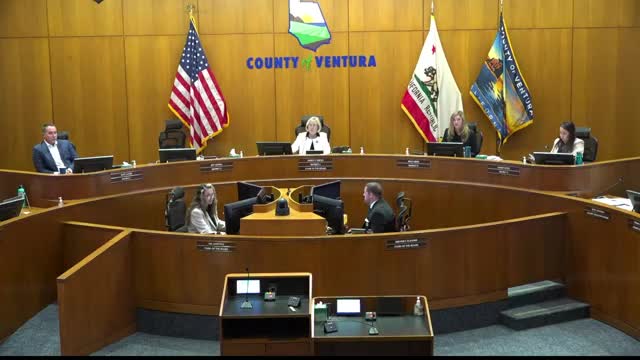
Summary
After hours of public comment and staff briefing, the Ventura County Board of Supervisors approved nonbinding policy and training measures but declined to provide $250,000 to a community-run immigration legal defense fund and took no action on a request to add seven public-defender positions.
The Ventura County Board of Supervisors on Aug. 12 considered a multi-part package to expand legal help, education and other services for immigrant residents, approving policy changes and staff-training direction but rejecting a $250,000 county contribution to a community-run legal-defense fund and taking no action on a request to add seven positions to the public defender—s office.
The measures were part of agenda item 43, introduced by Supervisor Vianney López and widely discussed during a nearly eight-hour public-comment period that drew dozens of speakers from cities across Ventura County. Supervisors voted to adopt nonmonetary actions directing county counsel and departments to develop staff policies, protocols and training for interactions with federal immigration authorities (approved 4-1) and unanimously approved amendments to the county—s legislative platform asking state and federal policymakers to preserve constitutional protections during immigration enforcement and to support comprehensive immigration reform.
But the board did not approve a proposal to set aside $250,000 from the county general fund to establish an immigration legal-assistance account administered through the Ventura County Community Foundation. That motion required four affirmative votes and failed after two supervisors voted no. A separate request to create seven fixed-term positions in the public defender—s office to stand up an immigration-defense unit failed to advance after it did not receive the backing necessary to move forward.
Public comment was overwhelmingly in favor of county action. Speakers representing city councils, school boards, nonprofit coalitions and dozens of individual residents described recent immigration enforcement actions, including July operations that community members said led to family separations, and urged the board to use county resources to expand legal help and education. Many speakers framed the proposals as preventive investments that would keep families intact and protect local industries (agriculture, hospitality, construction) that rely on immigrant labor; others warned of legal and fiscal risks and urged private fundraising or philanthropic solutions instead.
County staff warned of budget uncertainty. Scott Powers, the county—s director of finance, told the board the adopted 2025-26 budget was prepared amid significant unknowns at the state and federal level and that potential cuts to health, nutrition and other programs could put pressure on the general fund and reserves. He said the county retains reserves to respond to emergencies but that multi-year commitments out of those reserves carry risk if broader revenues decline.
Michael Albert (Public Defender—s Office) described how added public-defender capacity could be used in immigration-related matters: evaluating detained individuals for release from immigration custody, screening for forms of relief such as protection for trafficking victims, and doing quick, free legal assessments that many private attorneys charge tens of thousands of dollars to perform. County counsel and public-defender staff said similar units in other California counties handle both screening and representation in many removal cases, but building that capacity locally would require additional, sustained funding.
Vanessa Beckett, president of the Ventura County Community Foundation, told supervisors the foundation can receive and manage restricted philanthropic and public dollars and could operate a legal-assistance account that routes funds to nonprofit legal-service providers without charging administrative fees. Several speakers and cities indicated they would consider contributions to a county-anchored fund if the board authorized it.
Opponents, including speakers identified as residents and members of taxpayer associations, argued the county would risk violating federal law or exposing itself to legal challenges, and said philanthropic organizations or the federal government should be the primary funders of immigration legal representation. Some speakers also framed the issue as a matter of fiscal prudence given the county—s uncertain revenue outlook.
The board—s final roll calls on the key, contested items were: unanimous approval to receive and file the public presentations; a 4-1 vote approving direction to county counsel and departments to finalize staff policies and training for contact with federal immigration authorities; unanimous approval of agreed amendments to the county legislative platform calling for constitutional protections in federal immigration enforcement and support for comprehensive reform; failure to approve the $250,000 one-time county contribution to an immigration legal-assistance fund (motion did not reach the four-vote threshold); and no action on the proposal to add seven public-defender positions after the motion failed to secure the necessary support.
Supervisors who voiced reservations cited limits on county authority, the need to prioritize core services and concern about multi‑year fiscal commitments in an uncertain revenue environment. Supervisors supporting the measures emphasized the local economic and humanitarian impacts of enforcement activity and said limited, one-time county support could be an emergency stopgap while seeking private and jurisdictional partners.
The board directed staff and county counsel to finalize the nonmonetary policies and protocols, and supervisors and community groups said they would continue outreach to cities, philanthropies and potential state partners to secure outside funding for legal assistance and migrant education programs. Several speakers and nonprofits indicated they will continue community fundraising and coalition-building regardless of the board vote.
The board may revisit funding or staffing proposals in future meetings once staff provides additional budget analysis and implementation detail.