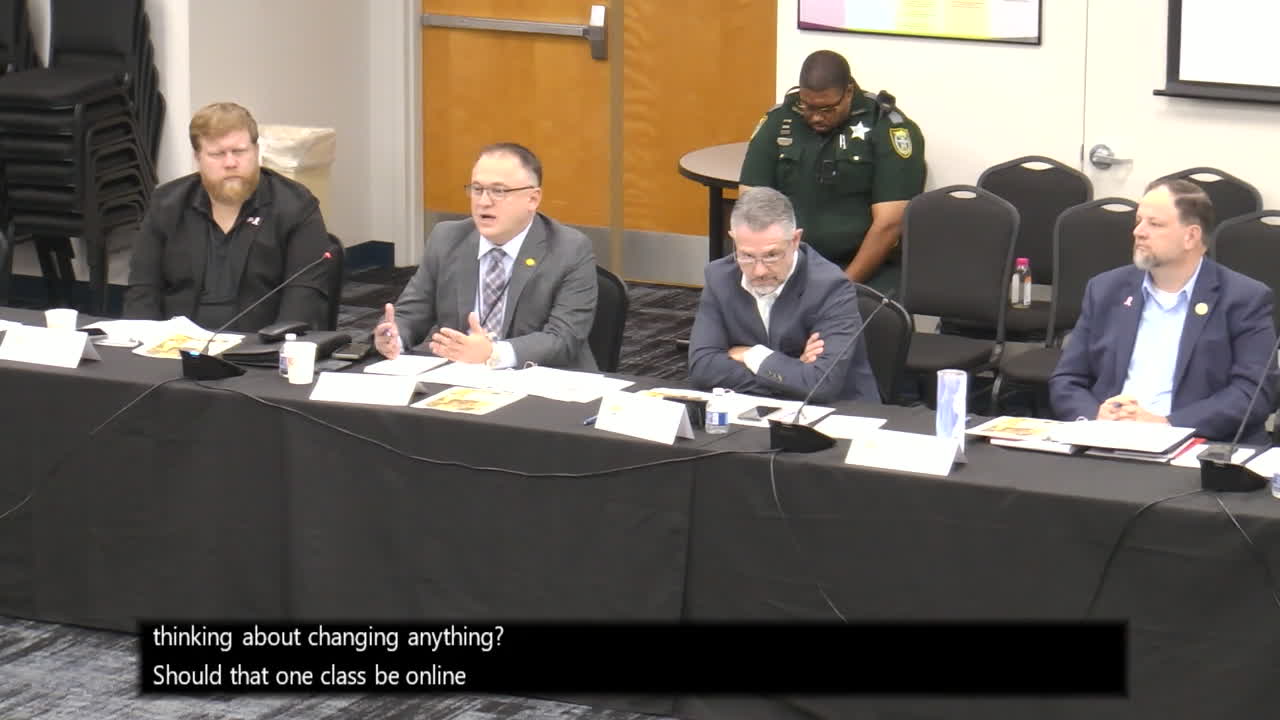
Officials consider opening school fields and building a shared aquatics center; safety, staffing and liability raised as constraints
Loading...
Summary
City, county and school leaders discussed expanding community access to school athletic facilities and exploring a shared aquatics center, but raised staffing, security and liability constraints.
County, city and school leaders explored options to increase public access to school athletic fields and discussed the long‑standing desire for a county aquatic facility.
Key themes
- Joint‑use possibility and precedent: County counsel noted Collier County has negotiated joint‑use agreements with its school district and cities that allow controlled public access when school campuses are not in session. Counsel suggested Hernando could pilot a trial at one or two campuses rather than attempt systemwide access. - Liability and security constraints: School district leaders said gates and hardened school security policies have tightened since earlier eras. Current state guidance requires locked access points when school buildings and campuses are occupied; staffing gates or manning entry points for public access would impose labor costs the district said it cannot cover without additional funding. The district highlighted recent pension/benefit cost increases that have squeezed other operating budgets. - Pool shortage and startup ideas: Elected officials and community members urged a shared regional aquatic center (examples suggested: Anderson Sowell park, Bud McKeithen quarry area, or a public–private partnership). Speakers stressed competitive disadvantages for student swimmers because local pools lack competition‑grade starting blocks and adequate depth, making it hard for athletes to train for district/regional meets. - Fee schedules and revenue: The district noted it already has a use‑of‑facilities fee schedule for organized groups and non‑profits; fees, insurance and staffing can cover maintenance and repairs, but unrestricted public access (walk‑on) raises security and liability issues.
Possible approaches discussed
- Case‑by‑case permitting for organized leagues and programs with insurance and scheduled stewarding (existing use‑of‑facilities processes could be expanded). - Trial joint‑use agreements at a limited number of campuses, modeled on existing agreements from other Florida counties, with clear hours and stewarding responsibilities. - Long‑term effort to plan and fund a regional aquatics center (public or mixed public‑private model) with shared scheduling for school teams and community programs; commissioners suggested exploring public bonds, sponsorships and legislative appropriations.
Quotations
"I think it'd be a creative way to generate revenue for the school board to take less out of the county... by creating a fee schedule," Commissioner Thomas Bronson said.
"We do have a fee schedule where entities can use our facility," a school official said, "but unrestricted walk‑on public access is where liability and staffing concerns arise."
Ending
Officials asked county, city and school legal and facilities staff to produce sample joint‑use agreements and to identify one or two campuses suitable for a pilot arrangement. The broader aquatics center concept drew unanimous interest but no firm commitment; officials said they would pursue feasibility studies and potential public‑private partners.