Get Full Government Meeting Transcripts, Videos, & Alerts Forever!
Get email alerts on the Water topic
No spam. Unsubscribe anytime.
Milwaukee Water Works proposes bigger 2026 budget to scale up lead service-line replacements
Summary
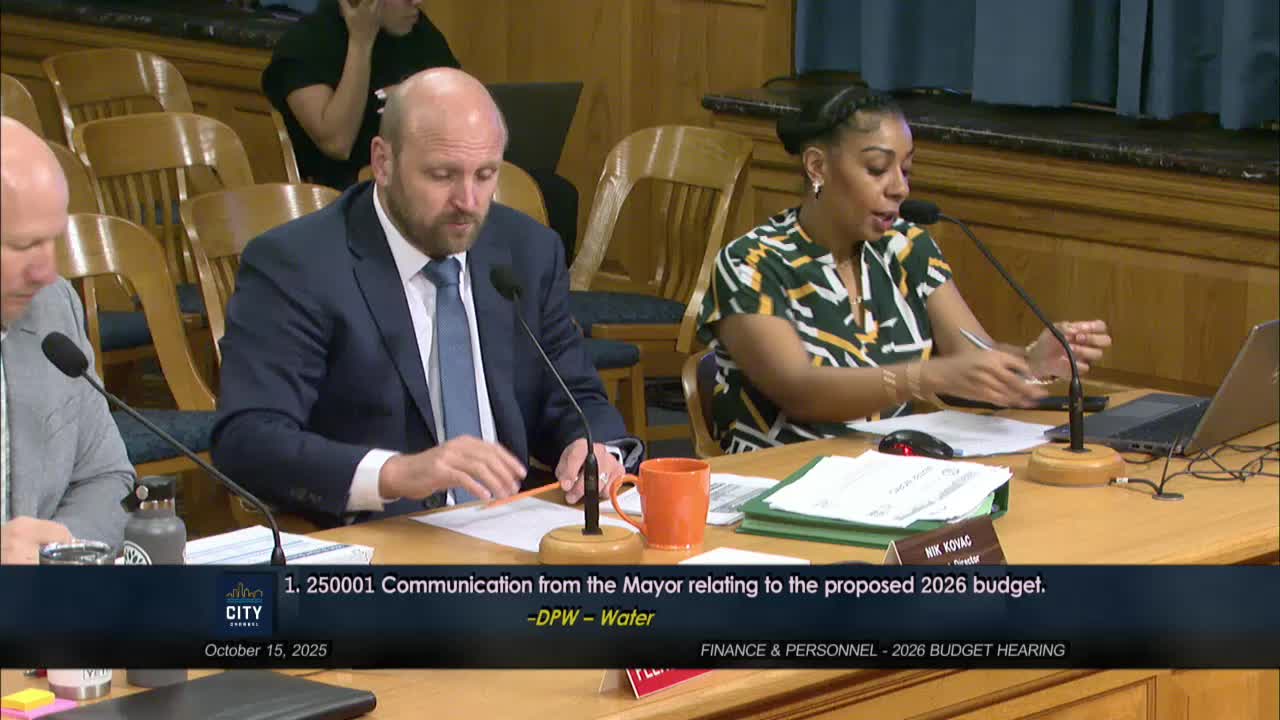
The Department of Administration presented the proposed 2026 Milwaukee Water Works budget as $216.9 million, with officials asking the Finance and Personnel Committee to fund an expanded lead service‑lateral replacement program and to cover higher debt service tied to that effort.
The Department of Administration presented the proposed 2026 Milwaukee Water Works budget as $216,900,988, a rise of about 11% from the 2025 adopted budget, with officials urging the committee to fund a sharply expanded lead service lateral program.
The budget analyst Shaquita Winters said, “The 2026 operating line is proposed at $104,723,830,” and that increase is driven largely by expanding the department’s lead service‑lateral replacement goal from 3,500 in 2025 to 5,000 replacements in 2026.
Why it matters: Water Works leaders told the Finance and Personnel Committee that meeting federal deadlines and federal rule changes makes the ramp‑up urgent. Officials said most private‑side replacement costs have been offset by federal principal‑forgiveness grants but warned that federal subsidy timelines and allocations remain uncertain.
Most important numbers and changes - Total proposed departmental budget: $216,900,988 (up ~11%). - Proposed operating budget: $104,723,830 (about a 21% increase vs. adopted 2025). - Proposed capital: $49,290,000 (down ~2%). - Salaries and positions: roughly $30,416,478 in salary (near 1% increase); 431.24 FTE / 443 positions (net small reductions noted). - Equipment: $4,438,000 (down ~24%). - Special fund line: $11,728,380 (up ~44%), reflecting debt‑service and interest costs tied to the lead program.
Lead service lateral ramp‑up and funding Superintendent Patrick Pauley told the committee the utility is working to reach 5,000 private‑side replacements per year beginning in 2026 and to sustain that pace through 2037 to meet EPA timelines tied to the Lead and Copper Rule’s replacement expectations. “We’re hoping to get to 5,000 next year and then maintain that pace moving forward,” Pauley said.
City leaders described current funding as follows: - Milwaukee has used federal principal‑forgiveness awards from the Bipartisan Infrastructure Law to offset nearly all private‑side costs to date. - The city reported awards it has received and spent (for example, awards in 2023 and 2024 were described as largely committed) and said it applied for approximately $50,500,000 for 2026; the federally allocated amounts for 2026 had not been announced in late 2025. - The utility also uses low‑interest loans and state drinking‑water loan programs for public‑side work; those loans have lower interest but still must be repaid.
Operational impacts and system condition Water Works staff described increased main‑break activity in 2024–25 and said a combination of environmental factors and aging pipe sections—especially post‑World War II pipes—have driven higher break rates. The department expects to replace roughly 11–14 miles of water main this year and plans to restore a 14‑mile annual pace in 2026 as engineering resources are reallocated.
Other items of note - The utility has applied for a conventional rate case (separate from a simplified 3% increase already adopted); officials said a conventional case could produce a materially larger increase for ratepayers but rulings from the Public Service Commission (PSC) may be many months out. The superintendent said the conventional case might not take effect until 2027, depending on PSC timing. - Water Works plans to continue orthophosphate corrosion control and other system measures after service‑line replacement to limit lead release from interior plumbing and solder. - The City’s owner‑request program (property owners volunteer to pay the private side) had more than 900 applicants; the department offered roughly 120 property owners slots in 2025 and plans to expand outreach in 2026 (targeting ~200 mailed invitations initially, then working down the backlog).
What’s next Committee members pressed staff on contractor capacity, the likely expiration of some federal private‑side funding, and rate impacts for residential customers. Water Works officials said the 3% simplified rate increase in 2025 equated to roughly a $2 per quarter rise for an average household; a conventional rate case the utility has filed could produce a larger increase, they said, and that case’s timing and outcome are controlled by the PSC.
Officials also committed to provide the committee with more granular tracking materials—maps of main breaks, lists of proposed 2026 neighborhoods prioritized for lateral work and the owner‑request rollouts—so aldermen can notify constituents and monitor progress.