
Volusia officials outline buyout, property-acquisition rules under Transform386 recovery program
Get AI-powered insights, summaries, and transcripts
Subscribe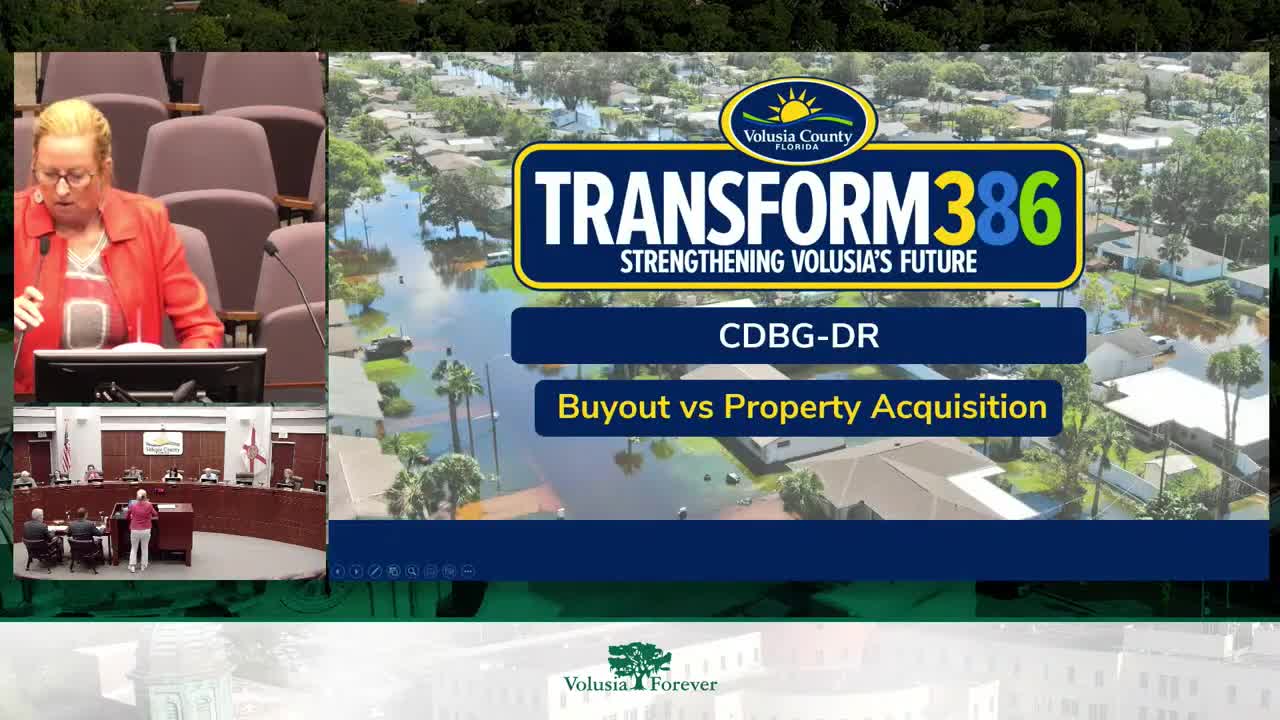
Summary
Donna Butler of the Office of Recovery and Resiliency explained differences between homeowner buyouts and infrastructure-driven property acquisition under federal CDBG-DR funds and related programs, including eligibility limits, funding caps and how cities must partner with the county.
Donna Butler, director of the Office of Recovery and Resiliency (Transform386), outlined Aug. 29 the county’s approach to homeowner buyouts and property acquisition under federal disaster-recovery funds, stressing eligibility limits, local partnership requirements and limited funding. "Buyout is a pathway to purchase eligible homeowner property," Butler said, adding that eligible parcels generally must be in a 100-year floodplain or a designated disaster risk reduction area.
Butler told the Volusia Forever committee that Volusia County received Community Development Block Grant — Disaster Recovery (CDBG-DR) funds following recent storms and hurricanes and has allocated those dollars across homeowner recovery and infrastructure/mitigation programs. "We initially after Hurricane Ian... got $328,900,000. $145,000,000 of that was set aside for homeowner recovery, and an additional $92,000,000 was set aside for infrastructure and mitigation," Butler said. She said a portion of those funds are specifically required for mitigation projects and that the county has been moving additional dollars between program buckets as projects are proposed.
Why it matters: Butler emphasized the practical limits of the programs. Homeowner buyouts require homeowners to be low- to moderate-income (0–80% of area median income), to have been the homesteaded owner at the time of the storm, and to be willing sellers. Buyouts are based on pre-storm fair market value; infrastructure-driven property acquisitions are based on current fair market value and do not require homeowner income eligibility.
How the two paths differ: Butler described five homeowner recovery pathways — rehabilitation, reconstruction, replacement (for mobile homes), buyout, and match assistance to help homeowners meet other grants’ required matches. She said a homeowner who qualifies for HMGP (Hazard Mitigation Grant Program) elevation funding may still need to provide a 25% match; Volusia County is offering match assistance in some cases. Butler gave an example in Deltona where elevation cost roughly $360,000 and county match was $90,000.
Property acquisition tied to infrastructure: Butler said property acquisition that is part of an infrastructure mitigation project does not start with a homeowner application. Instead, a city or the county must propose an infrastructure project through the federalized grant application process. "Property acquisition, they have to make an infrastructure application during the grant opening period," Butler said. Because applications are federalized, she added, counties and cities cannot negotiate or discuss compensation in a way that would be considered a "choice-limiting action" until HUD or the federal process allows it.
Disaster risk reduction areas and local data: Butler said counties and cities can propose "disaster risk reduction areas" using repetitive-loss and GIS data collected by growth management. Where such an area is formally identified, parcels outside the 100-year floodplain but shown to have repetitive flooding could become eligible for buyout pathways. "If a community identifies that repetitive flooding loss has occurred in residential areas, they can identify that on GIS and the homeowners can apply," Butler said.
Limited buyout capacity: Butler said the county currently has roughly $20 million set aside specifically for buyouts, with a per-home cap of $400,000 — a level that would fund about 50 homes at maximum cap values. She said the county has completed 50 homeowner reconstructions so far and is aiming for about 120 construction completions by the end of the year. Butler also said Elevate Florida, the state program, funded 16 Volusia homeowners out of about 477 applicants in the county.
Questions from committee members focused on eligibility for parcels that flood due to upstream development, the definition of allowable green-space uses after buyouts, and whether nonprofits could play a role in long-term maintenance. Butler said green-space parcels deeded to cities or agencies must be used only as green space or for stormwater infrastructure and that cities must provide a simple open-space management plan describing maintenance in perpetuity. On nonprofit involvement she said, "They would have to go to the city and offer those services. That's not something that we're gonna get in the middle of. Our relationship is with the city or state, and making sure that they are agreeing to maintain it for forever and not redevelop it."
Implementation and risk: Butler and county staff emphasized that many projects will require environmental review, appraisals, title work and federal compliance checks. She also said larger infrastructure projects must demonstrate cost-benefit performance per HUD/FEMA rules; the county has contracted consultants to assist cities with cost-benefit analyses and other federal application requirements.
Ending: Butler directed committee members to Transform386’s website (transform386.org) for action plans and progress updates and offered to provide a list of which jurisdictions had adopted partnership resolutions. "If you want to know if your city has, you can shoot me an email: ddbutler@volusia.org," she said. The county continues to solicit shovel-ready infrastructure applications from cities and nonprofits that can meet federal requirements.