Get Full Government Meeting Transcripts, Videos, & Alerts Forever!
Get email alerts on the Airport Operations topic
No spam. Unsubscribe anytime.
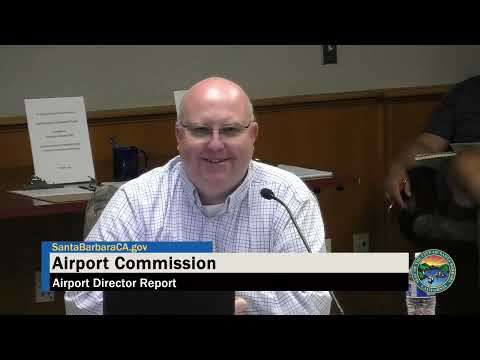
Airport director reports: new assistant director, FlightTech contract for noise/approach evaluation, restored ILS minimums and PFAS foam removed from ARFF
Summary
Airport staff announced a promotion to assistant airport director, a recently signed contract with FlightTech to evaluate departures and noise, restored ILS approach minimums, a triannual disaster drill, and a completed transition from PFAS-containing foam to fluorine-free foam in aircraft rescue firefighting vehicles.
Santa Barbara Airport staff updated the commission on operations and safety improvements on Oct. 9, including a recent promotion, a consultant contract to evaluate flight paths and noise, restoration of instrument landing system (ILS) minimums, a full-scale FAA disaster drill and the completed removal of PFAS-containing firefighting foam from airport rescue vehicles.
Airport staff announced the promotion of Sarah Iza to assistant airport director; Iza previously served as capital development manager and will oversee the airport’s capital program while the city evaluates filling the now-open capital development manager position. Principal architect Craig Shallenberger will serve part time as acting capital development manager during the search.
Staff told the commission the airport signed a contract with FlightTech to review approaches and departures and to help reduce noise impacts. Staff said the consultant’s work is intended to improve approaches for pilots and reduce diversions. Staff estimated the full development of a new approach could take about nine months, though some near-term adjustments to existing procedures may be completed sooner.
Operations staff reported the FAA has restored the airport’s ILS minimums to roughly 200 feet above terrain after resolving an earlier obstacle issue. The director also described a triannual full-scale FAA-required disaster drill that involved more than 90 volunteers and multiple agencies, saying it identified lessons learned and met the FAA requirement.
Staff also reported a completed transition away from PFAS-containing aqueous film forming foam (AFFF). The airport said it decontaminated and refitted three aircraft rescue firefighting (ARFF) vehicles to use fluorine-free foam, performed proportionate output testing, and arranged disposal of approximately 600 gallons of AFFF, 2,700 gallons of rinse solution and 15,000 gallons of output-based testing collection. Staff stated the transition was carried out in coordination with the FAA and with advice from other airports.
Why this matters: restoration of ILS minimums affects instrument-flight operations during low-visibility conditions; the FlightTech review may change flight procedures and noise exposure over surrounding neighborhoods; and removing PFAS-containing foam reduces on-site inventory of a persistent chemical.
Commissioners asked for ongoing updates on the FlightTech contract and were offered regular briefings at commission meetings and interim updates if public outreach or meetings occur.
The commission also received invitations to observe future drills and to receive more detailed briefings on magnetic-drift issues affecting runway designations.