Get AI Briefings, Transcripts & Alerts on Local & National Government Meetings — Forever.
Buncombe County subcommittee recommends funding for greenways, conservation and park repairs after storm delays
Loading...
Summary
The Buncombe County Passive Recreation Lands Subcommittee voted to recommend funding for seven projects totaling about $4.38 million from voter-approved open-space bond funds, held some projects pending, and asked the county to consider a second application round for remaining money after Tropical Storm Helene delayed work.
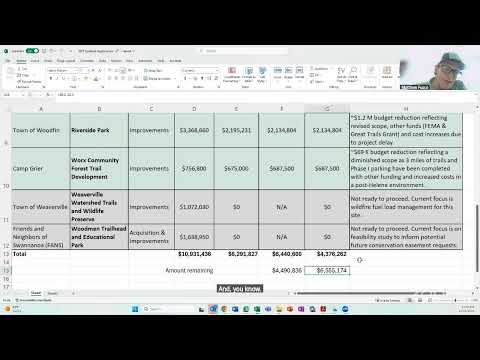
The Buncombe County Passive Recreation Lands Subcommittee on a virtual meeting recommended awards for seven passive-recreation projects totaling $4,376,262 and voted to ask the Board of Commissioners to consider a second round of applications for the remaining bond funds.
The recommendations, made during an Oct. meeting of the subcommittee that reviewed updated proposals after Tropical Storm Helene delayed the program, include allocations for greenway connections, trail repairs, park improvements and easement or acquisition funds. Subcommittee members also asked staff to bring the recommendations to the county commissioners for a briefing Nov. 4 and a decision meeting Nov. 18.
Why it matters: The projects are funded from voter-approved general obligation bonds for open space and related passive recreation projects. County staff told the subcommittee that Helene both delayed the program and produced new county needs — damaged parks and dozens to hundreds of properties expected to transfer to county ownership through FEMA Hazard Mitigation Grant Program (HMGP) buyouts — and recommended holding some funds in reserve for future site activation or resilience work.
At the meeting Rachel Sawyer, Buncombe County strategic partnerships director, summarized staff outreach to applicants after the storm and the county’s financial review. “We actually do have the ability to continue with this process,” Sawyer said, noting the open-space bond was originally $30 million and about $17.5 million has been committed to date. Sawyer told the group that the county’s passive-recreation allocation available to the subcommittee is roughly $9,934,430 before today’s recommendations.
The subcommittee first reviewed the financial context and then considered each project with updated budgets, storm-related scope changes and alternate funding sources such as FEMA public assistance and state hazard-mitigation grants. Members were explicit that the subcommittee’s job was to recommend amounts to the commissioners, after which county staff and legal counsel would handle negotiations and contracting.
Votes at a glance: - Balsam Gardens (Sand Hill Road) — recommended up to $750,000 to acquire the property or fund a greenway easement; motion passed with 3 yeas and 1 abstention (David, who identified himself as with the Buncombe County Parks and Rec Advisory Board, abstained). Motion mover: Matt Fusco; second: Bob Turner. The county assessor gave a ballpark comparable of $15,000–$19,000 per acre while the property owner’s submission was based on $50,000 per acre; staff said a conservation-easement alternative could value at roughly $5,000 per acre. - Gateway Park (Riverside Drive/Pearson Bridge, RiverLink) — $200,000 recommended; unanimous approval. - Haw Creek Park greenway connection (near Creekside restaurant) — $127,784 recommended to shift a footbridge and stabilize streambank after storm damage; unanimous approval. - Hominy/Hominy Creek Greenway (natural-surface trail near Sand Hill Road/Cary Deer Park area) — $326,174 recommended for trail surfacing, planting and relocation away from the channel; unanimous approval. - Warren Wilson College (river-adjacent trails) — $150,000 recommended to repair river-impacted trail segments and use the work as a resilient-design demonstration; unanimous approval. - Town of Woodfin, Riverside Park — $2,134,804 recommended (reduced from last year because other grants and FEMA funding are expected); unanimous approval. - Camp Greer/Works Community Forest Trail Development — $687,500 (approx.; updated request reflected state appropriations and project changes) recommended; unanimous approval.
Projects not advanced: The subcommittee declined to forward funding for the Black Mountain Ridgecrest/Bridgecrest connector after members said the town lacked design/engineering funding and the application appeared speculative. The committee also left Weaverville and the Friends and Neighbors of Swannanoa (Woodman Trailhead and Educational Park) off the recommended list; staff reported both remain under local development or feasibility study and are not shovel-ready.
Discussion highlights and process notes: - Tropical Storm Helene: Sawyer and others said the county paused the program in late 2024 after Helene and re-contacted applicants in July to confirm project viability. Sawyer said Helene reduced some county revenues and introduced new expenditures, but staff concluded the county could proceed with bond-financed allocations.
- FEMA HMGP buyouts: Sawyer said many properties are expected to transfer to county ownership through the state-administered Hazard Mitigation Grant Program, and those properties will carry deed restrictions for open-space uses in perpetuity. The subcommittee discussed leaving some bond money in reserve to program and activate those future county-owned parcels.
- Valuation and negotiation: Balsam Gardens prompted detailed discussion about fair market value and purchase versus easement options. Staff said voluntary purchases allow flexibility but noted past case law cautions about paying substantially more than market; staff recommended the committee could set an “up to” amount and let commissioners/staff negotiate.
- Shovel readiness and disallowed costs: The Black Mountain application included a large design/engineering line that the subcommittee’s funding guidelines treat as ineligible; members favored consistent treatment and expressed concern about awarding funds to projects lacking secured engineering/design or a clear timetable. Staff said award agreements will include contractual milestones and that funds would be returned to the bond “kitty” if milestones are not met.
- Follow-up and timing: Subcommittee members voted to recommend that the Board of Commissioners consider these awards at an informational briefing Nov. 4 followed by a decision meeting Nov. 18. The subcommittee also voted to recommend a second application window (a “phase 2”) for remaining funds so that new post-Helene project opportunities could be considered through a public process rather than being distributed solely at commissioners’ discretion.
Quotations from meeting participants are limited to those recorded in the transcript and attributed to the speakers who appear in public minutes. Rachel Sawyer, Buncombe County strategic partnerships director, summarized the program pause and restart after Helene: “We actually do have the ability to continue with this process.” Allison Danes, Buncombe County parks and recreation director, confirmed parks staff would take a lead on storm-damaged county parks and support implementation if commissioners approve recommendations.
Next steps: Staff will notify applicants and prepare materials for the Board of Commissioners briefing on Nov. 4 and the decision meeting on Nov. 18. If the commissioners approve the subcommittee’s recommendations, staff will proceed to contract negotiations and milestone-based agreements. The subcommittee voted to stand down after completing recommendations but to be reconstituted if commissioners direct phase-two funding or new opportunities emerge.