Get Full Government Meeting Transcripts, Videos, & Alerts Forever!
Get email alerts on the Rezoning Accountability Displacement topic
No spam. Unsubscribe anytime.
Land use committee seeks rezoning accountability, rent-regulation data and loft-conversion records to track displacement
Summary
The committee asked city agencies to study Hudson Square’s rezoning effects, add SoHo/NoHo to that review, and press DCP/HPD/Department of Finance for a non-granular rent-regulated dataset. Members also discussed Loft Law conversion records and recommended programmatic analysis and a planner budget to audit self-certification processes.
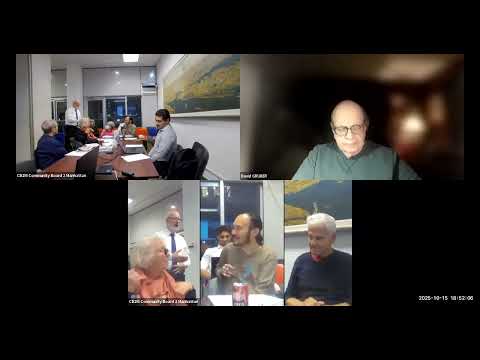
Manhattan Community Board 2’s Land Use & Housing Committee on Oct. 15 directed staff to pursue multiple studies and data requests aimed at measuring whether recent rezonings have produced the housing outcomes the city expected and at tracking displacement.
The committee asked that a study of the Hudson Square rezoning’s effectiveness be carried out and that the SoHo–NoHo rezoning be added to that scope to capture displacement trends and whether promised housing outcomes materialized. Eugene Yu, chair of the committee, said members want the studies framed to measure "if rezoning goals are being met — particularly housing production and affordable units — rather than producing only office or commercial development."
Data request: The committee discussed a standing request for a dataset of rent-regulated units and whether agencies will release building-level information. Carter Booth emphasized the state’s role in rent regulation; committee discussion noted that the city and state do maintain records but that agencies have told the committee they will not release granular, building-level data. Members urged requesting a non-granular, programmatic dataset (for example, by community board or assembly district) that would track year-over-year changes without exposing individual building records.
Workaround and agencies: Committee members described the Department of Finance as a practical workaround for aggregated rent-regulation estimates. As the committee summarized, "the Department of Finance data is the work around" for extracting aggregated information used by private researchers. The committee agreed to direct the request to DCP, HPD and the Department of Finance and to continue pressing for a repeatable, city-produced dataset.
Loft Law and conversion records: Members also reviewed a specific request for a historical report on commercial-to-residential conversions covered by the Loft Law and the Loft Board. Committee members said some relevant records were destroyed in a past fire and that Loft Board or DOB records may be incomplete; they questioned whether producing a full historic building-level report is feasible or useful. The committee recommended that, where building-level data cannot be produced, agencies instead provide aggregate statistics useful for evaluating rezoning impacts and displacement.
Resources and enforcement: The committee discussed hiring planning and legal expertise (cited as the consultant George James and support from Andrew Berman’s office in prior cases) to analyze complex applications and challenge self-certified, as-of-right filings when necessary. Members proposed budgeting for a planner/expert as an expense priority and recommended an audit or study of the self-certification process used by city agencies to ensure adequate review and timely challenge mechanisms.
Ending: The committee directed staff to fold these requests into the FY27 district needs and budget priorities — asking for a rezoning effectiveness study (Hudson Square and SoHo/NoHo), a city-produced aggregated rent-regulated dataset, programmatic Loft Board statistics or alternatives, and funding for technical expertise to evaluate complex land-use filings.