Get Full Government Meeting Transcripts, Videos, & Alerts Forever!
Get email alerts on the Municipal Budget topic
No spam. Unsubscribe anytime.
Mount Pleasant council approves 2025–26 budget and a 10.4% effective property tax-rate increase after debate over pay raises and cuts
Summary
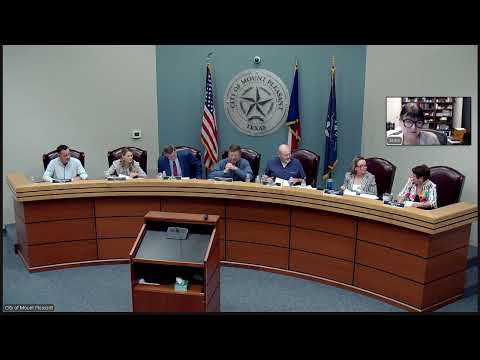
On Sept. 16 the Mount Pleasant City Council adopted the fiscal 2025–26 budget and set a property tax rate of 0.366042 per $100 of assessed value — an effective 10.4% increase — after a public hearing that focused on pay raises for first responders, sales-tax shortfalls and internal cuts.
The Mount Pleasant City Council approved the city’s fiscal 2025–26 budget and raised the property tax rate after a public hearing and extended discussion about salary increases, sales-tax shortfalls and internal cuts.
On Sept. 16 the council voted to adopt ordinance 2025‑17 (the 2025–26 budget) and ordinance 2025‑18 setting the city’s tax rate at 0.366042 per $100 of assessed value — an effective tax-rate increase the city characterized as 10.4%. The budget vote passed 4–1. Council members later ratified the tax revenue increase (ordinance 2025‑19) by the same 4–1 margin. The investment policy (Resolution 2025‑13) and a two‑year chemicals procurement award (Chemical Bid 9‑2025) were approved unanimously.
Why the change: City staff told the council the budget must address a multiyear gap driven mainly by lower-than-expected sales tax and rising debt service. Finance staff reported that full-year sales tax closed about $544,000 below the adopted budget for the year; staff said the general fund showed a year‑to‑date surplus of roughly $657,000 and the utility fund a surplus near $1.23 million, but that revenue trends and debt payments required action.
Competing pay-and-budget proposals: City management presented three compensation options labeled A, B and C. Option B (the city manager’s operational preference) would have paid a 3% cost-of-living adjustment for most employees, advanced eligible employees one step in their salary grade, and restructured longevity pay to a graduated lump-sum plan; staff said Option B could fund a permanent part‑time kennel technician position and some overtime coverage for special events. Option C reduced the immediate COLA to 2% citywide (excluding department heads), preserved steps for eligible employees, and set aside restricted funds so the council could authorize additional targeted market adjustments for police and fire after a March salary study (staff proposed possible caps of 6% for police and 4% for fire, to be approved by council if the study justified those increases).
After debate the council approved a modified version of Option C. During a brief recess the manager and staff changed the proposal to set the COLA at 2.5% rather than 2.0. The adopted motion required that any further wage adjustments funded from the restricted pool (the amounts identified to permit market corrections for police and fire) return to council for approval once the salary study is complete. The motion passed 4–1.
Numbers and tradeoffs presented to council: Staff presented the arithmetic the budget relies on. The portion of projected property-tax revenue above the no-new-revenue rate was shown as about $610,731; sales-tax shortfall was shown as about $544,155; department heads reported roughly $379,638 in operating-and-maintenance reductions year‑over‑year; the general fund payroll increase in the proposed budget was about $214,840 (for that budget scenario). Staff said restructuring longevity pay produced about $37,000 in savings and that removing one inadvertently included firefighter position produced about $54,000 in additional savings; a small allocation — $5,000 — was proposed to staff police overtime for sports tournaments that are expected to bring visiting teams and hotel/tax revenue.
Salary study and contingencies: The council authorized a consultant-led salary study that staff said will be completed in March. The adopted motion specifically requires council approval before any additional wage adjustments funded from the set-aside restricted amounts are implemented; the council also approved language allowing the city manager to implement market adjustments up to the previously-communicated caps only after the study and council authorization.
Public comment and council debate: Dozens of residents and employees spoke in public comment. Those urging caution on a tax increase warned that higher property taxes could reduce household discretionary spending and further depress sales tax, and several residents said rising appraisals were making homes harder to sell. Others — including firefighters and residents citing public-safety concerns — urged the council to prioritize raises to retain first responders. Council members repeatedly stressed the need for transparency and asked staff to return detailed policies for the new longevity and step processes. Councilmember Carl Hinton voted against the budget and tax-rate increases and said he would not support a tax increase until more internal cuts were identified; other council members said they favored protecting first responder staffing and passing a budget that avoids position cuts.
Other formal actions: After the budget and tax votes the council adopted Resolution 2025‑13 (investment policy) unanimously and awarded Chemical Bid 9‑2025 (two‑year chemical supply contracts for water/wastewater plants) to the low bidders; the chemicals award passed unanimously.
What happens next: Staff will implement the adopted budget and post the policies required for the new longevity and step rules. The salary study will be completed in March; any additional wage adjustments funded from the restricted pool will return to the council for approval as required by the motion. The council instructed staff to provide more detailed, web-posted budget and spending information to improve transparency and resident access to line‑item detail.
Votes at a glance - Ordinance 2025‑17 (Adopt 2025–26 budget) — outcome: approved 4–1 (motion and second recorded in council minutes; names withheld in roll-call summary), legal threshold met. - Ordinance 2025‑18 (Adopt property tax rate 0.366042 per $100; effective 10.4% increase) — outcome: approved 4–1, legal threshold met. - Ordinance 2025‑19 (Ratify property tax revenue increase reflected in adopted budget) — outcome: approved 4–1. - Resolution 2025‑13 (Adopt investment policy pursuant to Texas Public Funds Investment Act) — outcome: approved unanimous. - Chemical Bid 9‑2025 (Award two‑year chemical contracts for water/wastewater) — outcome: approved unanimous.
The council directed staff to provide updated web-accessible budget detail and to bring policies implementing the revised longevity and step structure back to council for formal adoption.